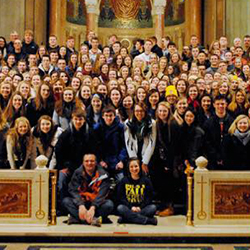


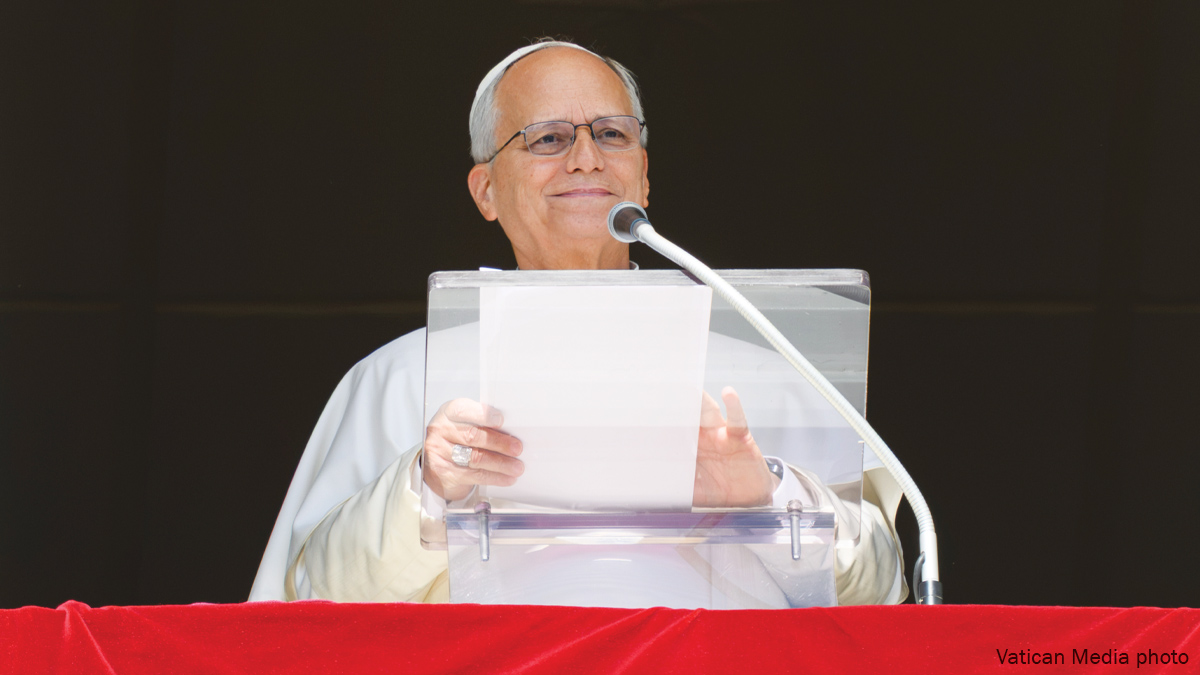









Mount St. Mary’s University, Emmitsburg, Maryland
("He – blessed be His name – has sanctioned and enjoined love and care for our relations and friends. Such love is a great duty." – Bl. JHN, The Duty of Self-denial1)
Good evening!
My topic tonight is the role of friendship in the New Evangelization, with a focus on the insights of Blessed John Henry Newman. The 19th century English convert and cardinal is a forerunner of the New Evangelization; and, as we'll see, he was also one of Church history's most devoted friends.
Newman regarded friendship as an important aspect of Christian discipleship. His life and teachings offer us antidotes to a culture of selfishness and individualism. Western culture needs both a restoration of faith, and a release from isolation; and these needs are interconnected.
In tonight's talk I will examine the cultural problem of isolation, and its roots in a broader social crisis involving the loss of faith. Newman's insights can help us overcome this problem of isolation; and they can help us evangelize our contemporaries who face the same problem.
First, however, I'd like to say a bit about the New Evangelization. As many of you know, it was envisioned by Blessed John Paul II, as a project to re-propose the Christian faith in countries where it historically flourished but is now threatened. The New Evangelization is among the most ambitious tasks ever set before the Church. Blessed John Paul II was not "thinking small" when he proposed Western Civilization's re-conversion to Christianity.
This project, continued by Pope Benedict XVI, arises from an orthodox interpretation of the Second Vatican Council, which urged the Church to present our faith to modern men and women in ways that responded to their hopes and concerns.
The council's document on the modern world, Gaudium et Spes, taught that the Church shares in the hopes, concerns, joys, and anxieties of mankind2. This premise underlies the New Evangelization, in which the Church proposes the person of Christ as the key unlocking the human condition.
Our faith does not solve every human problem; but it always offers the light of truth to those who struggle in darkness and confusion. We are called to convey the message of Christ to all people, especially to those whose struggles we share. The experience of loneliness is not unique to modern life. But severe isolation appears to be growing in our time, becoming a social epidemic acknowledged by the secular world.
This is an alarming situation; but from the perspective of our faith, it is also an opportunity.
Every human problem can, and must, be seen in the light of Christ. When the Church rises to this task, then problems also become opportunities to share our faith with the world. The New Evangelization envisions such an interaction, between modern questions and the Church's perennial wisdom.
With these considerations in mind, let us consider the problem of isolation, as seen through the eyes of faith.
Significant press coverage was recently given to statistics from the U.S. census, showing that the number of so-called "single-person households" in this country had risen by almost 800 percent since 1950. In many urban centers, over 40 percent of "households" contain just one person.3
Living by oneself can, of course, be perfectly healthy. But these statistics are concerning, in light of other figures suggesting a "culture of isolation."
Researchers are finding dramatic levels of self-reported loneliness, and declining rates of close friendship and community participation.4
A 2010 survey found significant loneliness in over a third of adults age 45 and older, a figure that had increased by 15 percent in a decade.5 A British survey reported similar results in that age group, and found problems with loneliness among more than 60 percent of younger people.6
Between 1985 and 2004, there was a 150 percent increase in the number of Americans who said they did not have a close friend with whom to discuss important topics. They now make up around a quarter of this country, along with the 20 percent who have only one such person in their lives.7
Some of these numbers were noted in a recent Atlantic Monthly article, which asked the question: "Is Facebook Making Us Lonely?" Its author, Stephen Marche, had the common sense to answer: "no." We are making ourselves lonely, albeit sometimes with the help of technology.8
What Marche couldn't say, is that we do this because we're fallen creatures, whose relationships with one another tend to go wrong because of our wrong relationship to God. In the realm of theology, the Latin phrase "incurvatus in se" – meaning "turned within oneself" - has been used to describe this effect of original sin.9
Neither the social sciences, nor an account of historical developments, can speak to what is really behind our present epidemic of loneliness. At best, they can point us to the problem of human nature itself - a problem that these disciplines, like all other human efforts, can discover but not solve.
Individualism, the "cult of the self," has become the favored heresy of this country and many other historically Christian nations. And it's not hard to see how our faith, with its focus on the individual soul, could be distorted into an mere ideology of individualism.
Selfishness, as theologians like St. Augustine knew, is part of original sin. But individualism poses a unique problem in historically Christian countries. Our cultural inheritance teaches us to stress the dignity of the individual; yet we may fail to recognize God as its source, and the love of others as its end goal.
Modern individualism, the cult of the inward-turned self, is one way that our Christian cultural inheritance now manifests itself in fragmentary and distorted forms. It's a kind of "heresy," a part of the faith dissociated from the whole and consequently corrupted.10
But this very fact gives believers an "edge" when it comes to addressing the "culture of isolation." We know things the secular world doesn't. We know the real problem, human nature, is not new, but perennial. And we know that the dignity of each person can't be reduced to mere individualism.
Along with the rise of individualism, we also see a general decline in trust. Cynicism dominates the culture; and between free-floating individuals, a false sense of closeness often hides a deeper insecurity and mistrust. Without conventions or rules, each person forages for himself, and must be on his guard.
In a climate of widespread cynicism and mistrust, people find it more difficult to make lasting connections. Instead of forming lifelong bonds based on a shared vision of what is good and true, they are more likely to make short-lived connections based on mutual "dislikes" or superficial enjoyments.
The growth of mistrust, like the rise of individualism, also seems related to a loss of religious faith. Trust requires shared commitments. But on a conscious or unconscious level, people sense that our culture's values are no longer grounded in the kind of ultimate foundation offered by belief in God.
Instead, where faith once was, there's a hollowness at the center of modern Western culture. That's arguably been the case for a long time; but today, the "cultural capital" of the past is running low, as we settle into a world whose values and institutions are grounded only in a shifting social consensus.
A religiously-rooted culture does not guarantee personal virtue. But it does help to ground the expectations of integrity and trustworthiness in public and private life. And a culture without faith easily becomes a culture of mistrust – both toward institutions, and among individuals.
Saint Paul, writing to the Colossians, says of Christ that "in Him, all things hold together."11 In the literal sense, this applies less to social institutions than to the whole of creation. Still, it may also serve as a warning to Western countries experiencing both social breakdown and a crisis of faith.
A society that actively abandons the Lord will not hold together. It will come apart, as the bonds of faith and love give way to mistrust, isolation, and loneliness. This may be what is happening to us.
In his mercy, God may forestall the process of social breakdown. But in time, if things continue as they are, we may expect an outcome like the one Christ predicted when he was asked about the last days of Jerusalem: "Because of the increase of evildoing, the love of many will grow cold."12
That is a dire possibility. But I am pointing to the bleakness of this situation precisely because we have the chance to offer hope and light in the midst of it. A social crisis is an opportunity for the Church – as an "expert in humanity"13 – to speak out. We may not have solutions; but we do have necessary wisdom.
The Church's knowledge of humanity is an important means of evangelization. We offer the world a perspective that the world does not have on itself – and this is true in relation to the problem of individualism and loneliness, just as it is true in relation to all the other crises of modern society.
No human problem can be seen with full accuracy apart from its theological dimension. When we grasp the theological aspect of a social problem, we can see in "three dimensions" what the secular world sees in just two. We see with depth and color, what appears to the world as flat, gray data.
Our Faith offers guidance toward a more connected society, just as it should offer guiding principles for all fields of human activity. And this is not a secondary, negligible activity of the Church, but a critical way of proclaiming the Gospel. The Church offers its "expertise in humanity" as a form of evangelism.
Friendship is a topic so apparently simple and obvious, that we might tend to skip over it in favor of subjects that seem more urgent. But in our age of growing isolation, it would be a serious mistake to ignore a topic as fundamental as friendship. It's imperative that we rediscover its theological meaning.
Friendship is truly a form of love; and when we take it seriously as such, we find it's not as simple and obvious as we thought. We can be thankful that the Church offers us her insights on this topic, through the writings of great teachers – and great friends – like Blessed John Henry Newman.
I discovered Cardinal Newman's writings as a college sophomore, and I have long regarded him as my "spiritual mentor." Newman, as you may know, lived from 1801 to 1890; he spent 45 of those years as an Anglican and nearly the same number as a Catholic. He is one of history's most celebrated converts.
My discovery of Newman preceded my own Catholic conversion. It came during a course on "Major British Authors after 1800." Out of a selection of different essayists in an anthology, I chose Newman, quite providentially, as the subject for a paper. I can still remember asking my mother to type it for me.
Along with his influence on my Catholic conversion, Blessed John Henry Newman also helped me to discover my vocation to the priesthood. When I became a bishop, I took Cardinal Newman's Latin motto as my episcopal motto: the phrase "Cor ad cor loquitur," meaning "heart speaks to heart."
Blessed Newman was known for his heartfelt preaching and theological insights. But he also had a prophetic sense of the secularization that Western culture was starting to undergo during his lifetime. His constructive responses to secularism make him a forerunner of our New Evangelization.
Newman's own lifetime saw the rise of the idea that religion could continue as a private pursuit in society, while being pushed out of social and cultural life. Faith would not generally be persecuted; but areas like politics, trade, science, and art, would proceed without any real regard for God.
One of Newman's concerns was to restore faith to its proper place, at the center and the heart of life. He challenged any notion of religion as a private pastime that we can take or leave at will. He called all of the faithful to the heights of holiness in every area of life – whether public, professional or personal.
As I mentioned earlier, Blessed Newman was also one of Church history's most devoted friends. For many years, he wrote up to 20 letters a day – to his friends, relatives, proteges, and others. They ranged from spiritual direction and theological guidance, to job recommendations and thank-you notes.
Sadly, many of Newman's friends distanced themselves from him after his Catholic conversion. But those who remained close to him, were blessed by the friendship of a man who regarded "love and care for our relations and friends" as a "great duty" of the Christian life.14
Newman also appreciated his close friendships as graces given by God. In his autobiography, written after he entered the Oratorian Congregation, he paid a beautiful tribute to six of his brothers in religious life, dedicating his book to them "as a memorial of affection and gratitude."15
He described these six men as friends "who have been so faithful to me; who have been so sensitive of my needs; who have been so indulgent to my failings; who have carried me through so many trials; who have grudged no sacrifice, if I asked for it; who have been so cheerful under discouragements of my causing; who have done so many good works, and let me have the credit of them; with whom I have lived so long, with whom I hope to die."
Blessed Newman also paid a particular tribute to his longtime friend Ambrose St. John., describing him as the friend "whom God gave me, when He took every one else away."16
Newman and St. John had converted and entered the Catholic Church together, and their friendship continued as they studied for the priesthood in Rome and joined the Oratory of St. Philip Neri. This led Newman to describe him as "the link between my old life and my new."
Ambrose St. John was Newman's dearest friend; and Newman addressed him in his book's dedication as someone who, for more than two decades, had been "so devoted to me, so patient, so zealous, so tender; who have let me lean so hard upon you; who have watched me so narrowly; who have never thought of yourself, if I was in question."17
We shouldn't make the mistake of thinking about saints as isolated, solitary figures. Blessed John Henry Newman was a heroic witness to Catholic truth; but he lived the faith with the support of dearly beloved friends – just as he, in turn, lived out his "great duty" of supporting his friends in their faith.
The Blessed Cardinal has much to teach us about the connection between friendship and the New Evangelization. In order to see how they're linked, we first have to understand Newman's teaching on friendship. We have to look at friendship through the eyes of faith, and see its religious significance.
In his sermon on "Love of Relations and Friends," Blessed Newman explains the importance of friendship as a school of Christian charity.18 Both in the natural order of the world, and the supernatural order of salvation, God has made us for friendship. And in Christ, these two orders come together.
God, Newman says, wants to use our relationships with our family and friends, to teach us a higher form of love: the "theological virtue" of love, which we call "agape" in Greek, "caritas" in Latin, and sometimes "charity" in English. This is a love that transcends, and yet still includes, our friendships.
"It has been the plan of Divine Providence," Newman states, "to ground what is good and true in religion and morals, on the basis of our good natural feelings. What we are towards our earthly friends in the instincts and wishes of our infancy, such we are to become at length towards God and man in the extended field of our duties as accountable beings."19
By Baptism, we are called to love "our fellow Christians" and "the world at large." But grace, as the great theologians often remind us, does not destroy or bypass what is natural to us. God wants to use the natural means of friendship, to achieve a supernatural end: our perfection in the virtue of charity.
For this reason, Newman describes friendship as "the natural branch on which a spiritual fruit is grafted." God uses the love of our friends and family, to lead us to that higher love which knows no limits, and is everlasting. Friendship is, in a very real way, a preparation for the life of Heaven.
Christian love, Newman reminds us, is not an passing attitude or a feeling. It is an orientation of the whole person; and it requires not just good intentions, but rigorous practice. "Real love," Newman says, "must depend on practice, and therefore, must begin by exercising itself on our friends around us."
In friendship, as elsewhere, we must be faithful in small things, so as to achieve great things. The faithfulness of a saint can begin as the loyalty of a friend. The life of Heaven makes itself present even in the small details of life on Earth. Our friendships in time are meant to bear fruit in eternity.
This begins, as Newman explains, with us "trying to love our relations and friends; by submitting to their wishes, though contrary to our own; by bearing with their infirmities, by overcoming their occasional waywardness by kindness; by dwelling on their excellences, and trying to copy them."
"Thus it is," says this great teacher – and great friend – "that we form in our hearts that root of charity, which, though small at first, may, like the mustard seed, at last even overshadow the earth."
This is a true and beautiful vision of friendship. But we shouldn't downplay the suffering it will involve. In order to sanctify us, friendship must also call us to sacrifice. Christ himself suggests s as much, when he declares: "No one has greater love than this, to lay down one's life for one's friends."20
Our deepest friendships are also likely to crucify us, in great ways or in small ones. But friendship is a part of discipleship, and discipleship calls us to bear crosses for those we love – suffering on their behalf, and sometimes even at their hands. Thus do we lay down our lives out of love for our friends.
Newman's emphasis on sacrificial love in everyday life is remarkable. But it's even more remarkable what he promises us. This sacrificial love for our friends, he says, will change everything. It will change the way you relate to everyone. It will bring you closer to God. You'll start to see life as the saints see it.
A truly Christlike love for one's friends does not remain confined to that small circle. It is "diffusive of itself," spilling over to everything else and everyone else.
This self-giving life, which we learn in friendship, is the opposite of the inwardturned, alienated modern tendency. It is the very life of Christ among us.
Friendship will sanctify us, if we devote ourselves to it with patience and care. And the holiness that it fosters in us will not be an aloof, abstract removal from the world – which is really no holiness at all. It will be, rather, the perfection of charity – the perfection of Christian love – within us and among us.
If any of this sounds abstract, it shouldn't. In fact, it begins with the most practical things. Am I patient with my friends? Am I generous with my time? Do I bear with them the way I would hope they would bear with me? Do I pray for them? Do they know – above all, through my actions – how much I appreciate them?
These are small, basic steps; but they can lead us toward God's Kingdom. As Newman promises, these small steps will put us on the path to a love that encompasses the entire world: a love that is truly "catholic," in the sense of being "universal." This all-embracing love must first begin with those closest to us.
What we are at first toward our beloved friends and family, "such we are to become at length" toward God, and all members of the human family. Yet this takes place without us losing our own friendships and family connections – just as Christ maintained his, while loving each of us without limit.
Once we understand this teaching on the religious significance of friendship, we can understand its simple, but very profound, connection to the work of the New Evangelization.
That connection can be summed up simply: The credibility of the New Evangelization depends upon a love that must be learned in friendship, if it is to exist at all.
On this point, we should recall Newman's motto that I mentioned earlier: "Cor Ad Cor Loquitur," "Heart Speaks To Heart." That phrase sums up Newman's thinking about many topics – and it describes the fundamental orientation of love that both friendship and evangelization require.
In living out this motto, Newman became a model for the kind of compassion and understanding that the New Evangelization requires. As he challenged the secularism of his contemporaries, he also understood and shared their joys and hopes, their griefs and anxieties. He spoke to their hearts.
Blessed John Henry Newman could proclaim the Gospel to the world because he loved the world – in a manner that was sacrificial and active, not sentimental or remote. He considered his sermons and writings as secondary to his personal influence on others, and his demonstration of God's love for them.21
It is love, above all, that makes Christian evangelism credible, and therefore effective. Love is not the only thing one needs, in order to proclaim the Gospel; but it is surely the most necessary thing. We can do nothing, ultimately, without it.
Without love, our proclamation of faith is jarring and unintelligible.
Our credibility as Christian witnesses depends on our ability to love those we evangelize – those to whom we proclaim the God who is Love. The love we believe in becomes credible through our manifestation of it, to those who do not yet know it. It becomes credible when "Heart speaks to Heart."
Here, again, the importance of friendship is clear and paramount. Friendship, along with family life, is one of the two great "schools" in which we learn to love. And the credibility of our Christian witness depends on our learning to love others – as we are taught to do in these "schools of charity," family life and friendship.
Truth must be passed on with love, if it is to be passed on at all. And it is in my close relationships, my relations with friends and family, that I first learn to abide in this orientation of love more generally. The love I learn through my friendships, is the love I bring to the world in my announcement of the Gospel.
My promise tonight, to all of you, is that you will become effective Christian witnesses, if – and I might say "only if" – you become devoted, loyal, and true friends. In that school of charity, you will learn the one thing that must be learned in order to carry a message of love to all people.
In his final Anglican sermon, Newman gives us a picture of what that kind of evangelism looks like. He describes St. Paul, history's greatest evangelist, as one who "had a thousand friends and loved each as his own soul, and seemed to live a thousand lives in them, and died a thousand deaths when he must quit them."22
That kind of love speaks to hearts – and changes them, in ways that change history. The single most essential thing in evangelism, is the simple and sincere continuation of that love which we first learn to practice through our friendships. It is through these friendships, that God seeks to instruct us in that attitude by which we may bring others to him.
The love we show to others – beginning with our friends and relatives, and rippling outward to all the world – prepares them to accept the love of God that we propose. We love others, as God first loved us; so that they may, in turn, discover God through us.
It is in Christ that all things hold together; and it is not surprising that our society's abandonment of him coincides with a trend toward people abandoning one another. These problems go together. But so, too, do their solutions. The restoration of faith, and the restoration of charitable love, go hand in hand.
In drawing us back to himself, God will also draw us back to one another. Just as the loss of faith leads to the destruction of bonds – so, too, can the revival of faith lead their restoration. The renewal of faith in our society must also involve a rediscovery of the love and trust learned in friendship.
I spoke earlier about individualism – the precondition of modern isolation – as a kind of Christian "heresy," an effect of our faith's high concept of human dignity being disconnected from the framework of Divine revelation. It turns the Christian emphasis on the individual soul into mere selfishness.
This selfishness has a "quicksand" quality about it: it's very difficult to get out, once one is sucked in. This is true for cultures, as it is for individuals. Only God's grace can ultimately rescue us from our inward-turned isolation.
The loss of faith has dealt a blow to all forms of love, friendship included. It falls to us, as believers, to show the world what love is. Our New Evangelization must be a means by which God grabs hold of the culture, to pull it out of its selfish slump.
We can only cooperate with this work of God if we learn to love others as Christ does. And this task begins with the people who are closest to us. It begins with our friendships. We begin by sharing "the joys and hopes, the griefs and anxieties,"23 of those closest to us.
Only in this way, by sacrificially loving those close to us, will we learn to love the world at large. If we can share the joys and burden of our friends, then we may go on to share "the joys and hopes, the griefs and anxieties of the men of this age, especially those who are poor or in any way afflicted."24
Let us lay down our lives for our friends. In this way, and no other, we will become capable of reintroducing modern men and women to the friendship of Christ.
References
1. No. 7 in Vol. 7 of Newman’s Plain and Parochial Sermons
http://www.newmanreader.org/works/parochial/volume7/sermon7.html
2. Gaudium et Spes, sect. 1
http://www.vatican.va/archive/hist_councils/ii_vatican_council/documents/vatii_ const_19651207_gaudium-et-spes_en.html
"The joys and the hopes, the griefs and the anxieties of the men of this age, especially those who are poor or in any way afflicted, these are the joys and hopes, the griefs and anxieties of the followers of Christ. Indeed, nothing genuinely human fails to raise an echo in their hearts."
3. Figures cited by David Brooks, "The Talent Society" (New York Times, February 20, 2012) http://www.nytimes.com/2012/02/21/opinion/brooks-the-talent-society.html?_r=0
"But today, as Eric Klinenberg reminds us in his book, "Going Solo," more than 50 percent of adults are single. Twenty-eight percent of households nationwide consist of just one person. There are more single-person households than there are married-with-children households. In cities like Denver, Washington and Atlanta, more than 40 percent of the households are one-person dwellings. In Manhattan, roughly half the households are solos."
4. Cf. "The Disconnect" by Nathan Heller, The New Yorker (April 16, 2012)
http://www.newyorker.com/arts/critics/books/2012/04/16/120416crbo_books_heller
"In a landmark study, "Bowling Alone" (2000), the Harvard political scientist Robert D. Putnam noted a puzzling three‐decade decline in what he called "social capital": the networks of support and reciprocity that bind people together and help things get done collectively. His work considered the waning of everything from P.T.A. enrollment to dinner parties and card games, but the core of his argument was declining civic participation. Between 1973 and 1994, the number of people who held a leadership role in any local organization fell by more than half. Newspaper readership among people under thirty‐five dropped during a similar period, as did voting rates."
5. Figures cited by Stephen Marche, "Is Facebook Making Us Lonely?" (Atlantic Monthly, May 2012)
http://www.theatlantic.com/magazine/archive/2012/05/is-facebook-making-us-lonely/308930/
6. Figures cited by Clare Murphy, "Young more lonely than the old, UK survey suggests" (BBC News, May 25, 2010)
http://news.bbc.co.uk/2/hi/8701763.stm
7. Marche, "Is Facebook Making Us Lonely?"
8. ibid.
9. Cf. David S. Yeago’s discussion of "incurvatus in se" in "The Catholic Luther" (First Things, no. 61)
http://www.leaderu.com/ftissues/ft9603/articles/yeago.html; cf. also St. Augustine, City of God, Book 14, Chapter 28 http://www.newadvent.org/fathers/120114.htm - ("Accordingly, two cities have been formed by two loves: the earthly by the love of self, even to the contempt of God; the heavenly by the love of God, even to the contempt of self.")
10. Further examination of "heresy" in this sense can be found in Ross Douthat's book Bad Religion: How We Became a Nation of Heretics, which - while not originating the method - provided some inspiration for the analysis of individualism as a "Christian heresy."
11. "He is before all things, and in him all things hold together." - Colossians 1:17, RSV
12. Matthew 24:12, NAB
13. Pope Paul VI's Address to United Nations General Assembly, October 4, 1965
https://w2.vatican.va/content/paul-vi/en/speeches/1965/documents/hf_p-vi_spe_19651004_united-nations.html
14. See note 1
15. Apologia Pro Vita Sua, Ch. 5 ("Position of my Mind since 1845")
http://www.newmanreader.org/works/apologia65/chapter5.html
16. ibid.
17. ibid.
18. No. 5 in Vol. 5 of Newman’s Parochial and Plain Sermons
http://www.newmanreader.org/works/parochial/volume2/sermon5.html
19. ibid.
20. John 15:13, NAB
21. Cf. "Personal Influence, the Means of Propagating the Truth," No. 5 in Newman’s Oxford University Sermons
http://www.newmanreader.org/works/oxford/sermon5.html
22. The Parting of Friends, No. 26 in Newman’s Sermons on Subjects of the Day
http://www.newmanreader.org/works/subjects/sermon26.html
23. Gaudium et Spes (see note 2)
24. ibid.
-
Youth Protection +
-
Evangelization & Catechesis +
-
Catholic Schools +
-
Youth Ministry +
-
Family Life & Discipleship +
-
News & Media +
-
Directory, Maps & Mass Times +
-
Diocese Home +