
Mass for Tuesday of Holy Week
Nebraska State Penitentiary
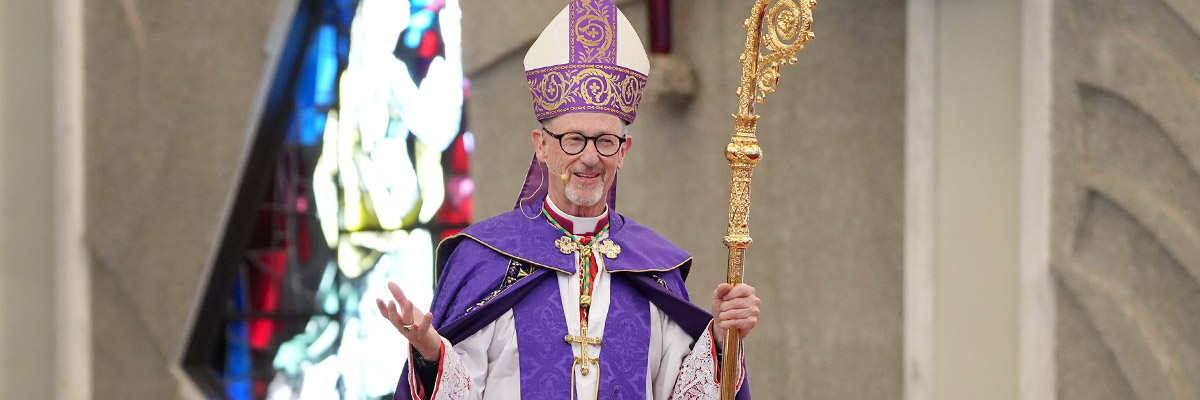
Bishop James Conley
March 31, 2015
Dear Brothers,
Thank you for welcoming me to celebrate Holy Mass here at the Nebraska State Penitentiary. I am very glad to be here -- to worship with you, to give glory and praise to God, and to administer the Sacrament of Confirmation for four of your brothers, and to offer the Holy Sacrifice of the Mass for your community. I am grateful to Fr. Kubat and Fr. McLean for all the work they do here as Catholic Chaplains at the State Penitentiary and I am glad they are with me to concelebrate this Holy Mass. I am also grateful to Scott Frakes, Director of the Department of Corrections and Lieutenant Governor Mike Foley for arranging this Mass.
Today is Tuesday of Holy Week – a week we call holy because it is the week when we remember, in a solemn and sacred way, the Passion, Death and Resurrection of our Lord and Savior Jesus Christ. On Thursday of this week we will commemorate the Last Supper of the Lord, Jesus, and on Friday – Good Friday – we will remember his redeeming death on the Cross. And on Sunday, we will celebrate his Resurrection from the dead. This is why we call this week holy – because we remember in a very solemn way the saving events of the life of our Lord.
I come to you today, brothers, as the Catholic bishop of the Diocese of Lincoln, called by God to serve as the shepherd for the Church in Southern Nebraska. I am humbled by the responsibility of that task, and I ask each of you for your prayers. I also come to you as a son of God, adopted by God the Father in the holy waters of baptism. And I come as your brother—in Jesus Christ we are joined as brothers in the Body of Christ, the Church.
But I also come to you as a sinner. In fact, each one us is a sinner. St. Paul tells us that, “all have sinned, and fall short of the glory of God.” And the Gospel today is taken from the Last Supper with Jesus and his disciples. It is the story of sinners—the sin of Judas, who betrayed Jesus Christ, and the prophecy that St. Peter would deny the Lord three times before the night was over.
Saint John’s gospel today reminds us that we are all sinners, and that no matter how close we grow to the Lord, we must always be wary of temptation. Every one us must be vigilant in the face of temptation. For our entire lives, the evil one lurks behind us, tempting us to sinfulness.
But today’s Gospel presents us with two men who responded to their sinfulness in different ways. Judas Iscariot succumbed to temptation and betrayed the Lord. St. Matthew’s Gospel tells us that after he realized what he had done, he ran outside of the city, and killed himself in despair. The sinfulness of Judas Iscariot defined his life, and his death.
St. Peter chose a different path. St. Peter also sinned against the Lord. He denied ever knowing Jesus Christ. And did so not only once, but three times! After that third time, I wouldn’t be surprised if St. Peter was tempted to despair, so ashamed he must have felt in betraying his best friend and Lord. Scripture tells us that he wept bitterly when he betrayed the Lord. He probably felt that he had committed the unforgiveable crime. But he returned to Jesus, and professed his love, and his sorrow, and Christ forgave his sins.
Christ called St. Peter—a sinner, a betrayer—to become the first pope of the Catholic Church, and to be the “Rock” on which he would build his Church on earth.
The sinfulness of Judas and St. Peter remind us of an important truth in the Christian life: we must decide how we will respond to our sinfulness. Each of us can despair, if we so choose. Each of us can believe we are unworthy of mercy. Each of us can live lives defined by our sinfulness. Or, like St. Peter, we can return to the Lord when we sin, confess our sinfulness, profess our love, and be made new.
The good news of Jesus Christ is that our lives need not be defined by our sins. The mercy of God is waiting to make us each anew.
Here, in prison, I imagine that much of your life seems defined by moments of sinfulness. Your liberty is constrained. Your daily life reminds you of past mistakes. The world often looks on men who are incarcerated through eyes of hatred or mistrust.
But dear brothers, the good news of today’s Gospel is that each one of you is more than your sinfulness. Each one of you is a son of God the Father, and a member of the Body of Christ.
Because of Christ, our sins do not need to define our lives. Because of Christ, each one of us can be transformed, from sinfulness to holiness. Because of Christ, each one of us can become a saint.
When we repent of our sins, Christ’s mercy washes us clean, and prepares us for lives of holiness.
Today, at this Mass, I will celebrate the sacrament of confirmation. Some of our brothers will be sealed with the gift of the Holy Spirit, and be strengthened for their vocations in the Christian life. The gift of the Holy Spirit prepares them to live an extraordinary life—a life of holiness in the most difficult circumstances. The gift of the Holy Spirit prepares them to imitate the choice of St. Peter, and to be men of hope and mercy.
We follow the path of St. Peter when we repent from our sins, embrace Christ, and follow him as his disciples. We follow the path of St. Peter when we persevere as Christ’s disciples-- despite our failings and shortcomings.
Here, in the Nebraska State Penitentiary, you have a unique opportunity for holiness. Christ is calling you to become saints, here, in this prison.
Some of you know that St. Peter spent time in prison. He was arrested in Jerusalem, and kept, in chains, in solitary confinement. He awaited trial for the crime of being a Christian. He might have been executed, but instead he was freed by an angel. Years later, St. Peter was arrested in Rome, and kept in prison until he was executed—a martyr for Jesus Christ.
I’d like to conclude this homily by telling you the story of another prisoner who became a saint. St. Maximillian Kolbe was a Polish priest who died in 1941 and spent his last days in prison. He was arrested for being a priest, and kept in the Auschwitz prison camp by the Nazis. Many in Auschwitz had committed no crime. But St. Maximilian Kolbe lived with thieves and criminals. He spent his time in prison in prayer. He offered his sufferings for the salvation of the world. He practiced kindness—he prayed that God would allow him to be kind to his fellow prisoners, and to his guards. He prayed that every man in prison would see Jesus Christ through him.
One day, three men escaped. The Nazis decided to execute ten prisoners as punishment. A man with a young family was chosen. Fr. Kolbe offered to die in his place. He spent two weeks in a starvation cell, and then he was killed by lethal injection.
St. Peter, and St. Maximilian Kolbe, died with the name of Jesus on their lips.
---
God is calling you men to be the saints of this prison. He is calling you to repent, and to receive his mercy. He is calling you to be a witness to Jesus Christ—to practice unbounded charity, so that every man in this prison might know the love of God through you. I know this is easier said than done. But it can be done with love.
To stay close to Jesus Christ, as his disciples, I suggest three important habits. The first is the reception of the Most Holy Eucharist. As often as you can, dear brothers, receive the Eucharist. Whenever Mass is offered, be present. Christ is present in the holy sacrament of the Eucharist. In the Eucharist, he enters your hearts, and transforms your lives. The next is the habit of Scripture. Read the scriptures often—daily, if you can, and read them with your brothers in Christ. Knowing Scripture means knowing Christ. Finally, dear brothers, I commend you to the Blessed Virgin Mary. She is present to us, and she intercedes for us in heaven. Pray the Rosary. Pray it daily. Ask the Blessed Mother to bring you closer to Jesus. Mary is our mother, and we are her sons.
God is also calling you to offer your sufferings in union with the sufferings of Jesus Christ. In a few days, the Church will observe Good Friday, the day when we recall that Christ suffered and died—as a prisoner—on a cross. Christ’s suffering saves us. You can offer to Jesus Christ the suffering of your daily life. You can offer your suffering for the conversion of the world. You can pray for the men of this prison, for your families, and for the Church. I would be grateful if you might pray for me. This prison can be a spiritual powerhouse—a place where holy suffering and righteous prayer transforms the world.
Each one of us has sinned. We must choose how to respond. Repent of sinfulness, dear brothers. Receive God’s incredible mercy. And become the saints of this prison. Christ is calling you. And the Church—throughout the world—needs your holiness. Please pray for me, and I will pray for you.
