
Ordination of Deacons
Cathedral of the Risen Christ
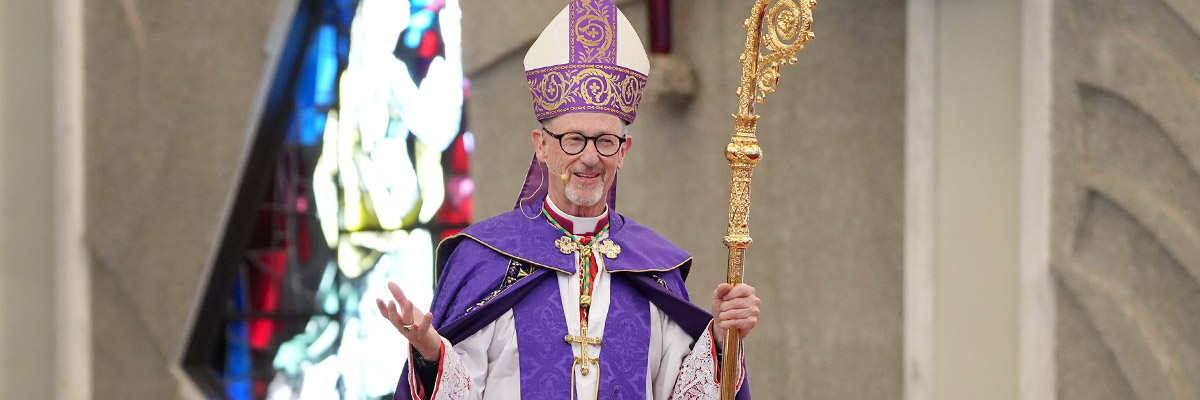
Bishop James D. Conley
May 27, 2016
Dear friends in Christ,
I would like to welcome everyone this evening to the Cathedral of the Risen Christ.
I would like to welcome Bishop Fabian Bruskewitz, my predecessor, the eighth Bishop of Lincoln, who will not be able to be with us at priestly ordinations tomorrow because he will be ordaining four men to the priesthood for the Fraternity of St. Peter (FSSP) at St. Cecilia’s Cathedral in Omaha.
I want to welcome all of my brother priests, deacons, and seminarians, both here in Lincoln and from other dioceses. I want to welcome representatives from Mount St. Mary’s Seminary, St. Charles Borromeo and the NAC in Rome.
I want to welcome in a special way the parents, family members and the friends of the five men who will soon be ordained deacons.
And I want to welcome you, our five ordinandi who will be advanced to the Order of Deacons in few moments.
Tonight, we celebrate the ordination of five men to the sacred order of the diaconate. Ordination is a solemn moment in the life of the Church, and in the lives of those to be ordained.
As many of you know, tomorrow I will have the privilege of ordaining four men as priests of Jesus Christ. Those men are serving as deacons in this Mass of Ordination. And next year, God willing, I will ordain you five men to the Order of the Presbyterate.
Because of the sacred and essential role of the priest in the life of the Church, there can be a temptation to see this moment—ordination to the diaconate—as something less significant, as something temporary, only an element of training or merely a moment of transition, a steppingstone, towards something greater to come. It can be easy for us to miss the significance of ordination to the sacred diaconate.
But the fact of the matter is, my dear sons, you will soon be ordained deacons forever. And those of you who are serving as deacons this evening, who will be ordained priests tomorrow, you do not lose your diaconate with your priestly ordination.
Beneath the priestly chasuble that I am wearing tonight, is a dalmatic, the vestment of a deacon. A bishop is consecrated to the fullness of the Sacrament of Holy Orders, but he never loses the order of deacon in the process.
What happens in this cathedral this evening in the solemn rite of ordination represents an irrevocable transformation of your identity before the Lord. We ought not underestimate the meaning of ordination to the sacred diaconate, and we cannot overstate the significance of the transformation which you will now undergo.
Tonight, you enter the ministry of sacred orders, instituted by Jesus Christ himself. Tonight you enter the clerical state. Tonight you will make a commitment to remain celibate for the rest of your lives, as a sign of your dedication to Christ the Lord for the sake of the Kingdom of Heaven, in the service of God and man. Tonight you will make a promise of respect and obedience to me, your bishop, and to my successors.
Tonight, you will be configured to Christ in a new and unique way, through the laying on of hands. Tonight, the sacrament of Holy Orders will mark you with an indelible imprint or character that cannot be removed which will configure you to Christ, who made himself “deacon” or servant of all (CCC #1579).
St. Polycarp, the disciple of St. John the Apostle, in the first century said that Jesus Christ “became a deacon to all” and a minister of charity.
So this evening, my dear sons, in this solemn rite of ordination, the five you become icons of Jesus Christ the servant. Your lives are commissioned in ordination for charity, in union with the charity of Jesus Christ himself.
In the Acts of the Apostles, we just read that seven deacons were chosen from among Christ’s disciples, and ordained, anointed, and commissioned to be servants. Service—charity—is the essential character of your sacred ordination, and of your essential identity as a deacon.
As deacons, that is, as ministers of the charity of Jesus Christ, who came among his disciples as one who served, I exhort you to do the will of God from the heart: serve the people in love and joy, as you would serve the Lord.
As I ordain you deacons tonight, in a new way, you now live to serve. You live as prophetic witnesses of Christ’s consecrated life of self-giving charity. You are truly icons of the suffering servant.
--
I am grateful for your formation, both intellectual and spiritual. First at St. Gregory the Great Seminary where you spent some years in philosophical studies; then at St. Charles Borromeo Seminary in Philadelphia, PA, and at Mount St. Mary’s Seminary in Emmitsburg, MD, where you have spent the past three years in theological studies, you have been formed in body, mind and soul for this very moment. You will continue your theological studies for another year, after your summer deacon assignments, but all of your education and formation was in preparation for this moment of consecration.
If you will remember back to your days at St. Gregory the Great Seminary, you will recall, in Plato’s great work, the Republic, the philosopher Socrates describes a group of people chained in a cave, facing a blank wall. They watch shadows on that wall, shadows of figures behind them which depict real things. Rather than seeing another person, they see only the shadows of a wooden figure depicting a person. They are insulated from reality. They live without ever knowing that they see only shadows—shallow depictions—of the truth.
As many of you realize, we live in an ever-more synthetic web of experiences. We live in the ever-growing experience of mediated reality. Over the past twenty years, our culture has willfully marched into Plato’s cave, and contented itself to be entertained by shadows on the wall.
Reality is mediated through media, technology, and perverse distortions of justice and tolerance. Conversation is mediated through texts and “emojiis.” Much of education is mediated through screens. Literature is mediated by “trigger warnings.” Friendships are mediated through tweets, and likes, and photo filters, and status updates.
We are ever more separated from the really-real. We live ever more insulated from the truth about our own hearts, about God, about real justice, and mercy, and peace.
Charity – love -- is an extraordinary force. Charity and service draws us out of ourselves us into reality. Charity and service draws us into real encounters with one another. Charity and service draws into real encounters with God.
We love those with whom we speak, or visit with, or encounter, or accompany. It is hard to really love through the shadowy and virtual experiences of contemporary culture. Charity is a necessary and radical disruption to the mediated world of technocracy.
Charity and service, the essence of the diaconal life, breaks through to the human heart. Love—the transmission of God’s own being—begets real love. Charity is the means by which we attain eternal salvation—life eternal with the Trinity of charity itself.
Your lives, as deacons, are meant to disrupt the love-less-ness of sin with the overwhelming power of Christian charity. You are meant to bring love to the places in which it is lacking. You—as deacons—are missionaries and witnesses and teachers of the most powerful force in the universe: the enduring love of God, a love that manifests itself in self-sacrificing service to those in need. You are missionaries and witnesses to the mercy of salvation.
Pope St. John Paul II put it this way: “In a world hungry and thirsty for convincing signs of the compassion and liberating love of God, the deacon sacramentalizes the mission of the Church in his words and deeds, responding to the Master’s command of service and providing real-life examples of how to carry it out.”
You are ministers of charity and ministers of the word. And those ministries are inseparable. Your ministry of the word, and ministry at the altar, flows from the ministry of charity. The Directory for Deacons says that “for the Church gathered at worship, the ministry of the deacon is a visible, grace-filled sign of the integral connection between sharing at the Lord’s Eucharistic table and serving the many human hungers felt so keenly by all God’s children…In his formal liturgical roles,” the Church says, “the deacon brings the poor to the Church and the Church to the poor.”
In the sacred worship of the Church, you assist as an icon of Christ the Servant, and you serve as a witness to the needs of the poor, hungering for mercy at the table of the Lord.
--
Our Gospel reading for this rite of ordination to the diaconate, is taken from the 17th Chapter of St. John, in which Christ is in prayer at the conclusion of the Last Supper, his Last Supper discourse. The Lord prays for the holiness, and salvation, of his disciples. And he prays that they might sanctify the world, continuing, as the Mystical Body of Christ, his own ministry. “I do not ask that you take them out of the world,” Jesus prays, “but that you keep them from the evil one.”
Dear sons, in your ordination as deacons, you are not “taken out of the world.” You are consecrated—set apart—for the ministry of word and charity. This is the work you undertake among those in need of the mercy of God. And as Christ does, I pray that you will be protected from the forces of evil that seek to destroy the children of God.
--
Sacred diaconate is a transformation of your identity. Tonight you become icons of Christ the Servant. You carry that with you for the rest of your lives—even after you are ordained priests, you are called to remain, for the whole of life, a witness to Christ, who came not to be served, but to serve.
May Almighty God bless you.
