

Q. Does “the Lord is one” in Deuteronomy 6:4 refute the doctrine of the Trinity?
A. This is an important question with apologetic and practical implications. It highlights a biblical passage that is central for both Judaism and Christianity.
Just as Christians recite the Church’s Creed as the summary of our faith, so Jews recite (twice daily) the Shema of Deuteronomy 6:4-5: “Hear [Heb., Shema], O Israel: The Lord our God, the Lord is one. You shall love the Lord your God with all your heart and with all your soul and with all your might.” This is the passage from which Jesus drew the first and greatest commandment (Matt 22:34-40). With our Jewish friends, we too confess that the Lord is our God and worthy to be loved above all else.
It is sometimes argued that the word ‘one’ at the end of verse 4 excludes any kind of plurality in the Godhead, thereby countering the Christian doctrine of the Trinity––God’s “three-in-oneness.” Is that necessarily the case?
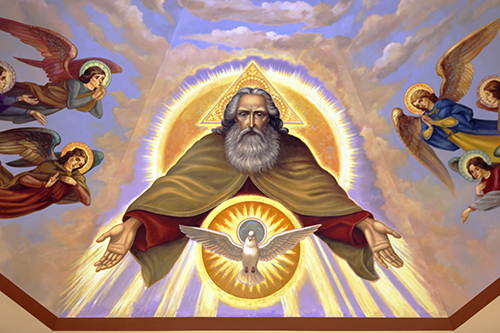
No, it is not. In fact, by the time we arrive at Deuteronomy, we will have encountered many indicators that God is mysteriously plural yet singular. In the very first chapter of Genesis, for example, the “Spirit of God” is present, hovering as a dove over the surface of the waters (v. 2); and the creation of humans entails a divine communion: “Let us make man in our image, after our likeness” (v. 26). Clearly God’s singularity does not exclude his plurality.
Why, then, does the Shema declare that God is ‘one,’ and why did the ancient scribes consider this so important that they inserted a little vertical line in the text, drawing special attention to that word?
To begin, while the Hebrew word echad, ‘one,’ can signify singular as opposed to plural, that does not by any means exhaust its semantic possibilities. This word ranges from the simple numeral one to such meanings as “only,” “unique,” “alone,” and “prominent.” So, for example, the prophet Zechariah declares, “And the Lord will be king over all the earth. On that day the Lord will be one [echad] and his name one [echad]” (14:9). In other words, the Lord alone will be King; there will be no other (cf. Mark 12:32 for a New Testament example).
This is the meaning of ‘one’ in the Shema. It is a declaration of the Lord’s onlyness, a confession that the Lord alone is God. This is the positive version of the first Commandment in the Decalogue: “You shall have no other gods before me” (Exodus 20:3). The Lord is one in the sense that he is exclusively God.
This understanding is supported by a powerful wordplay (Hebrew writers are masters at the art of punning!), and this is the genius of the word choice in the Shema. The words ‘one’ and ‘(an)other’ in Hebrew are virtually identical, with just one tiny difference in the shape of one Hebrew letter. In fact, so similar are these two words in appearance that the scribes who hand-copied the Bible cautioned that miswriting even one letter could bring the whole world to an end. It could spell the difference between the Lord alone as God, and the Lord as just another one of the gods! Yikes! Details in the biblical text do matter!
And so, by way of a subtle but mighty Hebrew pun, the word ‘one’ sets the Lord apart from all the “other gods.” The Egyptians and the Canaanites might have their make-believe gods, but the Lord alone is our God. The Lord is echad––the only one, the unique and exclusive God.
This verse, then, does not refute the doctrine of the Godhead Triunity, but it does most certainly dismiss the notion of any “other gods”––if not their theoretical existence or imagined reality, then most assuredly their recognition or worthiness as the object of Israel’s devotion and ours.
Interestingly, the “other gods” remain unnamed in Deuteronomy. Elsewhere in the Bible, some of the make-believe gods of Israel’s neighbors are identified as Amon-Re, Baal, Chemosh, or Molech. In Deuteronomy, however, “other gods” are things like materialism or military might when these are the object of misplaced trust. In other words, Deuteronomy presses a sobering question for each of us to ponder: Is the Lord truly echad, our one and only God, or do we allow other false deities, like wealth, pleasure, status, position, or friendships, to compete for his lordship and our love? The Shema and Jesus’ citation of it leave no ambiguity on the seriousness and implications of this question.
This question was answered by Dr. Vern Steiner, president emeritus of the Emmaus Institute for Biblical Studies. For more information, visit www.emmausinstitute.net.
Write to Ask the Register using our online form, or write to 3700 Sheridan Blvd., Suite 10, Lincoln NE 68506-6100. All questions are subject to editing. Editors decide which questions to publish. Personal questions cannot be answered. People with such questions are urged to take them to their nearest Catholic priest.
