

A guest column from the Diocesan Liturgical Commission
“The Diocesan Liturgical Commission was created to promote the full, active participation of Christ’s faithful in the worship of Almighty God.” These words come from the mission statement of the Diocesan Liturgical Commission.
This “full and active participation” could manifest itself in many ways, but our primary focus has been music in the liturgy. All the members of the committee have a musical background and are passionate about helping congregations meet Jesus in the liturgy through music. How can this practically be achieved? And why does music in the liturgy even matter?
First, why are we, as a liturgical commission, so passionate about music in the liturgy? Does it matter if we sing?
Does it matter if the congregation sings? In Sacrosanctum Concilium, or the Constitution on the Sacred Liturgy, a document given to us from Vatican II, it says, “The musical tradition of the universal Church is a treasure of inestimable value, greater even than that of any other art… it forms a necessary or integral part of the solemn liturgy.” Unlike a painting or a stained glass window, which serve as a visual backdrop, sacred music is an essential and active element of the Mass itself. Music combines holy words with melody to form a living prayer.
St. Augustine is attributed as saying, “He who sings prays twice,” meaning music elevates spoken words into a deeper, more emotional and spiritual dimension. As we were created as both body and soul, music, particularly singing, allows us to worship with our entire selves. Singing also fosters a shared voice and solidarity among the assembled faithful, turning individual worshippers into a unified body in Christ.
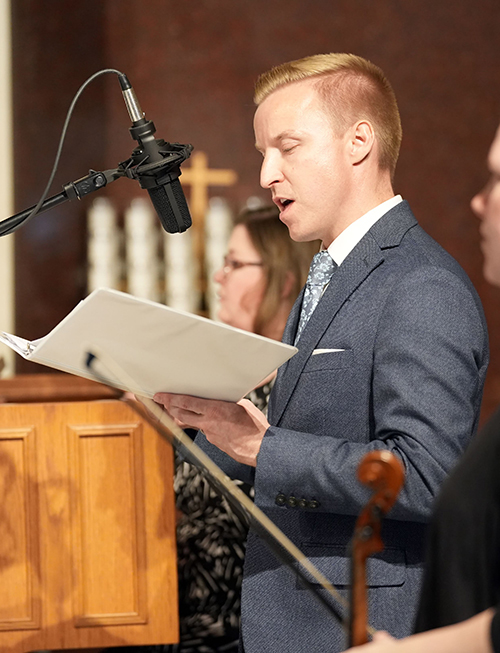
Further, singing is, in a real sense, practicing for heaven. There is very little that we know for certain about the physical reality of heaven, but we do know there is singing. Rather than sitting in silent contemplation, Revelation tells us repeatedly that the angels, elders, and multitude of voices sing the “Holy, Holy, Holy” and the Song of the Lamb (Rev. 4:8, 15:3). We can prepare ourselves for heaven by singing in the liturgy, and we also participate in heaven itself when we sing.
But how can we assist our congregations to sing during Mass? What are practical ways to help those in the pews feel comfortable in this “practice for heaven”?
First, sing the Mass! Not just the hymns and Alleluia, but the chants sung in dialogue between the priest and the people. This includes “The Lord be with you/And with your spirit,” the Mystery of Faith (Memorial Acclamation), and the Lord’s Prayer. These make up what is called the First Degree of singing, as given to us in the GIRM (General Instruction of the Roman Missal). When the priest is able to sing the calls and responses in the Mass, the congregation will become more comfortable with singing other parts of the Mass!
We know it is not always possible to have the priest lead all of the calls and responses, so here are some other ideas to encourage congregational participation.
Have cantors be well prepared to lead at Mass, and make sure microphones are loud enough so the congregation can hear them clearly.
Sing familiar songs, but also introduce new repertoire slowly, and don’t be afraid of singing a new hymn multiple weekends in a row.
Have the organ or piano play a new hymn before Mass as a prelude or use a long introduction as a way of introducing a new melody.
Make sure the congregation has the notation in front of them for any new Mass settings you introduce.
Consider practicing new hymns or Mass parts before Mass with the congregation.
Choose hymns that are “vertical” in nature (hymns that focus on God and are directed toward Him), rather than “horizontal” songs that focus primarily on our relationships with each other. We all have a natural desire to connect more deeply with God. Choosing beautiful, meaningful music can awaken that desire and inspire people to worship Him more fully through singing.
Above all, when encouraging more participation among your congregation, be patient. Our ultimate goal is never perfection, but instead “the glory of God and the sanctification of the faithful” (Sacrosanctum Concilium, para. 112). As always, if we, as a liturgical commission, can be of any assistance to you as a musician or pastor, please reach out to us using the contact link at lincolndiocese.org/liturgy.
