

by Fr. Brian Kane
Rector, St. Gregory the Great Seminary; Director of Seminarians
“Good teacher, what must I do to inherit eternal life?” (Lk 18:18)
If we are fortunate, each of us has a specific teacher who comes to mind when we think of our best experience in the classroom, or on a playing field, or in a work setting. It is someone who patiently guided us along the way. Father Tom Wells, a priest of the Archdiocese of Washington, D.C., first comes to mind when I think about a teacher who changed my life.
As we look at the ways seminary formation shapes young men to be a “healed, mystic, teacher,” our last focus is on the role of priest as teacher.
Father Wells was the assistant pastor of the parish grade school in Maryland that I attended from sixth to eighth grade. Once a week, he walked into our classroom with a smile on his face and a booming voice, ready to share with us a little of his life and his understanding of God. He did much more than that for me, although it was quite some time before I realized his impact as my teacher.
The document that guides seminary formation in the United States, published by the United States Conference of Catholic Bishops, the Program of Priestly Formation (PPF), highlights that Jesus Christ is the exemplar of all teachers: “The first task of [seminary] intellectual formation is to acquire a personal knowledge of the Lord Jesus Christ, who is the fullness and completion of God’s Revelation and the one Teacher” (PPF 263). This first task is the mystical dimension, an intimacy with Jesus that comes first through prayer.
Once the seminarian has encountered Jesus, he begins to learn from him. The document continues: “If the priest is to be a teacher, he must first be a student who continuously pursues an understanding of the faith to which he commits himself and invites his people” (PPF 291k).
Father Wells lived his life as a teacher, not only in the classroom, but also in the pulpit as he preached, and on the playground as he interacted with us during recess. When I transferred to his school as a sixth-grade student, he went out of his way to welcome me and make me feel at home. Without my realizing it, he was a real-life image of the “Good Teacher” in the Gospel of Luke: “Good teacher, what must I do to inherit eternal life?” (Lk 18:18)
Seminary formation seeks to help young men be this model of Jesus, the “Good Teacher.”
This includes rigorous intellectual formation, giving the seminarian the ability to teach and respond to questions. He is being formed to be a missionary evangelist, one who has the personal, human formation to approach anyone to answer the questions of those who are seeking, and to help bring back those who have fallen away. The PPF states: “Intellectual formation must be directed to the ecclesial dimensions of priestly formation, namely, the teaching office (munus docendi) of the priesthood. The doctrinal, educational, catechetical, and apologetical aspects of training are to prepare the seminarian to be a faithful, loyal, and authentic teacher of the Gospel” (PPF 265).
The priest as teacher is one who can give a homily at a school Mass—engaging young people and inspiring them—and then teach a classroom of adults seeking to enter the Catholic Church.
Many of the priests in our diocese teach in high schools or grade schools as part of their priestly assignments. The Diocese of Lincoln has a long history of priests in the classroom, instructing and guiding young people. We are always looking for ways to help better prepare our seminarians to fulfill their teaching responsibilities so that, as priests, they are equipped to enter the classroom and have the sort of effect that Father Wells had on me as a young person.
Alongside the dedicated religious sisters and lay people who also teach in our schools, our priests become a center of evangelization and a school of discipleship. Our schools are also important places that encourage vocations to the priesthood and religious life. Many of our current seminarians are products of our Catholic schools.
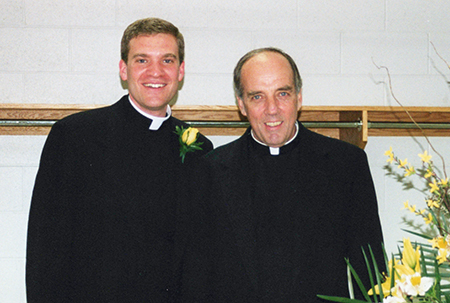
Father Wells had such an impact on me that I kept in touch with him throughout high school, even after he moved to a different parish and was made a pastor. When I graduated from high school, he was the first person to directly suggest the idea of entering the seminary. I continued to correspond with him in college and during my years in the seminary. When I was ordained a priest, I invited him to preach my first Mass of Thanksgiving. He was a true priest and teacher.
At the ordination of a deacon, the rite summarizes the goal of formation. He is handed the Book of the Gospels while the bishop says: “Receive the Gospel of Christ, whose herald you have become. Believe what you read, teach what you believe, and practice what you teach.”
