

By Sr. Teresa Marie, C.K. and Sr. John Marion, C.K.
“Sister! Guess what!” “What, Joe?” “Did you know that pterodactyls are the largest flying animals and that the humans were 100th the size of a megalodon?”
“Sister! Guess, what!” “What, Joe?” Did you know that the Anchiornis huxleyi was a chicken-sized dinosaur?”
Each year we teach, we have several “Joes” in our class. It has caused us to ponder—why this fascination? The child certainly did not encounter a dinosaur on his way to school! Dinosaurs are mysterious and are part of ancient history. The names of the different types are far from the child’s everyday vocabulary. And yet young children continue to be fascinated by these strange creatures and will spend hours looking at picture books, memorizing facts, and reciting their newfound knowledge for anyone who has ears to hear.
For some time, we thought the children’s fascination had to do with the uniqueness of these strange creatures. However, we have come to be convinced that it’s not about the dinosaurs. It’s about how God made the child.
At this age, children have a capacity that is ready for something larger than themselves. Around second grade, the child is outgrowing a self-centered perspective and is discovering a new reality outside of himself or herself. It is almost like the child suddenly woke up to the reality of a vast world all around. It begins with creation, leads up to Redemption, and is fulfilled when “God is all in all” at the Parousia (Second Coming). 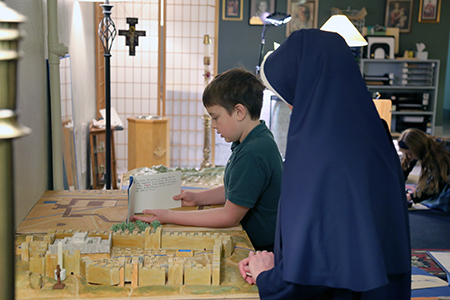
We have come to discover, whether in history class or in the Catechesis of the Good Shepherd atrium, that children love timelines and making connections between events. One student shared, “Sister, did you know that King David lived at the same time that Aeneas was fleeing Troy?” Not only are they excited to put people and events in order on the timeline, but they love finding their own place on the timeline. The children express a sense of wonder, energy, and adventure to explore what has been, what is, and what will be with God.
It is a combination of the smallness of a child and the child’s magnanimous heart. This paradox of small and large seems to be summarized in a parable that the children love, the parable of the mustard seed. They excitedly proclaim, “It is the tiniest seed, but it becomes the largest of shrubs!” How the seed grows is a mystery of love.
We unfold the mystery with the students in the atrium in a work called “La Fettucia,” which in essence is a very large timeline. When reflecting on creation we asked, “Why did God create the world?” One child responded, “Because He knew He would like it.”
Another little girl said, “I think God had fun making the world. And you know what? He’s still making it. Maybe because He can’t stop!”
When reflecting upon Redemption, one child responded, “Thank you for being born, dying, and rising for me.”
In contemplating the Parousia, one child connected the parable of the True Vine to this story and said, “At Parousia, the Vine won’t die. It will bear the best fruit.”
Their response to this lesson is almost like a fountain bubbling over with gratitude. “God is always giving. You just have to know that it’s Him,” said one child. The children connect their own love for creating—whether it’s creating with Legos, jewelry, or paper artwork—with God the Creator. Since they enjoy creating, it is natural for them to see that God also enjoys creating. This connection for the child does not stop there. They are drawn to respond by participating in God’s work of creating and renewing His creation.
The history continues on a page yet to be written, a blank page. One child joyfully shared, “The blank page is my favorite part. I can’t wait to see what God writes just for me.”
Another child would weekly pray in thanksgiving to God, “Thank you for helping me write my blank page.” The children’s joy is a glimpse into the joy of God in His creation.
