

By Sr. Marie Amata, C.K.
with Sr. John Marion, C.K.
Even when I was a child myself, I felt a longing to be a mother. My family and friends heard me say countless times as I was growing up, “I want to have 12 children!”
To bring life into the world and to nurture that life is a profound desire that God knits into a woman’s heart. It reaches the very core of who she is, of her identity: she is one who participates in God’s creative power, and daily, lovingly, cares for that life, helping to form in the child the great and exalted character that God desires for him. Motherhood is one of the most beautiful and noble callings that God has given to the human race. And He has given it to us as pure gift.
The desire for motherhood lives deep within a woman’s heart. It stems from an even deeper desire: to give herself freely and wholly to another in love. When a woman finds the one to whom she will make a complete self-gift, her desire for motherhood is awakened in a definitive way. Giving herself to him brings this desire to fulfillment. Motherhood and spousal love are intrinsically woven together: spousal love is life-giving by its very essence.
When a young woman hears the call to religious life, God does not ask her to set aside what He has woven into her being. He adds to these gifts already given yet another one: the supernatural grace to live a divine call to spousal union and motherhood through a complete gift of self to God. The call to religious consecration truly is “grace upon grace.”
The spiritual motherhood of a woman religious is an intimate participation in the motherhood of Mary. Mary’s role at the wedding feast at Cana gives an insight into this mystery. We read that “the mother of Jesus was there” (John 2:1). Presence is a particular gift of femininity. In the mother’s gift of presence, her child experiences being known, received, and loved.
“The mother of Jesus said to Him, ‘They have no wine’” (John 2:3). Mary’s heart is a place of refuge in which her children’s needs are met. She anticipates their needs and provides for them in an authentically life-giving way: by turning to Jesus. So, too, the woman religious is invited to live Mary’s magnanimity in her spiritual motherhood.
“His mother said to the servers, ‘Do whatever He tells you’” (John 2:5). Here is the culmination of motherhood: Mary invites her children, in a uniquely feminine way, to place themselves in the gaze of Jesus. A spiritual mother must develop a deep capacity to listen and encourage, so that she may support her children to receive Jesus.
I have had profoundly beautiful experiences of my spiritual motherhood at various points in my religious life. One such experience came during my 30-day retreat. I was praying with John 21:15-17, which details Peter’s triple profession of love after Jesus’ thrice questioning, “Peter, do you love me?”
In this meditation, Jesus brought to mind the specific children whom I would teach the following year. It was a class who had struggles and who were in particular need of healing love. In the words “Feed my sheep,” Jesus spoke to me about these children. They were His. And He, my Spouse, was asking me to love them with the heart of a mother. With this, He allowed me to see the children as they truly are. Tears were streaming down my face, and the words welled up in me: “Jesus, they are so beautiful!”
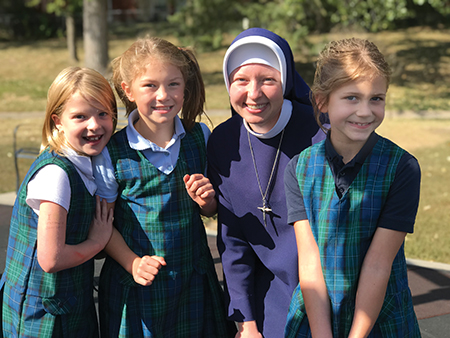
As members of a teaching community, the Sisters have, each day, before their eyes and penetrating their hearts, a constant reminder of this call to spiritual motherhood. This daily manifestation helps us to recognize that since every human person is a child of God, there is no one who is outside the realm of our spiritual motherhood. Even those we will never meet have a claim on our motherhood.
The spiritual motherhood of each woman religious is rooted in her spousal union with Jesus and the perfect motherhood of Mary. It is real, and it has to be. If it were not, God would be asking those He calls to this life to deny the uniquely beautiful gifts He has placed in a woman’s heart. This cannot be so, because God cannot contradict Himself. Instead, He raises the grace of motherhood in the heart of the religious woman to respond to all whom He Himself calls “children.”
