

by Katie Patrick
In the past two publications (Feb. 10 and Feb. 17), I shared with you the positive impact that a child tax credit can have on the families we serve. It was one of three issues we were invited to advocate for as part of our trip to Washington, D.C., for a Catholic conference in late January. The second issue we advocated for was the Afghan Adjustment Act. This issue is particularly dear to us at Catholic Social Services because it affects many of the families we help in different ways every day.
The Afghan Adjustment Act was introduced during the last Congressional session. Its passage would provide a pathway toward legal permanent residency for the Afghans who were welcomed in the United States as part of Operation Allies Welcome in the fall of 2021. To illustrate this urgent need and its effect on the families who now call Nebraska home, I will share the story of Safiullah.
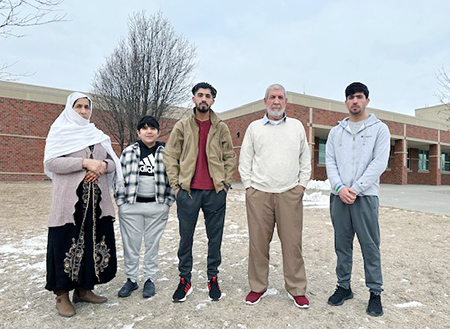 Safiullah graduated from Kabul Polytechnic University with a degree in construction in 1982. That same year, he married his wife. Together, they have eight sons and two daughters. Having built a good reputation for himself, he was recruited by the U.S. government in 2007 for his skills and expertise. The money he earned while serving the U.S. military was used to meet the basic needs of his wife, children, and grandchildren as well as for their education. During his service, he received several accolades from his superiors for his strong work ethic. He risked his life more than once for the safety of U.S. troops.
Having served the U.S. military for 14 years, Safiullah narrowly escaped with his wife and three of his sons Aug. 19, 2021, with Operation Allies Welcome. They were processed in Germany and arrived in the U.S. Oct. 16, 2021, and were resettled in Lincoln, Nebraska Dec. 8, 2021.
He has one son living in Canada, but regrettably his four older sons and two daughters and their families are in Pakistan, with no permission to work or earn money. After paying his bills, Safiullah sends as much as he can to assist them, though he asks that the adults eat only one meal per day, because they do not have enough to buy more food.
The situation in Afghanistan is dire. Friends of his are selling their property at half its value to pay smugglers to get them out of the country. His sons and their families fled by night for fear that the Taliban would kill them. Most terribly, Safiullah knows of families who have sold their 8- and 9-year-old daughters to buy food for the family. The Taliban has devastated the local economy and they are kidnapping and killing innocent people every day.
Safiullah is one of the lucky ones. Because his work with the U.S. government allowed him daily interactions with administrative offices in Kabul, and because he started the Special Immigrant Visa (SIV) process while still in Kabul, he submitted all of his residency paperwork in March 2021 and subsequently received his green card Oct. 30, 2022.
Today, Safiullah works at Catholic Social Services as a driver and interpreter, though his skills and compassion go far beyond that. Safiullah and our case managers have worked tirelessly to help our Afghan clients secure employment.
It’s important to note here that the Afghans who arrived in the United States through Operation Allies Welcome were not processed in the regular refugee channels. This alternative entry therefore offers them a “paroleed” status, not a “refugee” status, which has a clear and well established path toward naturalization. Their parole status allows them to work in the U.S. for two years, at which point their parole status and ability to work legally in the U.S. will expire if no action is taken by the U.S. government.
It’s understandable that due to this uncertainty and the concern they have for their families that remain unsafe in Afghanistan and neighboring countries, many Afghan humanitarian parolees are struggling here and often experience anxiety and depression. Passing legislation that provides Afghan parolees in the U.S. with a pathway to permanent legal status will help them successfully integrate into American society.
It was an honor to share Safiullah’s story with our Congressional delegation. We are eager to see how Congress will work together this year to hopefully create a pathway toward permanent residency for our newest neighbors. At CSS, we remain incredibly grateful to so many of you and all that you have done to welcome the many refugee communities who have arrived in our Nebraska cities over the years. Thank you and May God bless you!
