

by Katie Patrick
This is the fourth and final article that I will share with you regarding the three issues that John McDonald and I were invited to advocate for as part of our trip to Washington, D.C., for a Catholic conference in late January.
The first issue was the Child Tax Credit, and I shared the stories of Lila and Siena. The second issue that we advocated for was the Afghan Adjustment Act, and I shared the story of Safiullah. The third and final issue that we advocated for was an increase in international assistance or aid given from the United States government to developing countries.
But before I start, I want to celebrate with you that the United States is by far one of the most generous countries in the world, when it comes to helping the poor and vulnerable. As a historically Christian nation, our faith informs us well of the need to care for God’s children around the world.
In fact, one point that I emphasized that day with our elected representatives in Washington was that America’s strength and visibility in the far corners of the world isn’t exclusively its military might, though that is a very important part of it, but people from Europe to Asia to Africa to the southern tip of South America, see and define the strength of America by our generosity and our care for the poor.
The American flag, or the letters “USA,” for millions of people, mean that rice and clean drinking water is made available to them in the refugee camps. It means that their kids, including their daughters, have access to primary education. It means that people in remote regions of sub-Saharan Africa will receive the polio vaccine, urgent medications and medical treatment. It means that roads and buildings will be rebuilt after their city is destroyed by an earthquake. Individuals and foundations in America donate billions of dollars every year.
So why is that not enough? Why should the U.S. government increase its total amount of funds directed at international assistance, if individuals are already giving so much?
Right now, the U.S. government designates less than one percent of the federal budget to foreign aid. These funds trickle down and are made available to organizations that have developed long-standing, trust-based relationships with local governments and communities. The international projects that the U.S. government supports are usually directed at food insecurity, emergency response, and maternal and child health. It would be impossible for individuals and foundations to reach those who need it most without the assistance, direction and partnerships maintained by the U.S. government.
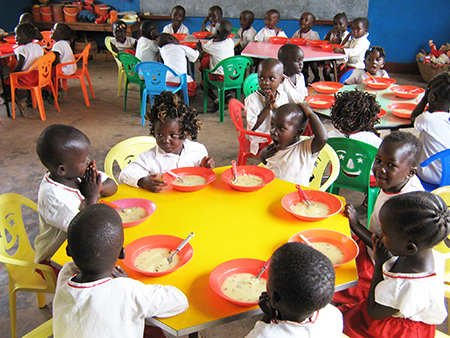 For example, while volunteering at the Center for Malnourished Children in the Congo, I would see vitamins, nutritionally enriched foods and powdered milk being distributed to moms, who would walk for miles every Thursday to gather those items for their children. Assistance from the U.S. made this possible. In the conflict regions of Ethiopia, where very few organizations are able to function, the U.S. government is able to deliver food, water and basic necessities to thousands of refugees and displaced families. Every dollar counts, whether it’s distributed by the funding made available by the U.S. government, or from individuals just like you and me.
Because when we receive calls or emails at Catholic Social Services after a natural disaster or conflict occurs in another part of the world, I always encourage people to give directly to the communities affected or to the organizations that have boots on the ground.
Selecting an international organization or an organization working in another country can at first seem daunting. You may have a lot of questions about where the money goes, who works for the agency, and well, frankly, does your money even end up there? The answer in most cases is – the money goes directly to the people who need it. The people who work for the agency are just as compassionate, talented and dedicated as those you are familiar with at your local nonprofits; and yes, your money reaches those who are most in need. In fact, when you donate financially online, it reaches them sooner and is more likely to meet their urgent needs, which can be ever changing in a crisis. But above all else, pray for those communities that are struggling.
