

By Katie Patrick
The first Friday of Lent marked a retreat day for the staff at Catholic Social Services. Our St. Teresa of Calcutta Committee, composed of CSS staff from across our different offices and programs, organized the day for us.
Father Timothy Danek, newly appointed clergy for the incarcerated, celebrated Holy Mass and gave one of three talks. Staff signed up to bring homemade soups and bread, and we had Eucharistic adoration continuously that day.
There was time for quiet meditation and opportunities to visit with each other outside the context of meetings. We were also blessed to welcome two special guests— Sister Dominga and Sister Jesula of the Missionaries of Charity, the Order founded by St. Teresa of Calcutta.
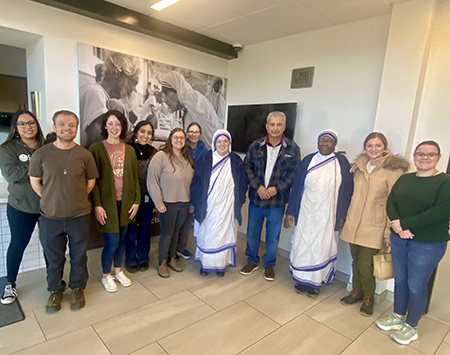 Sister Dominga told us stories of the experiences she shared with Mother Teresa—what she observed, learned, and admired. Sister Dominga also shared stories of the men, women and children that she herself cared for. Names and stories that I will never forget, not because of the trauma they had been through or the labels they carried, but because of the way Sister Dominga loved them. She talked about them and loved them the way Christ teaches us to love the poor—with total tenderness.
When asked by one of our staff what the core mission of the Missionaries of Charity is, she responded “to love Jesus and to prepare people for death.” Even now as I write this, I feel how heavy those words are— preparing people for death.
The Missionaries of Charity are known throughout the world for serving the poorest of the poor, accompanying people dying of hunger and AIDS, wounds and infection, and all manner of deformities. Yet, what sets the Missionaries of Charity apart, more than who they serve, is how they serve. They enter dark corners of the world where even governments look away, and they find among the rubble and under the soiled sheets and garbage and beyond the graffitied, needle-ridden warehouses, the forgotten. And they stay with them and they look them in the eyes and whisper to them how much they are loved, and they hold the dying in their arms, as if Christ were holding them himself.
Following the retreat that afternoon, a small group of us—including Sister Dominga and Sister Jesula—visited another agency to spend time with the homeless.
As I walked into a room full of men escaping the cold outside, I felt hesitation, questioning what I could offer them. I came with no food, no water bottle, no list of resources, not even a holy card to share. As I stood there trying to gain my confidence, I awkwardly put one foot in front of the other, approached them, knelt down, and asked about their day.
My first encounter was with a native man of the Ogallala tribe who came from a family of military service. We had a long talk about angels and prayed the Guardian Angel prayer. Then I met Jason, who came to Lincoln to be closer to his son. He enjoys working on cars and is actively looking for work. Another man I met had a job offer at a manufacturing plant outside of Lincoln, but lacks transportation and remains homeless. It’s hard to resist the temptation to help solve their problems on the spot, but our purpose at that time was to be present with them in the moment. To listen, to encourage, and ultimately, to love them as Jesus does.
Having the Sisters of Mother Teresa’s order present with us that day was an unexpected, grace-filled opportunity reminding me that loving the poorest of the poor often first requires an act of vulnerability on our part.
When I brought my daughter the next morning to drive the Missionaries of Charity Sisters back to the airport, I explained that the Sisters help people before they die—and Saoirse, like many 4-year-olds, I would imagine, responded to me and said, “You mean to help them meet Jesus.”
“Yes, Saoirse,” I said, “to help people be ready to meet Jesus.” And just like that, a young child’s understanding of death that follows life in this world is one where Jesus is the first person you meet.
