By Poe Dee,
Refugee Resettlement Director
Every refugee has a story to tell about his or her journey. To be sure, the journey of a refugee is not an easy one. Refugees flee their country because of persecution, war, or violence. Unable to return to their homeland, they seek refuge in another nearby country.
Life in refugee camps is difficult, though, and most refugees do not have opportunities to thrive in such conditions. This is why, when given the opportunity, refugees choose to be resettled in a third country, like the United States, in order to find a safe and stable place that they can call home.
However, the refugee vetting process is rigorous and lengthy. It involves multiple stages and includes extensive interviews with the Department of Homeland Security (DHS)/United States Citizenship and Immigration Services (USCIS), ensuring thorough security checks and medical screenings are undergone. Once approved by DHS, cases are matched with a resettlement agency and travel is arranged. This entire process can take years, or even decades.
It’s a difficult and stressful decision for refugees to come to a new country like the United States where they do not know the culture, the people, the systems and institutions, or (in most cases) even the language. I was only 18 years old when I decided to come to the U.S. as a refugee from Myanmar (Burma). I did not know anything about what it would be like in America.
As an adult, I had my own refugee case and was resettled in Lincoln by myself, without my family. I did not have anything special to bring with me to my new home. I packed all my belongings in a big plastic bag, because I did not own any luggage. Inside this bag, I had only a few pieces of clothing and nothing else.
I was lost in the beginning when I first arrived in Lincoln. There were not many people from Myanmar in the community when I resettled here in 2009. Just like other new arrivals, I faced significant challenges. My English was limited, and I needed to adapt to a new culture and learn how to navigate the systems here.
Like many 18-year-olds, I also wanted to go to college. In order for me to attend college, though, I had to have a high school degree from the U.S. Even though I had already completed my secondary education in the refugee camp, I was told that my high school diploma would not be accepted by colleges here. So I went back to high school. I did not make many friends during this time, as I was only focused on studying. I did not participate in social activities at school because I knew I had a lot of catching up to do.
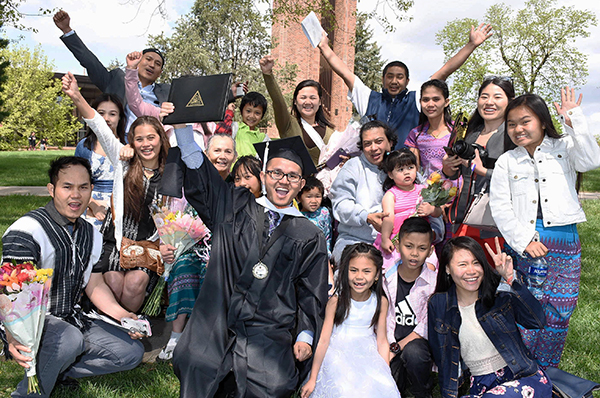
In the face of these struggles, I told myself that I must hold on to hope for a brighter future. And, indeed, I did not lose my hope. I finished high school – again – and went on to college, eventually earning my master’s degree.
Hope is a powerful force in my life and at my workplace. As the Resettlement Director at Catholic Social Services of Southern Nebraska, I work with many refugees like myself. I enjoy working with new arrivals because I have been in their situations before, so I understand their struggles and needs.
Occasionally, I meet with clients who lose their hope after coming to the U.S., because everything is so new and they do not know how to start over again. I take my time to meet with these clients and share the story of how I held on to hope when I, too, was lost. I can see the change in their faces and how it motivates them when clients hear my story. They come to realize that I was just like them at one point; now I am here and assisting them and other refugees in need. They start to believe that they can do the same, because they know it’s possible. Talk about “Hope in the Good Life!”