

by Fr. Brian Wirth,
Director of Rural Life
He said to them, “Do not be amazed! You seek Jesus of Nazareth, the crucified. He has been raised; he is not here.” (Mark 16:6)
These words from the angel to Mary Magdalene and the women never cease to amaze. I pray that you are having a hope-filled and joyous Easter season. Truly, He is Risen! Alleluia!
For priests, religious, and laity alike, one of the best Masses to attend every year is the Chrism Mass, which takes place annually at the Cathedral on the Monday of Holy Week.
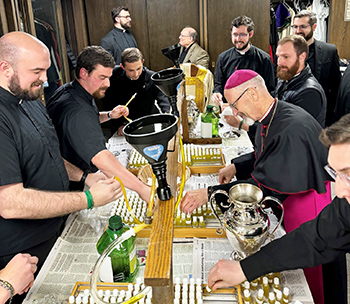 During the Chrism Mass, (a Solemnity, one of the few during the Lenten season), the bishop blesses the three sacred oils which will be sacramentally administered to the diocesan faithful throughout the liturgical year: the Oil of Catechumens, the Oil of the Sick, and the Sacred Chrism.
Once blessed, the oils are filled into vials, boxed, and distributed by the junior clergy (the newly ordained and priests not yet pastors) to the priests.
Along with the bishop, nearly the entire presbyterate is present to concelebrate the Chrism Mass and to renew the priestly vows made at their ordination. Relatedly, the religious and laity renew their promise to pray for their priests as well as honor those celebrating a jubilee anniversary (25, 50, etc. years of priestly ministry). For these reasons and more, the Chrism Mass is one of the most beautiful Masses of the year.
More specifically, the Chrism Mass is a liturgy during Holy Week which proclaims a powerful yet overlooked mystery. I was reminded of this as I was vesting, prior to this year’s Chrism Mass, by Father David Bourek, the former director of Catholic Rural Life in the Diocese. As we greeted each other, we briefly talked about CRL topics, he thanked me for continuing the good work of this important ministry, and then in his wisdom he suggested a theme I should talk about: The fruit of the earth and work of human hands.
As such, I would now like to offer such a reflection.
Every Mass, during the Offertory, the priest prays the following over the bread and wine:
Blessed are you, Lord God of all creation, for through your goodness we have received the bread we offer you: fruit of the earth and work of human hands, it will become for us the bread of life.
Blessed are you, Lord God of all creation, for through your goodness we have received the wine we offer you: fruit of the vine and work of human hands, it will become our spiritual drink.
These prayers take on eternal significance when Jesus, in the Bread of Life Discourse, proclaims to the murmuring Jews and disciples: “Does this shock you? It is the spirit that gives life, while the flesh is of no avail. The words I have spoken to you are spirit and life.” (John 6:61; 63)
Relatedly, the fruit of the earth represented in the olives that are grown each year by the work of human hands for the sake of producing the sacred oils in the Chrism Mass is a beautiful mystery to reflect on.
Like the fruit of the earth in the grains of wheat and grapes that are cultivated by the work of human hands for the sake of bringing Jesus’ Body and Blood to altars throughout the world, during the Chrism Mass, the olives/oils are offered to God: fruit of the tree and work of human hands, it will become for us our spiritual anointing.
To highlight this further, just prior to the final blessing, the bishop is brought the Chrism Oil. After breathing over the Chrism to invoke the “spirit and life” of the Holy Spirit, the bishop begins praying the Consecration prayer over the Chrism. Toward the end of the prayer, all of the concelebrants, with the bishop, extend their right hands toward the Chrism until the prayer concludes, to beseech God to consecrate the Chrism by the strength of the Holy Spirit.
Therefore, by God’s grace placed in the oils, man is strengthened and consecrated, becoming a new creation by the outpouring of the Holy Spirit through the Paschal Mystery of Christ and His Crucifixion upon the Tree of Life, which leads to Eternal Life via the Resurrection.
Recently, Pope Francis issued a message to the Church with a similar sentiment, stating: “The wounds of the Risen Jesus remind us of the suffering He endured for our love and salvation, but they are also signs of the Easter Victory. It is precisely through His wounds that the mercy of the Risen Crucified flows to us.”
By way of Christ’s humanity and divinity, by becoming the “fruit of the earth” within the womb of the Blessed Virgin Mary, and by his Incarnation, Passion, and Death, in view of “the work of his wounded hands, feet, and side” we receive the Supreme Gift of salvific love.
Thus, during the Chrism Mass and throughout Holy Week, we receive a powerful glimpse into the mystery of the fruit of the earth and work of human hands. As the prophet Isaiah and St. Peter equally attest: “By his wounds we have been healed.” (Isaiah 53:5; 1 Peter 2:24).
Providentially, regardless of when Holy Week falls, the Chrism Mass takes place either just prior to or within the early to middle stages of the spring planting season. Like Christ, our farmers labor tirelessly to produce the fruit of the earth by the work of their human hands.
United as One Body, may we keep our farmers in prayer during this busy season. May the Easter season fill them and us alike with renewed diligence, faith, hope, and charity.
Finally, may the work of our farmers’ hands, our priests’ hands, and all of your hands be daily steeped in prayerful contemplation of the “Risen Crucified” so that we may reap, by God’s grace, the greatest fruit of all, the eternal fruit of the Resurrection.
