

Cardinal Sarah to bishop, students: ‘Christ is not divided’
ROME (NI) - Current confusion born of mixed messages from Catholic leaders should not discourage the faithful because the teaching of Christ remains the same, harmonious and clear, Robert Cardinal Sarah, told students from Lincoln’s Newman Institute for Catholic Thought and Culture.
“Christ is not divided,” said Cardinal Sarah, prefect for the Congregation of Divine Worship, at a 40-minute audience in Rome two days before the Oct. 13 canonization of John Henry Newman. “Christ is one, and His Gospel is one, so if cardinals and bishops have different opinions, well, let them have their opinions. We have one voice, and a clear voice: the voice of Christ.
“I know we are passing through a very confusing time,” said the 74-year-old prelate from Guinea, who recently published “The Day Is Now Far Spent,” the third in a series of book-length interviews. “I myself am not confused. I know that Christ’s voice is very clear, and I follow Christ. My advice is to follow Christ. It’s difficult to follow his Gospel, but it’s the true way of salvation.”
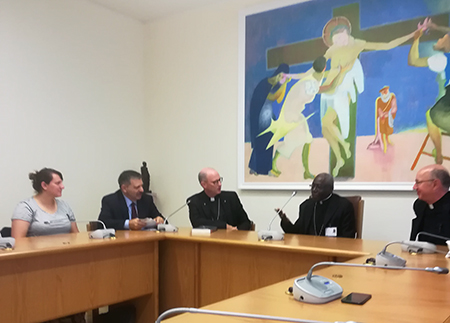 The special audience with students, also attended by Bishop James Conley and Newman Institute Director Dr. John Freeh, was organized by Msgr. Thomas Fucinaro, a Lincoln priest who works at Cardinal Sarah’s congregation. Ten Newman Institute students and alumni made the five-day pilgrimage for the canonization of Newman, the 19th-century Oxford scholar and Anglican preacher whose embrace of Roman Catholicism sent shockwaves through Protestant England and whose writings on religious freedom, conscience, education and the development of doctrine have greatly influenced the Church.
Asked how to follow Christ, Cardinal Sarah responded by saying that all must learn to pray as Jesus did.
“We need the light of the Holy Spirit,” he said. “Before preaching, he went to the desert for 40 days and 40 nights. And he prayed. And very often he brought the apostles to the desert and he prayed all night. I think the most important thing is to try to pray as Christ did.
“I very often say to bishops and priests to do what the disciples did when the boat was in the storm,” Cardinal Sarah added. “Hold firmly to the teachings of the Church and to pray.”
The Newman Institute pilgrimage included attendance at Newman’s canonization Mass, celebrated by Pope Francis in St. Peter’s Square, visits to Rome’s major basilicas and churches, the Vatican Museums and Sistine Chapel, as well as conferences with leading Newman scholars and a meeting with art historian Elizabeth Lev, who gave private tours of Santa Croce, which holds relics of the true cross, and St. John Lateran.
Newman biographer Father Ian Ker, an emeritus professor of theology at Oxford University, spoke of the new saint’s great sacrifice surrounding his decision to become a Catholic. In addition to having to resign as preacher of St. Mary’s Church, Oxford, Newman also had to give up his teaching fellowship at Oriel College. He was an outcast, Father Ker said, rejected by his former fellow Anglicans as a traitor and not immediately welcomed by the Catholic hierarchy and faithful in England.
Father Hermann Geissler, a former official at the Congregation for the Doctrine of the Faith (CDF), spoke about Newman’s pastoral care and his determination to visit, house by house, parishioners who had ceased attending church. We know Newman for his prolific writing and preaching, Father Geissler said, but forget his tender care for ordinary people and his tremendous capacity for friendship.
“Newman’s love was a topic that kept coming up during the course of our trip,” Dr. Freeh said. “We tend to think of him as a great thinker, scholar and apologist, but he was much more. He was moved first and foremost by what he himself called the ‘intemperate energy of love.’ Like all the saints, Newman was a world-class lover: of God, of the Church, and of all souls. We can certainly learn from his example.”
The Newman Institute students, many of whom had never been out of the country, were deeply moved by the pilgrimage.
“Being in Rome, surrounded by people so passionate about their faith, was amazing,” said UNL student Sarah Sutton.
“It was so beautiful to see the universality of the Catholic faith,” added senior Liz Foley, “to feel like we were really walking with the saints everywhere we went in Rome, and to realize how their how their friendship and intercession can remain with us.”
Senior engineering student Maureen Winter said that trip was a “huge reminder” of how God calls everyone to be saints: “Being in Rome, among those amazing saints, I could feel them beckoning to me to join in their greatness, or even to surpass it. This was particularly true when I visited the tombs of St. John Paul II and St. Paul, but it was also true with St. John Henry Newman. I was able to see some of myself in Newman, relate to his desire to teach and love on an individual level.”
Students had the privilege of attending Mass in St. Peter’s, celebrated by Bishop Conley, at the tomb of Pope St. John XXIII Oct. 11, the saint’s feast day. They also found themselves at a reception for English-speaking pilgrims hosted by the British Embassy at the Collegio Urbana, which overlooks St. Peter’s.
One student, Katie Thompson, was wearing the red Newman Center shirt when she greeted Prince Charles, the UK’s representative to the canonization and the reception’s guest of honor.
After seeing the logo on the shirt, the curious Prince of Wales asked Thompson: “What’s a Husker?”
She gladly explained.
Registration for Newman Institute undergraduate and evening seminar spring classes may be found on the website. Dr. Freeh will teach a new undergraduate course, Undaunted Courage: The Heroic Life, and an evening seminar to honor the Institute’s patron: From Shadows to Truth: An Introduction to St. John Henry Newman. For additional classes and evening seminars, along with information on the Spring Break Mission Trip to Gallup, N.M., and the June pilgrimage to the Holy Land, see https://newmaninstitute.com.
