

Q. Why does the priest break off a part of the celebrant’s host and drop it in the chalice just before the Communion Rite?
A. An interesting question. Thanks for asking it. The celebration of the Eucharist or the Mass is our Catholic act of worship. There is no greater act that we can or will do during a day greater than the celebration of the Eucharist.
The Catechism of the Catholic Church has a very explanatory description of the Eucharist in paragraphs 1322 – 1429. If you have the time and desire I encourage you to read it or look it up online.
The practice is known as “commingling,” and has an ancient origin, going all the way back to the earliest years of the Church. 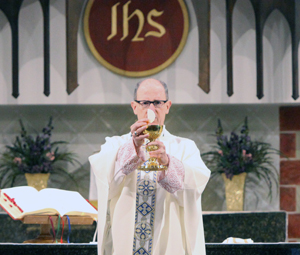
Originally, there was only one Eucharist in each city on Sunday. In Rome, it was usually celebrated by the Bishop of Rome – or the pope. At first the entire Christian community gathered together with an apostle (the first bishops) or the pope at the time. As Christianity spread, it became physically impossible for all to gather for one celebration as different Masses began to be held throughout the area. The bishop(s) appointed priests – called presbyters in Scripture – to preside over these Masses.
To maintain the connection to the bishop’s liturgy, a small portion of the host consecrated by the bishop was taken to each of the other Eucharistic celebrations over which priests were presiding. This piece was called the fermentum, a Latin word that means leaven. It was placed into the chalice and “commingled” with the wine.
In our local Masses we no longer receive a piece of the bishop’s host for each celebration. Instead the priest breaks off a small part of the larger host used at that particular Mass and places it into the chalice saying quietly as he does so:
“May this mingling of the Body and Blood of our Lord Jesus Christ bring eternal life to us who receive it.”
The commingling rite reminds us that each local Catholic community (parish) is united with the local bishop. Great question. If your schedule allows it you might consider participating in daily Mass in your parish church. This could be a great Advent resolution. You can usually attend Mass and still get to work or fulfill your daily duties. Mass times are in your parish bulletin.
This question was answered by a priest of the Diocese of Lincoln. Write to Ask the Register using our online form, or write to 3700 Sheridan Blvd., Suite 10, Lincoln NE 68506-6100. All questions are subject to editing. Editors decide which questions to publish. Personal questions cannot be answered. People with such questions are urged to take them to their nearest Catholic priest.
