

By Reagan Scott
LINCOLN (SNR) - The Saint Teresa School Family Association hosted a forum Feb. 11 entitled “Gender Issues & Our Children” in Kaczmarek Hall in Lincoln.
The event, attended by more than 60 people, was open to all St. Teresa parishioners and the parents of students who attend St. Teresa School.
It provided parishioners, parents and educators the opportunity to have their questions about gender and sexuality answered by a panel of speakers who spoke at a similar event at St. Joseph School in Lincoln last fall.
The goal was to share insights on how to navigate questions about these topics with children, and provide clarity for them in the culture’s “gender agenda,” according to a flyer for the event.
The panelists included Father Ryan Kaup, pastor at St. Benedict Church in Nebraska City; Dr. Courtney Miller, the clinical director of the Immaculate Heart of Mary Counseling Center in Lincoln; Father Andrew Heaslip, director of religious education for the Diocese of Lincoln; and Evan Divis, a counselor at the Immaculate Heart of Mary Counseling Center.
Each speaker was chosen for their knowledge or experience in a particular subject area. 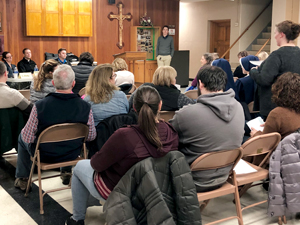
Father Kaup has taught in three of the diocese’s Catholic high schools in his five years as a priest, Dr. Miller was able to speak as a licensed psychologist and mother of eight,
Father Heaslip called on his academic background, and Divis was able to speak on his areas of focus as a counselor and the condition of gender dysphoria.
“The basic theme of tonight is how to navigate parents with helping children understand gender ideology, and the clinical aspect of helping parents understand the clinical condition of gender dysphoria,” Divis said.
In the Diagnostic and Statistical Manual of Mental Disorders (DSM-5) published by the American Psychiatric Association, gender dysphoria is listed as a condition by which clinically significant distress is associated with feeling as though one’s gender at birth is contrary to the one with which they identify.
In contrast to gender dysphoria, Father Heaslip spoke on gender ideology, which he defined as, “the social and political movement that disassociates biological sex from gender identity and often insists that those who do not accept this disassociation are guilty of bigoted motives.”
After an introduction from each of the panelists, attendees had the opportunity to ask questions, either out loud or anonymously. Topics and questions ranged from the significance of the pronoun “they” for an individual, to how to talk to children about someone who may be living a lifestyle not in accordance with the teachings of the Catholic Church. Others asked how to address questions that may come up in the family with children of different ages.
Jeff Knievel, who chairs the St. Teresa School Family Association along with his wife, said the idea for the panel discussion came up in one of their meetings after hearing about the event at St. Joseph School.
“We thought that that would be a great service to our families to be able to address these issues,” he explained.
Sister Mary Agnes, C.K., teaches fifth grade at St. Teresa School and said the event clarified a lot of the vocabulary she hears in the media today, and got insight into questions students are asking their parents at home about these issues.
She also said she was inspired by the sense of goodness of what the school’s families are doing, that they have a desire to help their children find the answers to their questions.
Each panelist expressed their hope that the event was fruitful for parents.
“I think the biggest thing for me is for parents to know that kids want to have these conversations and they want to have them with their parents,”said Dr. Miller.
“Even though we may be uncomfortable as parents having these conversations, we are the best, safest place for our kids to ask these questions, so getting outside of our own discomfort and really letting our kids ask us these tough questions” is important.
“I think one takeaway is really to be able to root ourselves in our identities as sons and daughters of God,” Father Kaup said. He added that people hear that “all the time, however it is everything.”
“It’s so integral to living out a healthy, holy life,” he explained. “So with all these issues, and really, any issues—to be able to connect our kids with God and to actually get them to hear God’s voice and to profess that God actually does speak to me and to help them to know what that sounds like in prayer is the biggest thing, so that they can stay connected to God.”
Father Heaslip added that he hoped all present at the event “walked away with a greater sense that it is good to be male and that it is good to be female, and that the diversity of sexes as male or female is an important aspect of being human, as well as is integral to God’s plan.”
“Likewise,” he added, “I hope those in attendance took away the distinction between gender dysphoria, which is a real psychological condition that needs our compassion, and gender ideology, which is a form of social engineering that we are all called to work against through genuine dialogue, truth, and charity.”
