

Story by Reagan Scott
LINCOLN (SNR) - When Sheri Baumgartner was hired as a part-time art teacher at Cathedral of the Risen Christ School in Lincoln in 2013, she was also able to utilize her background in early education and special education to tutor a student in reading.
Baumgartner could tell that something wasn’t right during the tutoring sessions, but wasn’t sure what that something was. She was also going through a training program in which the instructor talked about dyslexia and its common symptoms. It was then that she realized that the student she was tutoring exhibited signs of dyslexia.
The Mayo Clinic defines dyslexia as a learning disorder that involves difficulty reading due to problems identifying speech sounds and learning how they relate to letter and words (“decoding”). Also called a reading disability, dyslexia affects areas of the brain that process language.
Baumgartner said that in all her teaching education, dyslexia hadn’t been part of the curriculum. In 2016 she was able to go to a week-long training in Phoenix for the Barton Reading and Spelling System, a tutoring system designed to help those with reading, writing and spelling due to dyslexia or other learning disability.
“It really opened my eyes to what dyslexia is and how to recognize it. We even found it in our older students,” Baumgartner said. 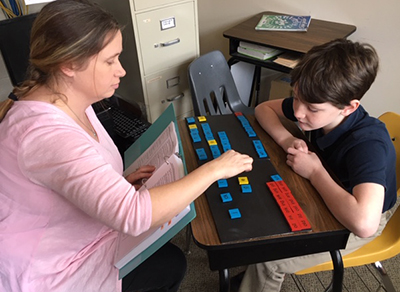
As a result of her training, Baumgartner was able to work with Cathedral administration to develop an early intervention program for dyslexia. Now in its fourth year, between 40 and 50 students participate in the program.
As part of the program, Baumgartner screens each first-grader for weakness in the area of phonemic awareness —that is, hearing, identifying and manipulating individual sounds. Failure to perform well in this area can be a symptom of dyslexia, and those students are offered free tutoring twice a week during the school day.
Younger students have 30-minute tutoring sessions while older students receive tutoring for 45 minutes.
“My goal is to never pull a student out of a special (class) or recess,” Baumgartner said. “Our teachers are good at being workable and flexible.”
Baumgartner does all the training for volunteers, which typically takes places at Cathedral School for a few hours on Saturdays. Currently, 10 to 15 tutors volunteer to work with students, and Baumgartner said she is always looking for more tutors.
Baumgartner said an estimated 15 to 20 percent of the population is thought to have dyslexia to some degree, and that it takes four times more resources to help a student who is diagnosed with dyslexia in fourth grade than would require if they had been diagnosed sooner.
Maria Benes noticed her daughter Gemma’s reading mistakes weren’t consistent when she was in kindergarten. A Google search revealed that Gemma was exhibiting a common symptom of dyslexia, and she was later diagnosed with phonological dyslexia, characterized by a difficulty breaking speech into individual sounds.
Benes heard that Cathedral had a new dyslexia program and enrolled Gemma in the school.
“It means the world to us,” Benes said. “To think that just a few years ago she couldn’t have gone to a Catholic school for this, it’s so amazing to have this opportunity in the diocese where she can continue to go to a Catholic school.”
Since starting at Cathedral, Benes said Gemma has made tremendous progress due to the tutoring she receives from the program and help outside the classroom. Gemma’s tutoring includes multi-sensory learning, using vision and sense of touch to better learn.
“In one year of being in the program she’s made tremendous progress from where she was before. Her confidence has gone way up; last year she didn’t like to go to school,” Benes said.
Gemma, now in the second grade, said that last year, she wasn’t able to read the books other students in her class were reading.
“Now that I go to my new school, I’m getting a lot better and I’m good at reading,” she said.
She also proudly reported that she’s getting 100s on all her spelling tests.
Both Benes and Baumgartner agreed that the more awareness there can be for students with dyslexia, the better.
Baumgartner said, “Regardless of their struggles, all students need to see that there is a place where they belong. If you can bring those struggles to light and address them, they can have that feeling of, ‘I belong here.’ They become much more comfortable in their own skin.”
