

“Something strange is happening – there is a great silence on earth today, a great silence and stillness. The whole earth keeps silence because the King is asleep.”
These are the opening words for the Holy Saturday Divine Office. Although these words are from an ancient homily, they sound as though they were meant for these current days.
As one walks around the stillness of streets in their community or into the darkness of the local parish church on Sunday, there is truly a strange silence these past few weeks.
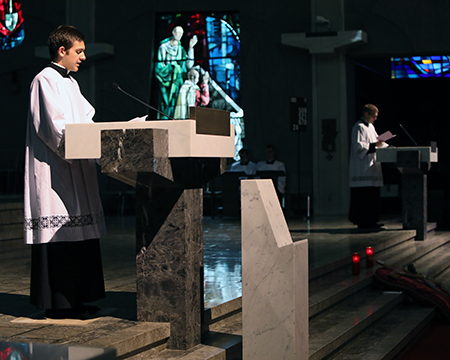 The Holy Saturday Divine Office liturgy known as Tenebrae, which is Latin for ‘gloom,’ ‘shadows’ or ‘darkness’ reminds us that Jesus descended into the darkness of death to search for those who awaited His coming. This liturgy, which goes back to the 9th century, was traditionally held at night. There is a sequence in which 15 candles are snuffed out after each scripture reading to signify the light of Christ extinguished by His death.
Also during this liturgy, the Lamentations of Jeremiah are chanted. They are the saddest melody in the whole range of music. A sadness filled with gloom and darkness because the Jewish temple was destroyed and there was a loss of sacrificial worship.
Although the sadness and silence of no public Masses the past few weeks is novel to us, it has not been so for many Catholics throughout the history of the Church, particularly in East Asia. In his 1979 letter to priests, Saint John Paul II wrote about the desire of the laity to participate in the Mass after many years, even generations, without the Eucharist. He stated the laity would go into their church and place a stole (the vestment that signifies the priestly office) on the altar. The saintly pope described, “They recite all the prayers of the Eucharistic liturgy; and then, at the moment that corresponds to the transubstantiation a deep silence comes down upon them, a silence sometimes broken by a sob… so ardently do they desire to hear the words that only the lips of a Priest can efficaciously utter.”
These Christians lived a perpetual Holy Saturday. Holy Saturday is a day in which the Holy Sacrifice of the Mass is not celebrated. This is done in order to commemorate the death and descent into the darkness of Christ.
Brothers and sisters, currently we find ourselves in the dark silent tomb of Jesus, as if we are going through an extensive Holy Saturday. We lament, like the Prophet Jeremiah, that our streets and churches seem silent. However, he instructs, “It is good to hope in silence for the saving help of the Lord” (Lamentations 3:26).
Although the word lamentation means a passionate expression of grief and sorrow, the book of Lamentations actually is a message of hope. Our hope lies in the knowledge that the King is only asleep but will be awakened anew in our culture.
Jesus Christ is the light of the world which dispels our darkness. Now is the time to find ourselves hoping in silence and waiting in darkness for the Easter light of Christ to come just as Zachariah anticipated, “When the day shall dawn upon us from on high to give light to those who sit in darkness and in the shadow of death” (Luke 1:78b-79). The Savior has come to search for us in the darkness of today so we may have the light of eternity for tomorrow.
May our sorrowful silence soon be turned into the exultations of Paschal joy as the Easter Exsultet proclaims, “Be glad, let earth be glad, as glory floods her, ablaze with the light form her eternal King, let all corners of the earth be glad, knowing an end to gloom and darkness…. Christ your Son, who, coming back from death’s domain, has shed His peaceful light on humanity and lives and reigns for ever and ever.”
Father Eric Clark is in residence at the Cathedral of the Risen Christ in Lincoln. He serves as diocesan master of ceremonies, teaches at Pius X High School, is director of the Charity and Stewardship Appeal and Bishop’s Appeal for Vocations, co-chaplain of the Frassati Young Adult Group, director of the diocesan acolyte and lector program and a member of the Diocesan Liturgical Commission.
