

What it’s like to be a priest in the Diocese of Lincoln when the presence of congregation is not possible
Story by Abbey Hugo
LINCOLN (SNR) - It’s been over a month since Masses were suspended in the Lincoln Diocese, and this time has been an adjustment for priests.
While for some, it’s been a welcomed time of retreat, for all, it’s been a time of physical separation from the people they’re meant to serve.
Preparing the necessary technologies makes every task take a little extra time, meaning that despite removal of some responsibilities, many priests still have busy schedules.
Father Brian Connor, pastor at North American Martyrs Parish in Lincoln, started his first streamed Mass two hours late due to technical issues. Since then, things have been going much smoother, but he said relying on technology has been difficult because it is unfamiliar and he favors real-life interaction.
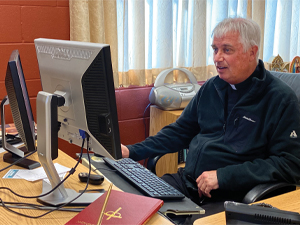
“The learning curve has been steep,” Connor said. “But since we don’t have other things to do, we have a chance to learn.”
When social distancing restrictions were first put into place, parishes looked for ways to continue to connect with parishioners. In some parishes, they increased communication through phone, mail or email messages, sending out homilies, prayers, letters and other updates. Some began sharing daily videos. Each pastor was permitted to make the best decision for his own parish’s needs.
Many priests didn’t intend to stream their Masses on internet platforms. Most originally opted to simply celebrate private Masses, since so many online Mass sources are already available, easily accessible and in some cases, even familiar to parishioners.
“You can watch two dozen different broadcasts. Why do they want to see my parish put out a Mass?” Connor relayed from conversations he had with parishioners. “Well, they said, ‘We want to see our church and our priest.’ ... So, we did it.”
Father Harlan Waskowiak of St. Joseph Parish in Geneva agreed that for his parish, it “just didn’t feel right” to ask parishioners to ‘go’ to Mass someplace else when he was able to livestream Masses, so he too, jumped into the fray.
Father Luke Fleck, assistant pastor at North American Martyrs Parish, said celebrating the first Mass in their now-empty church was “weird and eerie.”
Father James Morin, assistant pastor at St. Cecilia Church in Hastings, described his first day celebrating Mass for himself as heartbreaking.
“The first day I had a private Mass because that’s when it started being mandatory, I remember being kind of choked up, just hurt by the fact that I knew people wanted to be there,” Morin said. “It was really hard to look out into that empty church. Really hard.”
When Morin began streaming Mass the following day, he said it was a relief to be with his parishioners, even if not physically.
“The second day, when I set up for Mass... it was really quite beautiful to look at that and all of a sudden see the numbers of people participating in that Mass, being united in that Mass,” Morin said. “It was not the same as being physically there, obviously, but there was great sense of peace and contentment that I received knowing that the people of God were still united.”
Morin emphasized that there is never a truly private Mass, as the angels and saints are always present. He said, in many ways, offering an online Mass is not that different, because even in an ordinary Mass, the priest is always speaking to God more than to the people.
Preaching, however, is much different when the congregation isn’t physically present because the priest is unable to gauge reactions.
Holy Communion is also different, as no one is there to receive the Holy Eucharist. Father Matthew Zimmer at Ss. Mary and Joseph Parish in Valparaiso, said that is the hardest part of adjusting to the coronavirus restrictions.
“That’s what we were ordained to do: be a servant of the people of God, to bring Christ to the people of God. ... Not being able to give people the opportunity to receive our Lord in the Eucharist is hard,” Zimmer said. “I hate having to tell people, ‘I can’t give you communion.’ That is just so antithetical to what the priesthood is.”
Zimmer said every decision he makes is done to ensure people are able to remain connected to the parish and to the Lord. That is why priests throughout the diocese have chosen to stream the sacraments, become more active on the internet and offer unique opportunities for grace, like walk-up or drive-thru confessions, or parking-lot Easter blessings.
Though this has been a time of suffering and separation from the Eucharist, many priests said they believe good will come from it. One gift may be a stronger desire for the Lord and the sacraments, Morin said.
“The more faith in and gratitude you bring to the Mass, the more effective it is going to be. So for people to go through a—I guess you could call it, a desert time, where they miss the sacraments—God can use that to show us that it really is a gift and that’s it’s something that we really count on,” Morin said. “So when we can come back, they’ll be more able to receive the gift rather than it just be routine.”
This time has helped priests garner a deeper appreciation as well.
“I think it reaffirmed in my heart how important it is to be a priest for the people, not just be a priest. The priesthood isn’t about self; it’s about others and the service of others,” Zimmer said. “We shouldn’t take the people for granted any more than the people should take the Eucharist for granted.”
