

(CNA/SNR) - Nebraska Governor Pete Ricketts signed a ban on dilation and evacuation abortions into law at a ceremony Aug. 15, after the bill passed the state legislature Aug. 13.
Lauren Garcia, communication specialist for the Nebraska Catholic Conference (NCC), one of the main organizations supporting the legislation, told CNA they were happy Ricketts signed the bill into law right away, and in a public setting, because only five days remained for the governor to do so. 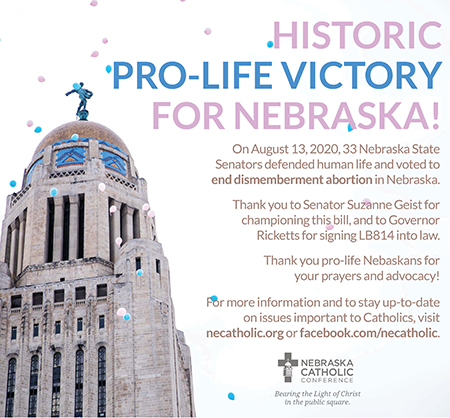
“He could have done something private, but we wanted to make this a celebration, because this is the most significant pro-life legislation that’s been passed since our 20-week ban 10 years ago,” Garcia told CNA.
“Even though we’re in the midst of COVID and all that, we thought it would be a good opportunity for people to come out to an outside event, with plenty of safe social distance, just to celebrate this big accomplishment.”
D&E abortions, commonly known as dismemberment abortions, are typically done in the second trimester of pregnancy and result in the dismemberment of an unborn child.
State Sen. Suzanne Geist (District 25-Lincoln) introduced LB814 in January. Twenty-one state senators joined the legislation as co-sponsors upon its introduction, with another four joining later.
Ricketts came out in strong support of the measure upon its introduction.
“This barbaric procedure literally rips apart a preborn child, piece by piece, to destroy the life of the baby. I urge Senators to act quickly to end this horrendous form of abortion,” Ricketts said.
“Protecting the dignity of life has been, is, and will remain a core value of what it means to be a Nebraskan. I invite you to join us in affirming the preciousness of unborn life and in opposing the brutal practices used to end it,” he said.
Marion Miner, associate director for Pro-Life and Family at the NCC, spoke on the passage.
“Life has won today in Nebraska. By ending dismemberment abortion, our state has demonstrated and reaffirmed its deep respect for the human dignity of preborn children and their mothers,” he said. “Passing LB814 will again establish Nebraska as a national leader in the cause for life. We are committed to affirming the humanity of every single life and making every form of abortion unthinkable.”
The bill specifically bans the use of clamps, forceps, or similar instruments in abortion procedures.
NCC, Nebraska Family Alliance, and Nebraska Right to Life co-hosted the signing event. Geist, the sponsor of the legislation, was also in attendance at the signing.
The measure passed its first vote in Nebraska’s unicameral legislature Aug. 5 by a 34-9 vote. Multiple senators attempted to filibuster the bill at that point, but the bill earned the 33 votes necessary to break the filibuster as Geist moved to invoke cloture.
On Aug. 13, the final vote stood at 33-8. State Sen. Carol Blood (3-Bellevue) abstained from voting after saying she had concerns that the ban would not apply if suction is used to remove pieces of a fetus, nor would it apply if the fetus was killed before being removed, a process that Blood called equally horrific, according to the Omaha World-Herald.
According to the pro-abortion Guttmacher Institute, to date 11 states have passed bans on dilation and evacuation abortions, though because of courts blocking the measures, the bans in two states, Mississippi and West Virginia, are currently in effect; and an appeals court recently ruled to allow Arkansas’ D&E ban to come into effect Aug. 28.
Opponents of the Nebraska bill have maintained that courts will likely deem the legislation unconstitutional under Roe v. Wade.
However, Nebraska Attorney General Doug Peterson recently released an opinion, at the request of State Sen. Ernie Chambers, concluding that LB814 is “likely constitutional” because it “does not appear that it will impose a substantial obstacle on abortion access in Nebraska.”
The U.S. Court of Appeals for the Eighth Circuit ruled Aug. 7 to reinstate the 2017 Arkansas laws. They can take effect Aug. 28, although they may still face legal challenges. The laws include a ban on abortions based solely on the sex of the baby, and two regulations on the preservation and disposal of tissue from aborted babies, as well as legislation prohibiting D&E abortions.
A district judge had blocked the rules following a legal challenge from the ACLU and the Center for Reproductive Rights on behalf of a local abortion doctor.
A federal judge in July 2019 blocked Indiana’s D&E ban from taking effect.
