

Q. Can a Catholic vote for a pro-abortion candidate?
A. This is an important question we often receive during an election cycle—thanks for asking it!
Catholics have never had and never will have the luxury of voting for a perfect candidate or party. We must judge between imperfect candidates with a conscience that is well-formed by reason and Church teaching. An unformed or poorly formed conscience, on the other hand, leads to erroneous judgments for which we are morally responsible.
“A good Catholic,” Pope Francis said in a homily in September 2013, “meddles in politics, offering the best of himself.” Every Catholic should work in common with others to pursue what is good for persons, families, communities, and the nation. Catholics have much to offer in building up the common good, and it would be unconscionable for us to abandon or neglect the field of politics.
The obligation to oppose abortion and other intrinsic evils
In their teaching document on political responsibility (Forming Consciences for Faithful Citizenship), the U.S. bishops have reminded Catholics of their obligation to pursue the good and discourage and prevent evil. They also reiterate that abortion is intrinsically evil, and intrinsic evils “must always be rejected and opposed and must never be supported or condoned” (no. 22). 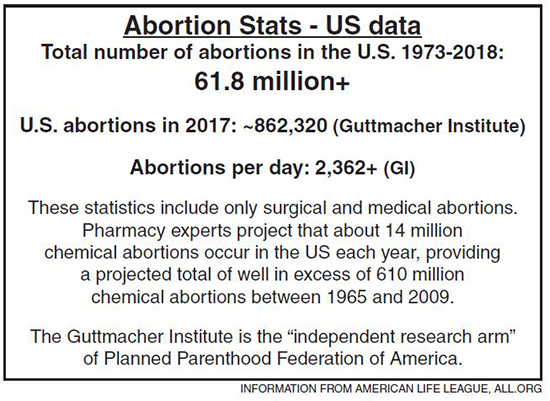
Abortion is not the only intrinsically evil action, nor the only evil that violates human life or weakens its protection. But Forming Consciences teaches that “[t]he threat of abortion remains our preeminent priority because it directly attacks life itself, because it takes place within the sanctuary of the family, and because of the number of lives destroyed” (p. 6).
Simply stated, “[a] Catholic cannot vote for a candidate who favors an intrinsically evil act … if the voter’s intent is to support that position” (no. 34). And, according to the Vatican’s Congregation for the Doctrine of the Faith, “[a] Catholic would be guilty of formal cooperation in evil… if he were to deliberately vote for a candidate precisely because of the candidate’s permissive stand on abortion.” This can never be justified.
The hard cases: where both candidates support intrinsically evil positions
There are circumstances, however, where both candidates support intrinsically evil positions. In such cases, no Catholic is morally required to support either candidate. One may abstain from voting or cast a third-party vote in good conscience.
There are even circumstances where a Catholic could vote for a pro-abortion candidate whose views on abortion he or she did not share—for “truly grave moral reasons” (no. 35).
If, for example, in the voter’s good-faith, conscientious judgment, the “pro-life” candidate’s positions on other foundational issues are so gravely evil that the balance of those evils outweighs the other candidate’s support for abortion, this may constitute a “truly grave moral reason” that could justify support of the pro-abortion candidate. This judgment may be further supported if that candidate is more likely to pursue policies promoting other authentic human goods, such as marriage and family life, religious liberty, an end to unjust warfare, and educational opportunity for the poor. However, given the right to life’s preeminence and status as the necessary foundation for all other human rights, this is a very difficult case to make.
As Pope St. John Paul II reminds us in Christifideles Laici, “the common outcry which is justly made on behalf of human rights... is false and illusory if the right to life, the most basic and fundamental right and the condition for all other personal rights, is not defended with maximum determination.”
Deciding how to cast our votes in certain elections can be difficult and even stressful. Our political responsibility is no light matter. But elections are also opportunities to continue our formation of conscience in accord with the Church, discern the difficult choices that face us, and turn to prayer so that we may come to peace with our decisions. As always, let us call upon the Holy Spirit for wisdom.
Write to Ask the Register using our online form, or write to 3700 Sheridan Blvd., Suite 10, Lincoln NE 68506-6100. All questions are subject to editing. Editors decide which questions to publish. Personal questions cannot be answered. People with such questions are urged to take them to their nearest Catholic priest.
