

Written above the door leading into Ron Sack’s den is the quote, “When a person dies, a library is lost.” He uses that quote as inspiration.
The quote is based on an old African proverb, but Sack heard it again while visiting with historian Alex Meyer of Snyder, Nebraska.
“It’s so true,” explained Sack. “My grandparents recorded as much history as they could over their lifetimes in order that it could be passed down for future generations.”
That type of vision is what is inspiring both Ron Sack and Chase Becker of Omaha to tackle their most ambitious project to date—the history of the built environment of Catholic parishes in Nebraska.
Both Sack and Becker have strong ties to their respective hometown communities. Sack grew up in Saint Paul and still considers Ss. Peter and Paul his home parish. Becker grew up in Exeter and calls St. Stephen Parish his home.
Since childhood, the two have collected photographs, artifacts, stories, and records of Nebraska Catholic parishes which also includes schools, convents, rectories, hospitals, and cemeteries.
Their collections are long and extensive.
“As an example, both Ron and I have well over a thousand historic images in our photography libraries,” Becker stated. “Most are from the early 1900s.”
The two met at a postcard show in Omaha several years ago. Over a period of time, conversations started to include writing a book and telling the story of the Catholic parishes in Nebraska—both past and present.
“There has never been a comprehensive book documenting parishes in all three Nebraska dioceses,” Becker said. “We felt these stories and photographs need to be published in one book.”
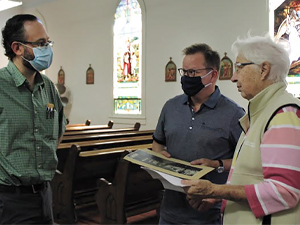
When the two started to go on the road to research various parishes throughout the state, both thought they needed a good name to call themselves—thus, “The Nebraska Church Guys” was born.
“Our name had to be a name that was simple and memorable,” Sack noted.
Sack’s family traces their Nebraska roots to such Howard County Catholic parishes as Saint Paul, Saint Libory, Farwell, Warsaw, and Paplin. His professional background includes extensive advertising and design experience at agencies in both Lincoln and Omaha. Ron considers the Nebraska Sesquicentennial logo for Nebraska’s 150th statehood anniversary as one of the favorites in his design career.
“It was an honor to work on something for 1.8 million Nebraskans,” he said.
Besides Exeter, Becker’s family roots are in Fillmore County. Becker studied at St. Gregory the Great Seminary in Seward, and later studied at St. John School of Theology and Seminary in Minnesota. Currently, he is the liturgy coordinator at Creighton Campus Ministry at St. John Church on the Creighton University campus.
Both have dabbled with writing over the years. Sack, along with Marion Bahensky and the Howard County Historical Society in Saint Paul, published the book “Entering Howard County.” The book went on to win Best Non-Fiction Book at the Nebraska Book Awards, sponsored by the Nebraska Center for the Book. It also won a merit award from the American Association For State and Local History which is headquartered in Nashville, Tenn.
Sack also self-published a book on Howard County architecture titled “My Gift to Howard County.” Becker self-published a book on the Church of the Visitation in O’Connor. The book also highlights the architecture of James Henry Craddock (1856-1932), a well-known Nebraska architect of Catholic churches.
One of the first tasks the duo tackled together was documenting every Catholic parish that ever existed in Nebraska. From there, the two designed several maps that outlined all official Catholic parishes in the three Nebraska dioceses. At last count, there were more than 500 parishes that have been established at one time or another. They also created maps highlighting the locations of Catholic schools, colleges, hospitals, and other relevant data.
Over the years, the two have visited most of the Catholic sites throughout the state. Every month, they continue to take road trips across Nebraska and do additional research.
“These road trips are so valuable for the book,” Becker explained. “We not only get to meet the parishioners, but we also get to learn their stories and what makes their parish unique.”
Road trips will be part of their monthly routine for the next three years or so.
The duo will be in the Diocese of Grand Island this month, and will launch their next Lincoln Diocese road trip Nov. 13-15 in Fillmore County.
Besides maps, photographs, data, and parish histories, some sections will highlight those areas of Catholic history that are unique to Nebraska.
“One of the big Nebraska promoters for the people of Poland was a man by the name of John Barzynski. He helped settle thousands of acres of land in Howard, Sherman, and Valley Counties,” recalled Sack. “Barzynski and those communities will be the focus of one section in the book.”
Some of the other areas that will have additional focus in the book will include the Irish Colonization of Greeley County; the advancement of Father Flanagan’s sainthood cause; the combination Catholic/Protestant Church in Keystone; Mid-Century Modern churches including St. Luke’s in Ogallala; stories of the Catholic immigrants from the early 1900s and the Catholic immigrants of today; the vision of Bishop John J. Sullivan, Diocese of Grand Island; the relationship between liturgy and architecture.
The two have been posting images of their recent journeys on their facebook page, The Nebraska Church Guys. They invite everyone to view and engage in the conversations on their page.
“I’m a lover of architecture and design,” concluded Sack. “Gothic, Romanesque, Mid-Century, and Contemporary architecture all add grace notes of beauty, variety and visual texture to our communities. All have stories to tell.”
To contact The Nebraska Church Guys, email Ron Sack at This email address is being protected from spambots. You need JavaScript enabled to view it. or call 402-440-0823; or email Chase Becker at This email address is being protected from spambots. You need JavaScript enabled to view it. or call 402-363-2982.
