

Story by Randy Porter
LINCOLN (SNR) – St. Andrew Dung-Lac (1795-1839), a Vietnamese Roman Catholic priest, was one of 117 people martyred in Vietnam between 1820 and 1862.
He was executed by beheading Dec. 21, 1839 during the reign of Minh Mạng. Born Tran An Dung, he took the name Andrew at his baptism. Born to pagan parents, Dung-Lac was a Catholic convert.
The saint was ordained a priest March 15, 1823. During severe and unending persecution, Andrew Dung changed his name to Lạc to avoid capture, and thus he is memorialized as Andrew Dung-Lạc.
His memorial is Nov. 24. Catholics also observe all the Vietnamese Martyrs of the 17th, 18th, and 19th centuries (1625–1886) on that date.
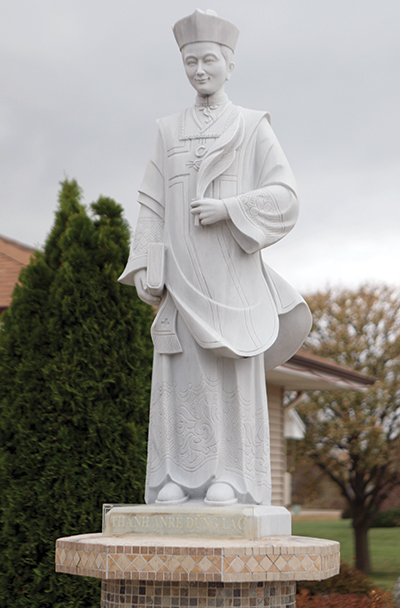 Father Andrew Dung-Lạc alone is named on this feast. The brutal and gruesome torture he endured rather than renounce Christ typifies those of his co-martyrs. Andrew’s name often represents the entire group.
All 117 Vietnamese martyrs were canonized June 19, 1988. The Vatican estimates the number of Vietnamese martyrs at between 130,000 and 300,000. John Paul II decided to canonize those whose names are known and unknown, giving them a single feast day.
A number of these saints have another memorial, as they were beatified and on the calendar prior to the canonization of the group.
The group of 117 includes 96 Vietnamese, 11 Spaniards, and 10 French. Eight of the group were bishops, 50 were priests and 59 were lay Catholics, including a 9-year-old child.
Their torture is considered by the Vatican to be among the worst in the history of Christian martyrdom. Members of the companions group gave their lives for Christ and received beatification on four different occasions between 1900 and 1951.
Faithful Vietnamese
Christianity came to Vietnam through the Portuguese. Jesuits opened the first permanent mission at Da Nang in 1615. They ministered to Japanese Catholics who had been driven from Japan.
Severe persecutions were launched at least three times in the 19th century. During the six decades after 1820, between 100,000 and 300,000 Catholics were killed or subjected to great hardship.
Foreign missionaries martyred in the first wave included priests of the Paris Mission Society, and Spanish Dominican priests and tertiaries.
In 1832, Emperor Minh-Mang banned all foreign missionaries, and tried to make all Vietnamese deny their faith by trampling on a crucifix. Hiding places were offered in homes of the faithful. Persecution broke out again in 1847 when the emperor suspected foreign missionaries and Vietnamese Christians of sympathizing with a rebellion led by of one of his sons.
The last of the martyrs, 17 laypersons, one of them a 9-year-old, were executed in 1862. That year a treaty with France guaranteed religious freedom to Catholics, but it did not stop all persecution.
By 1954, there were more than 1 million Catholics—about 7 percent of the population—in the north. Buddhists represented about 60 percent. Persistent persecution forced some 670,000 Catholics to abandon lands, homes and possessions and flee to the south.
In 1964, 833,000 Catholics remained in the north, but many were in prison. In the south, Catholics enjoyed the first decade of religious freedom in centuries, their numbers swelled by refugees.
During the Vietnamese war, Catholics again suffered in the north, and again moved to the south in great numbers. Now reunited, the entire country is under Communist rule.
Today, Vietnam has more than 2,000 parishes and nearly 3,000 priests. Its population is about 8 percent Catholic. Their faith survived—even thrived—due to the exemplary witness of so many staunch disciples such as St. Andrew and companions.
Related item: Direct relative tells story
Related item: Pandemic alters usual events
