

By Randy Porter
CAMBRIDGE (SNR) - There will be more color in St. John the Baptist Catholic Church in Cambridge this Lent.
A well-known artist who also is a parishioner at St. John the Baptist completed a beautification project of the stations of the cross there in December.
Sondra Jonson, who owns and operates S. L. Jonson Studios, added mosaic backgrounds to the stations using tens of thousands of pieces of colored glass and other materials.
The 14th station was hung on the feast of Our Lady of Guadalupe, Saturday, Dec. 12.
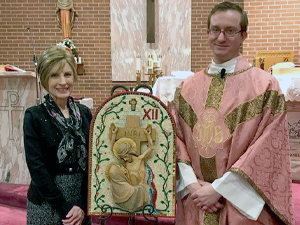 The stations were dedicated and blessed at a Saturday vigil Mass. That day also marked Gaudete Sunday when the priest wears rose-colored vestments in anticipation of the joy of Christmas.
“It was indeed a joyous occasion,” said pastor Father Kenneth Wehrs.
The idea of refurbishing the stations of the cross was something he thought of nearly the first time he visited the church a few years ago, he said. While the wooden carvings are beautiful, they are hung on a wooden wall, making them difficult to see.
He thought different backgrounds for the carvings would make them stand out. Last year after celebrating stations of the cross liturgies, Wehrs visited Jonson, a talented sculptor and artist, about the idea. He knew she had done mosaic work for a church, and thought that would be a good solution for the stations.
The only design choice he made was that a small cross and the Roman numeral of each station be placed near the top of the background.
“A week or so later, we went into lockdown (due to the COVID-19 pandemic),” Father Wehrs said.
“Those two months when people were not allowed to attend church made me think about how our parish was going through its own ‘stations of the cross,’” Wehrs said. “We were separated from each other and from receiving Our Lord at Mass.”
To him, it was fitting to have a set of refurbished stations as a reminder of that time away from Jesus, he said. Jonson started the project in late April and completed the first panel three weeks later on the Feast of the Ascension. She completed the remaining stations one by one nearly every two weeks.
Providentially, various days on which the stations were hung were also a Marian feast day.
The parishioners love the new stations, Wehrs said. There are little details to them that make each one unique. They really catch the eye — they sparkle even with the lights off.
“Hopefully, we will have more attendance at our Friday stations of the cross this Lent because of them,” he said.
The next step is adding spotlights for each of them. The walls on which they hang do not get much light.
While St. John the Baptist is the oldest church in town, its current building was constructed in the 1970s, Jonson said.
The wood-carved stations were understated in size, style and color, she said. Father Wehrs knew she had experience in liturgical mosaics, and asked if she could create backgrounds to enhance the stations.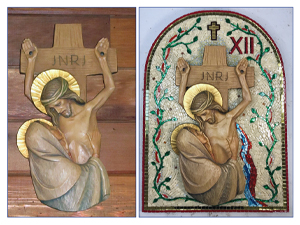
The new stations bring light and color to the dark wooden walls, Jonson said, and the mosaics have brought more life into the stations.
“The wood carvings have simple beauty, and bordered by the bright colors and lively patterns of the tiles, the carvings become eloquent.”
Each of the stations is a stirring scene from the lives of Jesus and Mary and offers a focus for meditation and prayer.
Jonson presented several prototypes and color schemes to Wehrs. She shared a description of the design he ultimately approved:
“Each station was mounted on an 18- by 24-inch arch-shaped panel, blanketed with a field of glass tiles in shades of ivory.
“The ivory colors are accented by a dark green flowing vine in metallic glass, threaded with a red cord of vitreous glass. Each panel is framed by a rim of red tiles against a border of gold mirror tiles. The ivory tiles are placed in curving patterns, following the classic Andamento mosaic technique. The arched shape of the panels reflects existing arched niches in the church, and also suggests traditional clerestory windows,” she continued.
Even the colors are significant, not just separating the wood carvings from the wood walls: “The green vine symbolizes Jesus as the source of life, and the red cord signifies His saving blood,” Johnson explained.
Each panel features a 24-karat gold cross and a Roman numeral formed in red tiles. More than half of the panels feature additional symbols to illustrate that station’s theme, she said.
“For example, in the first station, the water of Pilate’s hand-washing overflows in a falling stream of blue glass. In the fourth station, Jesus meets His mother and two red intertwined hearts appear. In the 14th station, the Lord’s burial is silhouetted against a second archway filled with silver mirror tiles.”
The glass tiles have varying degrees of reflectivity, which give all the stations a shimmering effect that changes with the light and the viewer’s perspective, Jonson described.
Each panel bears about 2,000 tile pieces and required 50 to 60 hours to create. The tiles are from outlets across the U.S. and the Netherlands.
“I’m always surprised by how intensive and time-consuming mosaic work is,” Jonson said.
“This one was particularly arduous because I used the curving patterns with the background tiles,” she said. “There’s no way to do an intricate mosaic quickly. Yet, I think the beautiful effect created by the tile patterns, colors and textures is worth all the time and effort it takes to create.”
Artists like to take credit for their work and think of it as original and distinctive, Jonson said. But in liturgical art, and especially a project in which she was hired to enhance another artist’s work, artists learn to be servants rather than masters of their creative labor.
“The stations will be speaking to worshipers in St. John’s long after I’m gone,” she said.
The project is counter-cultural to today’s art, but in keeping with the history of Christian art to serve the Gospel, not the ego of the artist, Jonson said. The early art of the church, created by hundreds of unknown artists, was a powerful invitation for her to the faith.
“Although the stations project took nearly a year of my working life, all my attention and patience, I feel blessed to be part of that noble tradition of putting my skills and abilities at the service of Christ’s church,” she said.
Liturgical projects meaningful to widely known artist, parishioner
By Randy Porter
CAMBRIDGE (SNR) - A parishioner at St. John the Baptist Catholic Church, Sondra Jonson of Cambridge, sees the whole world as art.
“I started dreaming of a career in art in first grade,” said the noted sculptor and artist who created new mosaic backgrounds for the stations of the cross. “The school system I attended outside Philadelphia had excellent art teachers.”
By junior high, Jonson also was taking private art classes and classes at the Philadelphia College of Art. She majored in art at Bryn Mawr College, then studied classical sculpture at Frudakis Academy of Art in Philadelphia. After graduating college, she converted to Christianity from Judaism.
“Several years later I became a Catholic,” she said. “Liturgical art projects are especially meaningful and gratifying to me because they allow me to use my training, skills and love of art to share in God’s message of love.”
Jonson’s career includes various professional achievements.
She has created more than 100 large sculptures for sites throughout the U.S. and in Canada; however, her first life-size sculptures were done for the Diocese of Lincoln. They include Pope St. John XXIII for the diocesan center and her pro-life sculpture, “Rachel Weeping for Her Children” for the Shrine of Our Lady of Fatima.
Now, she is working on a sculpture of the grieving father, “A Father’s Tears,” to be a companion piece to “Rachel Weeping.”
“One of the small pieces I’m most grateful to have done is the Tabernacle door for the church at Our Lady of Salette Shrine in Massachusetts,” Jonson said. “My largest monument is the fallen soldier memorial, “Going Home,” at the Veterans Memorial Park in Sioux Falls, SD.
