

Q. What is supposed to be done when a consecrated host falls to the ground?
A. Thank you for your question. I preface the answer to your question by stating our Catholic belief in the Real Presence of Christ in the Eucharist. This means we believe that through the words of consecration by the priest, bread and wine change substantially in Christ’s body, blood, soul and divinity. Christ’s total gift of self that began with his incarnation, came to its culmination on the cross where he dies for us, continues to be present to us under the appearance of simple bread and wine. The whole of Christ is present under the consecrated species of bread and wine, and, thus, must be treated with respect.
One of the gifts of the Holy Spirit that is infused within us at baptism, and sealed in the sacrament of Confirmation is reverence or piety. Reverence is giving God his due worship. The gift of reverence should be expressed in our participation at Mass, where we encounter the Lord in a profound way.
We live out the gift of reverence in how we treat our Eucharistic Lord. We genuflect to Jesus who is reposed in the tabernacle, or perhaps exposed in a monstrance for Eucharistic adoration. As we approach Holy Communion we make a gesture of reverence: a bow, genuflection, or receive while kneeling.
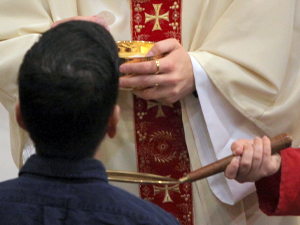 We do all that we can to protect the consecrated host throughout the Mass. Ministers of Holy Communion purify their fingers after distributing Holy Communion. Altar servers hold patens, which are small plates held by the server during Communion. The paten is placed under the chin or the hands of the communicant to ensure that the host, or particles of the host, do not fall to the ground. The patens are then purified over the chalice by the priest or deacon, and the chalice is purified with water, which is drunk by the priest or deacon.
Inevitably, despite the use of patens, and being cautious, consecrated hosts still fall to the ground. At times, this may be done due to apathy or carelessness, but usually it’s an accident which causes embarrassment to the communicant.
The Church gives some direction when the misfortune of a dropped host occurs. The General Instruction of the Roman Missal (GIRM) gives norms which instruct how the Mass is to be celebrated. The GIRM addresses the question of a fallen host: “If a host or any particle should fall, it is to be picked up reverently. If any of the Precious Blood is spilled, the area where the spill occurred should be washed with water, and this water should then be poured into the sacrarium in the sacristy” (GIRM 280).
If the host is not soiled, it may be consumed by the minister of Holy Communion or the minister. If the dropped host is severely soiled, it may be dissolved in water, the contents of which are poured down the sacrarium, a special sink in the sacristy of the church which goes directly into the ground. The spot where the host was dropped may be marked (perhaps by a cloth purificator) and any visible particles diluted with water.
This question was answered by a priest of the Diocese of Lincoln. Write to Ask the Register using our online form, or write to 3700 Sheridan Blvd., Suite 10, Lincoln NE 68506-6100. All questions are subject to editing. Editors decide which questions to publish. Personal questions cannot be answered. People with such questions are urged to take them to their nearest Catholic priest.
