

Special to the Register by Father Kenneth Borowiak
PAUL (SNR) – In a chance meeting a century and a half ago, St. Joseph Parish in Paul was established.
In the afternoon of August 19, 1871 a horse with a rider came slowly toward a little house in the peak of a hill south and west of Nebraska City. Great was the subsequent joy in that little house, for the rider proved to be none other than Father Anthony Kasper, a Benedictine missionary priest and a close friend of Joseph and Catherine Durr, whose marriage he had witnessed four years before in Minnesota. The Durrs were the residents of that small house.
Word was sent to mothers, fathers, brothers and sisters and neighbors that Father Kasper was at the Durrs’ home and they all came at once.
After hours of visiting and reminiscing that afternoon, it was decided that Father Kasper would celebrate Mass for all of the Catholics in the area the following day.
Thus, the Eucharist was the inauguration of St. Joseph Parish in Paul. Perhaps those pioneer Catholics did not realize that their participation at Mass that late August morning in 1871 would be the nucleus of the parish which is still the focal point of the Paul community.
One hundred fifty years later, this Aug. 20, current pastor Father Stephen Graeve will celebrate the Eucharist to mark that solemn occasion. There will be many similarities. Graeve’s Mass will be celebrated at 5:30 p.m. on the same farm first settled by Joseph and Catherine Durr, a quarter mile northeast of St. Joseph Church on 56th Road.
Father Graeve said it is important for parishes to celebrate milestones in their history.
“This Mass is for all parishioners and friends of St. Joseph, as well as our mission parish St. Bernard in Julian.” He said. “August 20th happens to be the feast of St. Bernard, so we’re doing a combined celebration.”
Parishioners have been looking forward to the celebration.
“Ours is a parish family,” longtime member Dale Kreifels said. “My grandfather Martin Kreifels hauled bricks from the railroad station in Paul to build the church. I am proud to be a fourth-generation parish family member.
“It is 150 years since the first Mass was celebrated here and it’s important to celebrate as a family. It’s what families do,” he added.
History of St. Joseph Parish
Descendants of the families who settled the Paul parish more than 150 years ago are members today. The names include Ballermans, Carlin, Heng, Houlihan, Komma, Kreifels, Reblin, Ress, Schmitz and Sullivan.
One family, Joseph and Catherine Durr, began to think of moving to southeast Nebraska in 1868. Catherine’s father Peter Schmitz wrote to his daughter and son-in-law who at the time were living in Minnesota and encouraged them to move to southern Otoe County. The young couple was barely making a living with Joseph working as a teacher and he and his wife caring for their young daughter. After months of discussion they decided that when the current school year was over, they would load up a covered wagon and be on their way to Nebraska.
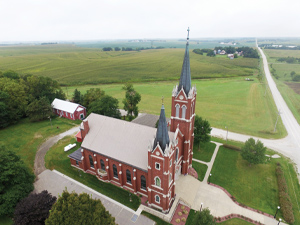 They bought a small plot of land on one of the highest points in Otoe County and by 1869 they found themselves in a small, two-room house with a tiny loft, located virtually where the current St. Joseph Church is. The parish campus sits on a hill overlooking the surrounding farmland for miles. The cemetery is immediately across the gravel road east from the front doors of the church.
The Durrs, like many other Catholic settlers, had a 10-mile one-way trip across the trackless, treeless prairie to the nearest church, St. Benedict at Kearney Hill near Nebraska City. Often the trip had to be made in an open lumber wagon as there were no spring seats nor buggies, which were considered luxuries.
Despite the hardships, the early Catholic pioneers made the trip every time they could. The 20-mile round trip pilgrimage to St. Benedict Church was kept up for two years.
When Father Kasper arrived the afternoon of August 19, 1871, his visit sparked a conversation that ultimately resulted in the establishment of St. Joseph Parish, Paul.
After Father Kasper visited with the Durrs, word soon went out to neighboring Catholics that he was there. Father Kasper planned to celebrate Mass the next day. Young neighbor boys on foot and horseback acted as messengers to neighboring Catholic families. The glad news was spread from house to house throughout the settlement. The next morning, before dawn, local Catholics were astir anticipating being part of the celebration of the Mass.
An altar was improvised from two old barrels and a board. A fine linen tablecloth, a cherished wedding gift, was draped over the board as well as lace curtains from the Durr home.
From Father Kasper’s saddlebags came his chalice, vestments, candles, a crucifix and holy pictures. The makeshift altar was an element of beauty to the settlers’ eyes.
Soon lumber wagons began pulling into the farmyard. Young and old all entered the little house to lay the foundation of what is now St. Joseph Parish in Paul.
After that Mass, the parish record begins with the baptism of Mary Catherine Durr, daughter of Joseph and Catherine. From this time on Father Emmanuel Hartig O.S.B., another pioneer priest and Father Kasper made regular visits to the mission.
The first St. Joseph Church was a 24’ x 40’ wood frame church completed in 1879 at a cost of $1,150. At the time St. Joseph parish consisted of 34 German families and five Irish families. A rectory was constructed in 1889 for $950. The parish received its first resident pastor in 1890. A two-story Catholic school was constructed during the pastorate of Father Aloys Hahn (1894 -1904).
The current church was dedicated by Bishop J. Henry Tihen May 30, 1916. The 125’ x 59’ church has two towers, one 130 feet high, the other 60 feet high. The art glass windows were imported from Munich, Germany. The cost of the new Gothic church with furnishings was $35,000.
A number of religious vocations have come from St. Joseph Parish: one diocesan priest, two Ursuline Sisters, seven Franciscan Sisters and one Sister of St. Joseph.
