

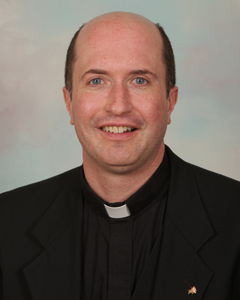
by Father David Oldham
I have been teaching in Catholic Schools for all 18 years of my priesthood. If you would have told me back when I when I was ordained that I would be teaching for this long, I would have said you were crazy. Since then, I have grown to enjoy teaching. I see that almost everything in a priest’s life is an opportunity to teach. Years, and of course God’s grace, have helped me to enjoy this part of ministry.
A question a priest inevitably gets is: how did you know you were supposed to be a priest? (Sometimes the question is “How/why did you decide to become a priest? As many of you know, most of a vocation is God calling while deciding to answer is only part of the equation.) This question is of particular interest to students. The answer to the question is, “God called me.” But that answer needs to be explored.
 Anything in life, especially a calling from God, comes under the sphere of divine providence. Divine providence can be seen as a “catch-all” explanation for the way God works and the way things are. But what is divine providence?
While preparing for teaching a senior religion class on vocations, I came across this explanation: “divine providence is God’s interest and action in guiding his creation to perfection.” Note the key words of “interest,” “action,” “guiding” and “perfection.” These words help show that God is not a dictator or puppet-master, on one hand. Nor is God a watchmaker who is uninvolved in daily happenings in the universe.
The Catechism of the Catholic Church #302 tells us: “Creation has its own goodness and proper perfection, but it did not spring forth complete from the hands of the Creator. The universe was created “in a state of journeying” (in statu viae) toward an ultimate perfection yet to be attained, to which God has destined it. We call ‘divine providence’ the dispositions by which God guides his creation toward this perfection.”
Also, #306 states: “God is the sovereign master of his plan. But to carry it out he also makes use of his creatures’ co-operation. This use is not a sign of weakness, but rather a token of almighty God’s greatness and goodness. For God grants his creatures not only their existence, but also the dignity of acting on their own, of being causes and principles for each other, and thus of co-operating in the accomplishment of his plan.”
So for some strange, mysterious and wonderful reason, God works through, with and in us. While we can know some things about God’s providence, we will never know all about it. It is truly a mystery of our faith. We do know that God does not force us to do anything, but also “We know that all things work for good for those who love God, who are called according to his purpose.” (Romans 8:28)
So, back to the original question of knowing one’s vocation. God works through events, people, and decisions in our lives. He does not speak to us like a call on the telephone, but he speaks to us through the people we know, the situations we are in, and most of all, in the silence of prayer.
I didn’t see myself teaching school this many years into my priesthood. I also didn’t see myself in a lot of other situations in my life. And while I can’t say I totally understand the twists and turns, ups and downs in life, I do know that God loves us, cares for us and keeps us in the palm of His providential hand.
This mystery is hard to grasp. The uncertainty of life can be a source of worry. It is natural to be afraid. As Catholic Christians, we are not immune from these feelings. But we do have the solid bedrock of our faith. Part of our faith is that God loves us and He can bring about good out of evil. He can “write straight with crooked lines.” This does not mean we should challenge God by making the biggest mess that we can. It also does not give us permission to be careless. But it does give us confidence and comfort in God and his work.
To close, the Catechism #314 says, “We firmly believe that God is master of the world and of its history. But the ways of his providence are often unknown to us. Only at the end, when our partial knowledge ceases, when we see God “face to face,” will we fully know the ways by which – even through the dramas of evil and sin – God has guided his creation to that definitive sabbath rest for which he created heaven and earth.”
The triumphs and tragedies of life can be viewed with this perspective, and the goal of heaven can help us through whatever happens in our day to day lives. When we use the phrase “God willing,” we can trust that God wills our salvation and good. We just need to answer his call with “yes.”
Father David Oldham, pastor of Immaculate Conception Parish in Rulo and St. Mary in Arago, serves as director of guidance and religion teacher at Sacred Heart School in Falls City.
