

Story by Kloee Sander
(SNR) - It started at a dinner party.
Father Kubat, the director of Catholic Social Services of Southern Nebraska at the time, had an idea for a long-term shelter for women leaving abusive homes. He saw the need for one within the Lincoln community but did not know what it would look like or who would run it.
Father Kubat turned to Marian Sister Bernadette at the party and jokingly said, “I wish you Marians did other things rather than just teach.”
Sister Bernadette smiled at him and said they just follow the bishop’s orders, so their work could truly take them into any profession. That was just the answer Father Kubat needed. He sent in his request to the bishop and began to fundraise—St. Gianna Women’s Home was going to become a reality.
St. Gianna Women’s Home celebrates its 10th anniversary this year. The Marian Sisters of the Diocese of Lincoln primarily run the home, and look back on that dinner party with a smile.
St. Gianna Women’s Home is a hidden, gated community in Lincoln for women and their children who are fleeing abusive relationships and homes. It is funded by Catholic Social Services. St. Gianna’s residents are fleeing emotional or physical abuse or the pressure to get an abortion. Named after St. Gianna Beretta Molla who sacrificed her life to save her unborn daughter, the home helps women regain independence and heal from all types of abuse.
Veronica Hotovy, the director of St. Gianna, said a woman begins the process of entering St. Gianna with a phone interview. This informal interview discusses the woman’s situation, children and readiness to leave her abuser.
On average, statistics say that victims of abuse return to their abusers seven times before leaving once and for all. It is essential for women entering the St. Gianna program to be ready to completely detach from the abuser. If the location of the home was discovered, it could compromise the whole community, and they cannot risk that.
After the initial conversation, the potential resident would meet with one of the Marian Sisters and continue to speak about her situation, the logistics of living there and the possibility of entering the program. If the program is deemed a good fit for her, Catholic Social Services begins the paperwork and moves her in as soon as possible.
Katie Patrick, executive director of Catholic Social Services, said the home has 24 private units: six one-bedroom, 12 two-bedroom and six three-bedroom units. On their move-in day, women and their children are welcomed by the Marian Sisters and shown around the complex. Their rooms are fully furnished and have towels, blankets, plates and toiletries. At the beginning of women’s stays, the staff provide women and their children all the essentials because they are often entering with few possessions. Staff want to make the transition as stress-free as possible.
 Hotovy said the staff work with the women through weekly meetings, workshops and therapy. They help the women create goals and family action plans. Being financially independent is often the first step these women take to regain control over their situation. Catholic Social Services employment services work with the residents to help them find a job and begin that transition. Finance workshops are offered throughout the year to teach money management skills that many of the women may lack because they have been financially reliant on their abuser for so long.
Sister Carol, a Marian Sister and advocate at St. Gianna, said her work is fulfilling and dynamic. She often is cleaning common spaces and organizing donations, but she and her fellow sisters are always trying to cultivate a community and create intimate friendships with the residents. They do this through conversations in the hallways, group meetings, and formal one-on-ones. Each sister has seven or eight residents they are assigned to and has weekly meetings with them to converse about goals and progress on family action plans. Slowly, the women become more comfortable in their new home and begin to trust the Marian Sisters.
“It’s [St. Gianna] peaceful. It’s quiet. There’s calm for the mother, there’s more stability, and how the kids open up,” Sister Carol said. “They just become so friendly because, again, they see Mom is at peace, and so, they can know peace. It is very beautiful to see.”
Patrick said the staff members are there as friends and mentors for the women. She has offered emotional support for many women and even went to a courtroom with a resident to face the abusive partner. It was a frightening experience for Patrick because, she said, she created such a close friendship with her resident and knew the terrible things the partner did to her resident. To see the resident speak out against the abuser and face her fear was an impactful experience for Patrick. She said that moment reaffirmed to her that St. Gianna Women’s Home is helping women heal and overcome their past.
Sister Carol said God is a big part of the success of their mission, but the Catholic faith is never forced upon the women. Community meetings open in prayer and all women, no matter their denomination, are welcomed to join in.
Hotovy said, “You’re [the women] not required to believe the same things we do. You don’t have to speak in prayer, but you know if you want to, it is an option for you, and this is part of our mission.”
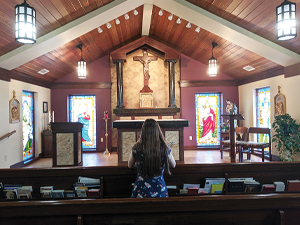
There is also a chapel near the front doors of the home where the women and their children can pray, attend Mass or just relax in its comforting setting. Women often find peace just being able to sit in the chapel where it is safe and quiet, Patrick said.
The average stay at the home is 381 days, but leases can be extended for as long as one needs the community to help them heal, Patrick said. Once the women complete the program and are ready to live independently, Catholic Social Services pays their first month’s rent, furnishes their new apartment and allows them to bring all dishes and bedding from their unit at St. Gianna into their new home.
The women can begin to build a new life while still knowing they have a family and support system that will always be there to love and support them at St. Gianna Women’s Home.
The COVID-19 pandemic has changed the way the community can help the women at the home. Normally, people can volunteer at the childcare service center and help give mothers a break to run errands or take time for themselves, but with COVID-19 restrictions, the service has been shut down.
Sister Carol said the community is continuously invited to pray for the women and the home’s mission and donate items or money to Catholic Social Services earmarked for St. Gianna. All donations are greatly appreciated, and she sees “God’s providence” through them. She said God takes care of their community through its donors. Once they were low on pillows, and the Sisters had been debating if they were going to buy new ones but decided to wait one more day.
That afternoon, a staff member went to pick up their mail at Catholic Social Services, and a whole car full of new pillows pulled up to the donation center.
“I am amazed at how many people really do support us, either with prayers or with donations or with their time,” said Sister Carol. “There are a lot of different volunteers in all different realms really wanting to support these women who are less fortunate.”
Since St. Gianna Women’s Home opened, it has helped 189 households. Its staff have served 462 women and children and helped them find peace and regain independence.
