

Q. I know that the rosary is scriptural, but where in the Bible does it say Mary was assumed into heaven?
A. Thank you for writing. Before I specifically answer your question, it’s good to ponder what the rosary is all about. I find the rosary to be one of the most powerful and beautiful devotions that the Church encourages.
The historical origins of the rosary is uncertain. According to one tradition, in the 13th Century, the Blessed Virgin Mary herself gave the rosary to St. Dominic, the founder of the Dominican Order. However, the use of prayer beads may have been used in the early Church, as well.
The rosary is comprised of 20 “mysteries.” These mysteries are significant events or moments in the life of Jesus and Mary, and they are grouped into four series: the first series contains joyful mysteries (recited on Mondays and Saturdays); the second, the mysteries of light (Thursdays); the third, the sorrowful mysteries (Tuesdays and Fridays); and the fourth, the glorious mysteries (Wednesdays and Sundays).
The praying of the rosary begins with the Apostles’ Creed, which is a symbol of the faith, as it summarizes the great mysteries of the Catholic faith. The Our Father, which is the prayer that Jesus himself has taught us, introduces each mystery. Three Hail Mary prayers are recited before the introduction of the first mystery. The Hail Mary is recited 10 times during each decade of the rosary as the person meditates on the mystery of that particular decade. The Glory Be is said at the conclusion of each decade. The praying of the Hail, Holy Queen concludes the rosary.
The Church offers the possibility of gaining an indulgence through pious practices such as the recitation of the rosary to promote devotional practices. Devotional practices like the recitation of the rosary instill in our hearts greater charity and trust in the Lord. It provides us stability when we are faced with temptations, desolations and suffering.
You are correct in describing the rosary as a scripture-based devotion since it is a meditation on the life of Christ, and asking the Blessed Virgin Mary to be a part of that meditation. The first part of the Hail Mary contains both the angel’s words announcing the conception of Christ in the Annunciation and Elizabeth’s greeting to Mary in the Visitation.
Jesus is the culmination of God’s Revelation. God has revealed himself throughout history in many ways: prophets, stone tablets, kings, miracles, and in many other ways. Nevertheless, Jesus is the perfection of Divine Revelation, for he is the Revealer and the Revealed. We continue to receive Divine Revelation through Sacred Scripture, the written Word of God, and Sacred Tradition, which is all revelation that has been handed down to us. The Magisterium, the teaching office of the Church, continues to hand down the teachings of the apostles and has the authority to interpret Scripture correctly.
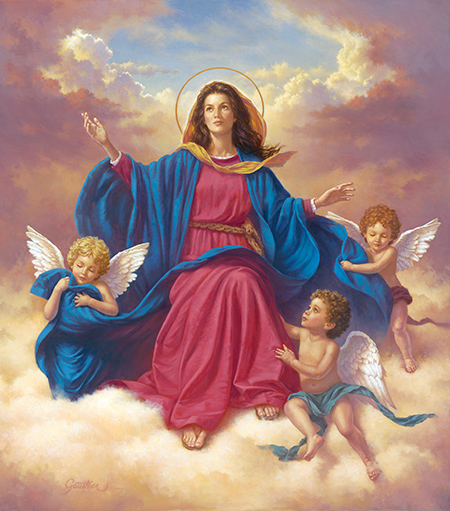
On November 1, 1950, Pope Pius XII dogmatically defined the doctrine of the Assumption of the Blessed Virgin Mary, stating that the Virgin Mary “having completed the course of her earthly life, was assumed body and soul into heavenly glory.” This is a teaching that had been believed throughout the history of the Church, and the teaching was celebrated in the Church’s Liturgy.
While there is no explicit reference to the Assumption in Sacred Scripture, that, of course, doesn’t mean that it didn’t happen. In fact, in St. Luke’s Gospel, the Blessed Mother seems to foretell the blessedness she will receive in heaven, saying “Behold, from now on will all ages call me blessed. The Mighty One has done great things for me, and holy is his name” (Lk 1:48-49). Mary’s Assumption into heaven is a realization of God’s promise he makes to all of us—that through the grace of God we, too, can share in the resurrection of Jesus.
This question was answered by Father Nicholas Kipper, moderator of the curia. Write to Ask the Register using our online form, or write to 3700 Sheridan Blvd., Suite 10, Lincoln NE 68506-6100. All questions are subject to editing. Editors decide which questions to publish. Personal questions cannot be answered. People with such questions are urged to take them to their nearest Catholic priest.
