

LINCOLN (SNR) – Bishop James Conley celebrated a solemn pontifical Mass Dec. 14 at St. Francis of Assisi Oratory in Lincoln, in honor of the chapel’s 100th anniversary.
The chapel, at 1145 South St., is an apostolate of the Priestly Fraternity of Saint Peter (FSSP). The FSSP is a clerical Society of Apostolic Life of Pontifical Right, canonically erected by Pope St. John Paul II in 1988. Their priests serve in apostolates across the world, with the faithful celebration of the traditional Mass and sacraments (extraordinary form of the Roman Rite) at the center of their charism. Their international seminary for English-speaking seminarians is Our Lady of Guadalupe Seminary in Denton.
The Priestly Fraternity of St. Peter was invited to the Diocese of Lincoln in 1994, and purchased St. Francis Chapel, 1145 South St. from Lancaster County in 1998. Bishop Fabian Bruskewitz blessed and rededicated the building as St. Francis of Assisi Church in 1999.
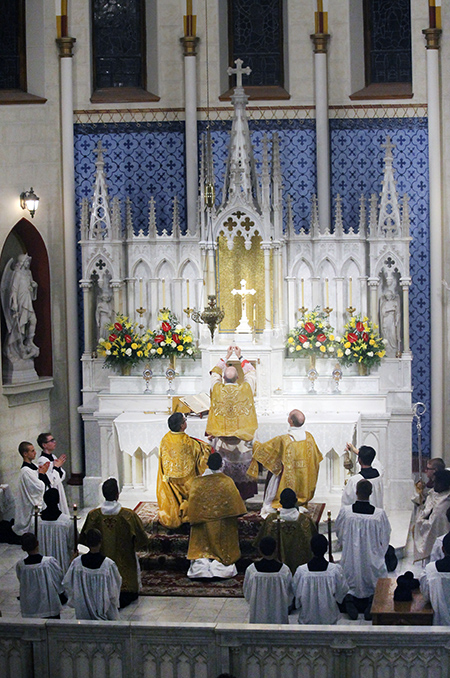 The chapel was previously owned by St. Elizabeth Hospital. The Sisters of St. Francis opened the original St. Elizabeth’s hospital in Lincoln in 1889 in a large house at 12th and South streets. The main wing was started in 1901. The chapel was added in 1921 as part of the east wing addition. Hospital chapels at that time were built with the finest materials available to be beautiful and provide “honor and glory to God.”
The liturgical design studio of Emil Frei & Associates of St Louis, established in 1898, produced the so-called “crown jewels” of the parish, its 25 stained-glass windows. Originally purchased for $4,500, the windows carry the signature of the company and, while noted for their beauty are also unusual for being such a large collection of windows preserved in one church. In fact, the windows are a featured part of the company’s portfolio on their website to this day.
In anticipation of the 100th anniversary, St. Francis Church shared information about the windows and history of the chapel. Emil Frei, a Bavarian immigrant, worked in the Munich Pictorial Style of stained glass. Like other aspects of the Gothic Revival, Emil Frei & Associates stained glass designs are not simply copies of medieval stained glass designs; instead they are created with a Raphael-inspired Italian Renaissance compositional style, with carefully delineated and shaded figures. Multiple artists would work on each window, each specializing in particular areas, such as faces or landscapes. The windows are especially beautiful for the detail in the hands, feet, and faces.
The chapel became an integral part of the life of the hospital and its spiritual center. It was used for retreats by the priests and nuns and for prayer by patients and their families. Ordinations were held there and morning Mass was attended by nursing students before going on to their daily assignments.
In 1970, St. Elizabeth hospital moved to new facilities on South 70th Street and the old hospital, along with the chapel, was purchased by Lancaster County for use as a nursing home.
As the main facilities deteriorated, Lancaster County decided to build a new nursing care facility in 1983. Anne Senkbeil and Louise Slatinsky discovered in 1986 that the chapel was slated for demolition during their research to catalog stained glass windows in local churches. Along with Sister Barbara Ann Braun, they spearheaded a drive to preserve the chapel.
In 1987, County commissioners spared the chapel and approved funds to build a front face for it after the demolition of the attached hospital, which occurred in 1994. The St. Francis Chapel Foundation was created to manage the ongoing preservation efforts and the chapel was used as a non-denominational community center – hosting concerts, weddings, and meetings by local community organizations.
In July 1998, the Lancaster County Board of Commissioners voted to sell the chapel to the FSSP. This marked the building’s return to use as an active Catholic church, and the St. Francis of Assisi Oratory was established to serve the needs of the Tridentine Mass apostolate.
Under the guidance and craftsmanship of its first rector, Father Karl Pikus, FSSP, the church and its stained glass windows were preserved and the interior of the church beautified with frescos and wall detailing. The restoration – with Neo-Gothic architecture, Italian Renaissance-style stained glass windows, white Carrera marble sanctuary, art deco tapestry, statues, stations of the cross, murals, and paintings – is a fitting place for offering the Holy Sacrifice of the Mass.
Father Joseph Heffernan, F.S.S.P. was named rector of St. Francis in August. On the parish website at www.stfrancislincoln.org he offers a welcome to visitors: “Open to all the faithful of the Diocese of Lincoln by the express permission of His Excellency, Bishop James D. Conley, in accord with the wishes of recent Popes St. John Paul II and Benedict XVI this beautiful church is dedicated to the Extraordinary Form of the Roman Rite, all the Sacred Rites being celebrated according to the Liturgical Books of 1962. Mass is offered daily and confessions are heard before every Mass. Visitors are always welcome; we look forward to meeting you.”
