

(SNR) – Pope Francis officially opened the “Synod on Synodality” in Rome Oct. 9, 2021, launching a worldwide undertaking during which Catholics will be encouraged to submit feedback to their local dioceses.
The two-year process is the fruit of the Holy Father’s desire to gain a deeper awareness of how to walk more perfectly with the people of God upon the Christian path of holiness.
“The Holy Father seeks a deeper awareness of the joys, struggles, problems, and blessings facing each member of the human family, so as to better accompany them on this journey towards deeper communion with Christ,” said Father Christopher Eckrich of the Diocese of Lincoln.
In order to help bishops advise him, Pope Francis instituted a diocesan phase of the synod meeting, and Bishop James Conley appointed Father Eckrich and Father Caleb La Rue as coordinators for the Diocese of Lincoln.
Father Eckrich said the diocesan phase gives “each member of the faithful the chance to be heard, and, by means of a summation, have their opinions presented to the Holy Father to aid in his job of guiding the Lord’s flock.”
Father La Rue explained that each diocese will compile the information that they gather during the listening phase into a 10-page report that will then be submitted to the episcopal conference of their territory – the United States Conference of Catholic Bishops (USCCB) in this case.
“Each episcopal conference will then gather the responses together and submit them to the Synod who will use these responses to frame the topics of discussion for the actual Synod on Synodality in 2023,” he said. “While each response will not be read by the Synodal Fathers, the themes that are gathered from all the responses of the Faithful throughout the world will shape the direction of the Synod.”
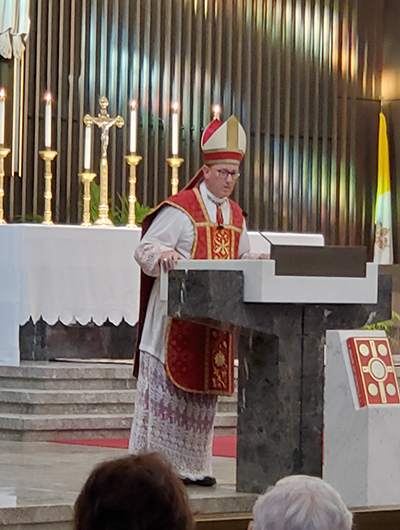
This diocesan phase was formally inaugurated by Bishop Conley during a Mass at the Cathedral of the Risen Christ in Lincoln in October 2021. After a few months of planning and organization, the Diocese of Lincoln invites the people of God to participate.
“The Apostolic See provided a ‘vademecum’ (handbook) to all dioceses with information and ideas on how to proceed,” Father La Rue said. “Additionally, the USCCB frequently sends out updates and resources for the diocese to facilitate the listening sessions.
“Reaching out to every diocese like this is a new aspect of the preparatory phase for a synod of bishops,” he said, “so dioceses have been eager to share ideas and reach out to one another to try to develop some best practices.”
Because of the expansive size of the Diocese of Lincoln – which spans nearly 24,000 square miles – and the uncertain nature of the COVID-19 pandemic, it would be impossible to meet with people one-on-one across a large portion of the faithful. Therefore, all members of the Diocese of Lincoln are invited to send in emails or letters with their opinions to either This email address is being protected from spambots. You need JavaScript enabled to view it., or Diocesan Synod, Diocese of Lincoln, 3400 Sheridan Blvd., Lincoln, NE 68506.
“This assures that every single person is heard,” Father Eckrich said. “All letters and emails will be read with diligence, and all responses will be recorded and summarized in the report our diocese sends in.”
Because of the expansive size of the Diocese of Lincoln – which spans nearly 24,000 square miles – and the uncertain nature of the COVID-19 pandemic, it would be impossible to meet with people one-on-one across a large portion of the faithful. Therefore, all members of the Diocese of Lincoln are invited to send in emails or letters with their opinions to either This email address is being protected from spambots. You need JavaScript enabled to view it., or Diocesan Synod, Diocese of Lincoln, 3400 Sheridan Blvd., Lincoln, NE 68506.
In-person meetings will occur for various groups and organizations across the diocese. Letters will be sent informing the groups and organizations when their listening sessions will be, and how they can participate.
Some of the groups that will be reached out to specifically are the Knights of Columbus, the St. Vincent de Paul Society, and Lincoln Diocesan Council of Catholic Women (LDCCW), to name a few.
“Specific communities within the diocese, such as our Hispanic, Vietnamese, and Eastern Catholic diocesan brothers and sisters will also be invited to gather and share their experiences of and ideas for walking together as the People of God,” Father La Rue said.
 Father Eckrich pointed out that the Holy Father was clear in his letter to the faithful that “The Synodal Process is first and foremost a spiritual process. It is not a mechanical data-gathering exercise or a series of meetings and debates.”
“We invite the people of God to pray about their own experiences in the Church, and how the Church has accompanied them on their journey in holiness,” he said. “What have been the blessings? What have been the failures? Where has goodness been demonstrated? How can the Church improve her accompaniment? What have been the challenges? How can the Church better engage the world, so as to bring more people to the knowledge and love of Christ? How can the Church more effectively call people to conversion, as our Lord demanded of us?”
He said responses are asked to be framed within the context of: How can this build up the Body of Christ? How can we be more faithful to the Lord’s command of ‘Going out to all the Nations’ and spread the good news of our salvation?
“All Catholics by virtue of our baptism are members of the Mystical Body of Christ,” said Bishop Conley. “We all share in the universal call to holiness in our lives, no matter what our vocation may be. It is my hope that this worldwide synod will lead to greater unity and solidarity in the Church and greater personal holiness among us all.”
La diócesis de Lincoln inicia la fase local del sínodo de dos años
(SNR) — El Papa Francisco inauguró oficialmente el "Sínodo sobre la Sinodalidad" en Roma el 9 de octubre de 2021, poniendo en marcha una iniciativa mundial durante la cual se animará a los católicos a enviar sus comentarios a sus diócesis locales.
El proceso, de dos años de duración, es fruto del deseo del Santo Padre de adquirir una conciencia más profunda de cómo caminar más perfectamente con el pueblo de Dios por el camino cristiano de la santidad.
"El Santo Padre busca un conocimiento más profundo de las alegrías, las luchas, los problemas y las bendiciones a las que se enfrenta cada miembro de la familia humana, para poder acompañarlos mejor en este camino hacia una comunión más profunda con Cristo", dijo el padre Christopher Eckrich, de la diócesis de Lincoln.
Para ayudar a los obispos a asesorarle, el Papa Francisco instituyó una fase diocesana de la reunión sinodal, y el obispo James Conley nombró al padre Eckrich y al padre Caleb La Rue como coordinadores de la diócesis de Lincoln.
El padre Eckrich dijo que la fase diocesana da "a cada miembro de los fieles la oportunidad de ser escuchado, y, por medio de un resumen, tener sus opiniones presentadas al Santo Padre para ayudarlo en su trabajo de guiar el rebaño del Señor.”
El padre La Rue explicó que cada diócesis recopilará la información que obtenga durante la fase de escucha en un informe de 10 páginas que luego se presentará a la conferencia episcopal de su territorio, la Conferencia de Obispos Católicos de Estados Unidos (USCCB) en este caso.
"Cada conferencia episcopal reunirá entonces las respuestas y las presentará al Sínodo, que utilizará estas respuestas para enmarcar los temas de discusión para el Sínodo real sobre la Sinodalidad en 2023", dijo. "Aunque cada respuesta no será leída por los Padres Sinodales, los temas que se recojan de todas las respuestas de los fieles de todo el mundo darán forma a la dirección del Sínodo".
Esta fase diocesana fue inaugurada formalmente por el Obispo Conley durante una Misa en la Catedral de Cristo Resucitado en Lincoln en octubre de 2021. Tras unos meses de planificación y organización, la Diócesis de Lincoln invita al pueblo de Dios a participar.
"La Sede Apostólica proporcionó un 'vademécum' (manual) a todas las diócesis con información e ideas sobre cómo proceder", dijo el padre La Rue. "Además, la USCCB envía con frecuencia actualizaciones y recursos para que la diócesis facilite las sesiones de escucha".
"Llegar a todas las diócesis de esta manera es un nuevo aspecto de la fase preparatoria de un sínodo de obispos", dijo, "por lo que las diócesis han estado ansiosas por compartir ideas y llegar a los demás para tratar de desarrollar algunas mejores prácticas.”
Debido al gran tamaño de la Diócesis de Lincoln — que abarca casi 24,000 millas cuadradas — y a la naturaleza incierta de la pandemia de COVID-19, sería imposible reunirse individualmente con la mayoría de los fieles. Por lo tanto, se invita a todos los miembros de la Diócesis de Lincoln a enviar correos electrónicos o cartas con sus opiniones a This email address is being protected from spambots. You need JavaScript enabled to view it., o al Sínodo Diocesano, Diócesis de Lincoln, 3400 Sheridan Blvd., Lincoln, NE 68506.
"Esto asegura que cada persona sea escuchada", dijo el Padre Eckrich. "Todas las cartas y correos electrónicos serán leídos con diligencia, y todas las respuestas serán registradas y resumidas en el informe que nuestra diócesis envíe".
Se celebrarán reuniones en persona para varios grupos y organizaciones de toda la diócesis. Se enviarán cartas informando a los grupos y organizaciones de cuándo serán sus sesiones de escucha y cómo pueden participar.
Algunos de los grupos a los que se llegará específicamente son los Caballeros de Colón, la Sociedad de San Vicente de Paúl y el Consejo Diocesano de Mujeres Católicas de Lincoln (LDCCW), por nombrar algunos.
"Comunidades específicas dentro de la diócesis, como nuestros hermanos y hermanas católicos hispanos, vietnamitas y católicos del Este, también serán invitados a reunirse y compartir sus experiencias e ideas para caminar juntos como Pueblo de Dios", dijo el padre La Rue.
El padre Eckrich señaló que el Santo Padre fue claro en su carta a los fieles en el sentido de que "el Proceso Sinodal es ante todo un proceso espiritual. No es un ejercicio mecánico de recopilación de datos o una serie de reuniones y debates."
"Invitamos al pueblo de Dios a rezar sobre sus propias experiencias en la Iglesia, y sobre cómo la Iglesia les ha acompañado en su camino de santidad", dijo. "¿Cuáles han sido las bendiciones? ¿Cuáles han sido los fracasos? ¿Dónde se ha demostrado la bondad? ¿Cómo puede la Iglesia mejorar su acompañamiento? ¿Cuáles han sido los desafíos? ¿Cómo puede la Iglesia comprometerse mejor con el mundo, para llevar a más personas al conocimiento y al amor de Cristo? ¿Cómo puede la Iglesia llamar más eficazmente a la gente a la conversión, como nuestro Señor nos exigió?"
Dijo que se pide que las respuestas se enmarquen en el contexto de: ¿Cómo puede esto edificar el Cuerpo de Cristo? ¿Cómo podemos ser más fieles al mandato del Señor de "ir a todas las naciones" y difundir la buena noticia de nuestra salvación?
"Todos los católicos, en virtud de nuestro bautismo, somos miembros del Cuerpo Místico de Cristo", dijo el obispo Conley. "Todos compartimos la llamada universal a la santidad en nuestras vidas, sea cual sea nuestra vocación. Tengo la esperanza de que este sínodo mundial conduzca a una mayor unidad y solidaridad en la Iglesia y a una mayor santidad personal entre todos nosotros."
