

By Ron Lawson
LINCOLN (SNR) – Fourteen teens devoted a Saturday to learning how to take a conversation about abortion from debate to dialogue.
They attended a day-long workshop offered by Justice for All (JFA), a non-profit organization whose goal is to “train thousands to make abortion unthinkable for millions, one person at a time.”
Mary St. Hilaire, a native Nebraskan who is a full-time training specialist with JFA, led the workshop with help from interns Bella O’Neill and Kristina Massa. The training was hosted at St. Francis of Assisi Church in Lincoln.
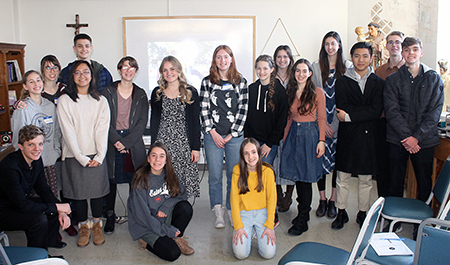
The five boys and nine girls in attendance learned how to take on what is often an uncomfortable or unproductive conversation, and one which can shed more heat than light.
Emma, a junior, observed, “I think we often underestimate how difficult it can be to engage in a pro-life conversation. The training focused on how to start a conversation and make sure that it continues as a beneficial one.”
While there are no magic bullets to sharing views on the topic, JFA taught, learning to find some common ground is often the starting point. Carefully listening and thoughtfully asking questions, to avoid assuming you know what someone else thinks, they said, can help find this common ground.
The students were introduced to a variety of arguments that are often made to justify or defend abortion, and learned how to respond.
Understanding the arguments about when life begins and what defines a human being are often critical to having a discussion about the reality of abortion.
Sometimes the discussion revolves around “hard questions” – rape, life of the mother, birth defects, ectopic pregnancy – and the attendees learned there are good answers and approaches to discussing even these exceptional cases.
Dominic, a 14-year-old participant, said, “They broke down the hard cases…. They told you first to talk about it with a bunch of sympathy for the person. You want them to know they’re hurt and are understood. At the beginning [of the workshop] they show a conversation with a lady who was pregnant at 13 and had an abortion, and, obviously, her decision was wrong, but they didn’t sound sympathetic at all. They went into all these different facts, instead of asking how she was, if she’s okay, how they could help.”
In addition to training sessions, JFA specializes in college campus outreach, and the presenters shared stories about the kinds of conversations they have had with students who hold many different viewpoints.
St. Hilaire, in a recent article, wrote: “In conversing with people from various races, religions, states and even countries, getting to know them on a personal level, sharing my beliefs with them, and searching for the truth along side of them, I have come to realize that my love does not have to be limited to only those with whom I share the same views. I knew this in my head, but, until I actually participated in outreach with Justice For All, I didn’t know it in my heart.”
Toward the end of the workshop, the participants were asked to pair up and take turns role-playing a conversation, with one professing pro-abortion views and the other pro-life views. For some it was an eye-opening exercise, and it was a chance to practice the three essential skills JFA teaches: asking questions with an open heart, listening to understand and finding common ground when possible.
The students discovered that often a conversation doesn’t end with the other person dramatically changing his or her position on abortion, but that seeds are planted and may take time to grow. Individuals often have nuanced views on abortion, and many have never really taken the time to express or think deeply about what it is they actually believe or why they hold the position they do, the students learned. JFA taught that misconceptions about “pro-lifers” by those who support abortion often prevent them from understanding that those who are opposed to abortion really do care about the reasons they think it should be allowed. Once the misunderstandings are cleared up, it is possible to show that there are real, and compassionate, alternatives to killing an unborn human being.
Meredith, another high school aged participant, said, “For the first time I feel like I can have an effective conversation on a controversial topic.”
Siblings Hop and Eve agreed that the experience gave them “confidence and knowledge about how to constructively dialogue with someone who is pro-abortion.”
St. Hilaire said “Training people, but especially teenagers, to have productive conversations about abortion is one of the best parts of my job with Justice For All and our seminar at St. Francis was no exception! All the students seemed to be very engaged and receptive to the material and I really enjoyed seeing them learn and grow in their dialoguing skills.
“It is always an encouragement to see that there are young people who are willing to get out of their comfort zone in order to educate others on the reality of abortion and bring an end to this injustice,” she added.
Justice for All currently has 11 full-time missionaries who travel around the country to conduct trainings and campus outreach, in addition to several staff members who support them from the JFA headquarters in Wichita, Kan. or work from home.
“We each have our own ‘team’ of donors that supports our work,” St. Hilaire explained. “Several of us, myself included, are still working to raise full support.”
People can donate to a specific staff member, intern, or the organization at jfaweb.org/donate.
JFA teams visit approximately 15 college campuses and conduct about 50 trainings each year. In response to pandemic-related restrictions on in-person events, JFA now offers a free online training series called “Love 3.”
