

by Sandy Danek,
coordinator, Healing Hearts Grief Program
Grieving is some of the hardest work one can do. While there are common stages of the grief process including shock, denial, anger, fear, sadness and gradual acceptance, which stages and in what order one experiences them varies. One can even experience several stages at the same time.
How someone grieves depends on one’s personality, family background, experience with previous loss, relationship with the one who has died, and relationship with God. Research shows that people with strong spiritual beliefs rebound from the death of a loved one more quickly and completely than nonbelievers.
Grief is an intense and intimate journey. This is why it is important to not compare experiences. Those who are in the moment of their intense grief do not want to immediately hear stories of others’ losses and how they dealt with them. They are often emotionally paralyzed and simply need to hear a validation of what they are feeling. However, in time it can be comforting to experience the stories of others’ losses and how they are coping.
In the case of the loss of a pre-born baby, when sympathy is not expressed to the grieving couple, they can easily develop a feeling of isolation. Most cannot comprehend how anyone can grieve a child they have never met. But, consider a couple who has tried for many years to conceive, and is finally experiencing parenthood, only to hear the news that their baby has died. The death of an unborn child destroys whatever hopes and dreams they had for this child and their family. Acknowledging the loss is the best gift you can give. Suggesting that they name their baby and offering a Mass for the family to recognize their loss can be tremendous comfort.
Grief has no timetable; emotions can come and go at different levels of intensity for months or years. There is such an onslaught of support directly after the death, but when the family leaves and everyone returns to their own lives, the griever is left to deal—often alone—with a multitude of emotions (not to mention lots of paperwork, financial and other decisions). It is for this reason that I often recommend sending condolence cards a few months after the death. It is very comforting to go the mailbox and discover that after everyone else has gone back to their lives, someone still remembers what you are going through.
The loneliness factor, especially for a spouse, is a challenge. There are usually signs of our loved ones constantly in front of us. Some tell of seeing, smelling or hearing their loved ones, and many will surround themselves with their loved ones’ possessions. It is a means of supporting themselves through the loneliness process.
Another type of loneliness can come to those who have suffered the loss of their parents, especially the last one. It can feel as though they are orphans and the family structure and foundation they have known their whole life is gone.
It can take longer for someone to work through an unexpected loss such as one due to an accident or sudden medical crisis. People may suffer an increased level of fear or anxiety. They may want to find someone to blame. They may even be angry at the loved one who has died for “abandoning” them. This can be frustrating for widows and widowers, as they must take over the duties previously provided by their spouse. It usually is about fear and the feeling that they have lost control of their own circumstances. A suggestion may be to have them write down what makes them angry and assess what can or cannot be changed.
In addition to emotional and mental issues, including forgetfulness and inability to concentrate, physical symptoms may appear such as exhaustion, headaches, body aches, stomach issues and altered sleep patterns. We need to be patient with the griever, and they need to be patient with themselves.
Tears are a valuable part of the process. Unfortunately, our society doesn’t always see tears as a gift. Often those who grieve can feel embarrassed when they cry in front of others. It is important that we are comfortable with tears and resist the urge to feel as though we caused their pain because we asked questions or made comments that brought about painful memories.
One of the most challenging issues of grief is how it affects our relationships. Well-meaning supporters make comments that may come off as trite, such as “you can have more children” or “at least they are not suffering anymore.” This is why communication is important when families are grieving. Time should be given to talking, crying and listening.
Also important is the parish family. After a death, most will gain comfort from their faith in God, but some may experience anger at God for allowing this to happen. It is important to reassure the griever that God “has broad shoulders” and understands. If you do not have a grief support system in your parish, perhaps there is a trusted parishioner who could be asked to check in on the person for a while.
What is most evident in children’s grief is their behavior. They may begin to misbehave or become quiet and withdrawn. Young children can sometimes regress into thumb sucking or bed wetting or become clingy. Older children may cut off communication and turn to their friends for support. Keeping a routine is important, as is encouraging them to ask questions. Keep the answers simple and accurate. It is also helpful for them to be involved, whether it’s drawing pictures to place in the casket or asking them to bring flowers to the church or burial site.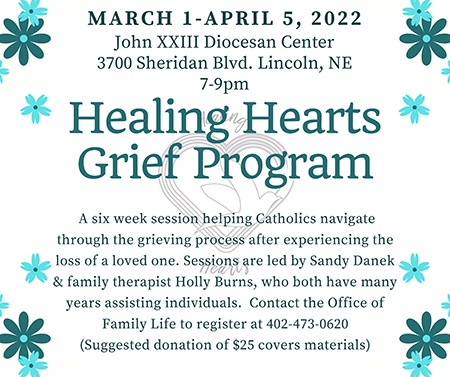
Men and women grieve differently, and those gender differences are an important part of supporting couples. For example, with baby loss, it is not uncommon for someone to ask about the mother and completely ignore the feelings of the father. This can create a wedge between the couple, as women are culturally conditioned to share their emotions while men often have difficulty doing so, largely because society has taught them that they should remain “strong” and support everyone else. Again, communication is key, and understanding that no one person can be everything for everyone. Sometimes it is more helpful to talk to a trusted friend. It is also why support programs like Healing Hearts can be so helpful.
Eventually though, for most, resolution is found as the griever comes to terms with the death and begins to adapt. Memories may prompt episodes of grief, but in time, the memories become a gift.
When providing support, the best gift you can offer is your time; listen, and validate their feelings, resisting the urge to try to “fix” the pain or offer advice. Allow them to tell and retell the story of their loss; it gives them the opportunity to process their grief. Show genuine emotion when you feel it. Most importantly, talk to the griever and be positive. It takes time and energy to support someone who has had a loss, but this can be a critical time for them in their spiritual life. You may also experience spiritual enrichment in the process!
Sandy Danek is the coordinator of the Healing Hearts Grief Program sponsored by the Family Life Office. Since 1991, this Christ-Centered ministry has provided assistance to those who are grieving the loss of a loved one.
Two six-session series, spring and fall, are held each year in the Lincoln area. The grief team includes family therapist Holly Burns and diocesan priests.
A Healing Hearts six-week session will begin Tuesday, March 1, 7 to 9 p.m. at the John XXIII Diocesan Center, 3700 Sheridan Blvd.
For more information, contact the Family Life Office, 402-473-0620.
