LINCOLN (SNR) – Over the unprecedented challenges of the past two years, recent test scores demonstrate that the Catholic schools of the Diocese of Lincoln have continued to provide excellent educational opportunities for the children of the parishes and communities they serve.
All of this was done without the usual security and sense of normalcy usually expected from within the school atmosphere.
In spite of the challenges, the diocesan schools have continued to focus on “the mission of the Catholic schools of the Diocese of Lincoln: to form students spiritually, intellectually, emotionally, socially, and physically, in partnership with parents, and in harmony with the specific gifts given by God to each student” as determined in the Diocesan Policy Handbook. In this regard, the diocesan parish priests have provided outstanding spiritual support for the teachers, the staff members, the students and the families they serve, observed Deacon Matthew Hecker, Ph.D., chief administrating officer of the diocesan schools.
The State of Nebraska requires schools to administer a norm-referenced test for students. The Diocese of Lincoln utilizes the Iowa Test of Basic Skills (ITBS) and the Cognitive Abilities Test (CogAT). The ITBS is given once a year in grades 3-9, with an optional test for grade 10, and the CogAT is given every other year.
The 2022 results provided a glimpse at the exceptional work being done in diocesan schools.
The work is significantly demonstrated in the diocesan averages for each grade and each subject, scoring above the national percentile ranks and the grade equivalents. Officials at the Diocesan Education Office stressed that given the pandemic implications for learning and the participation of students, as well as the health of teachers and administrators, the averages were remarkable for the norm-referenced standardized testing. The diocesan scores are very good, with the schools evidently having academically-talented students.
“These average scores across the diocese indicate that achievement is not dependent on the size or economic status of the school,” Sister Collette Bruskewitz, assistant superintendent pointed out, “because each is successful in various areas of academics. Our schools are just good, solid parish and local schools.”
School administrators, teachers and staff members, despite the very difficult conditions and the real challenge to their own health and well-being, diligently kept at the task, faithfully and lovingly educating their students, which was noted by Dr. Hecker and Education Office personnel throughout the past two years, and summed up in the schools’ average scores.
The diocesan schools’ scores were so close for a highest in each subject for each grade, the office highlighted grade-score lists from highest to lowest, in one subject in each grade to give a picture of the overall work in spite of a persistent pandemic.
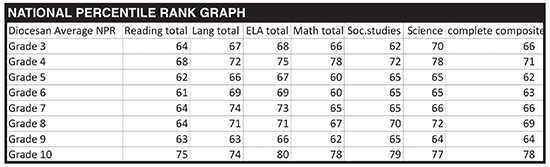
In K-12 schools, nationwide educational measurement is determined on two primary metrics. The first and most commonly known is what is referred to as the “National Percentile Rank.” It is based on a scale of 1-100, with the national average always being 50. This represents the middle point for all schools in the nation. Starting with grades 3-10, the diocesan averages, for all the schools and all the students in these grades, are given compared to the National Percentile Rank. This graph below depicts where all the diocesan schools rank in comparison to the national percentile rank (50) for each grade.
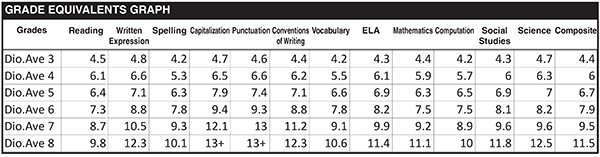
The second common metric educators employ are referred to as, “Grade Equivalents.” Grade equivalents are also based on nationwide norms. Grade equivalents are numbers based on the year in school and the month of the school year. For example, at the beginning of the school year in September, a student in seventh grade should be a grade equivalent of 7.1 (seventh grade, first month). To further the example, in the beginning of March, when the national tests were administered, a seventh grade student is expected to test at a 7.6 level (seventh grade, sixth month). The highest possible grade equivalent is 13+, meaning students scored at the collegiate level. The “Grade Equivalents” graph below depicts the grade equivalent levels of all the diocesan schools.