

Special to the Register by Fr. Kenneth Borowiak
Dar es Salaam, Tanzania (SNR) – Msgr. Richard Gyhra, a priest of the Diocese of Lincoln serving the Church in the east African nation of Tanzania, described the nation as “Mutual of Omaha’s Wild Kingdom,” referring to the 1963-88 weekly American television documentary.
In his 13th year of diplomatic service for the Holy See, Msgr. Gyhra is the acting head of the apostolic nunciature at the nunciature, or papal embassy, in Tanzania.
The nunciature is in the city of Dar es Salaam, on the Indian Ocean coast. The Holy See has diplomatic relations with 183 sovereign nations. The pope’s personal representative, usually an archbishop, is frequently the nuncio in the represented country.
A nuncio is responsible for carrying out instructions from the Holy See. Since the Holy See does not have the commercial, trade, military or business interests that other countries have, much of a nuncio’s work in a remote country involves working with the local Church.
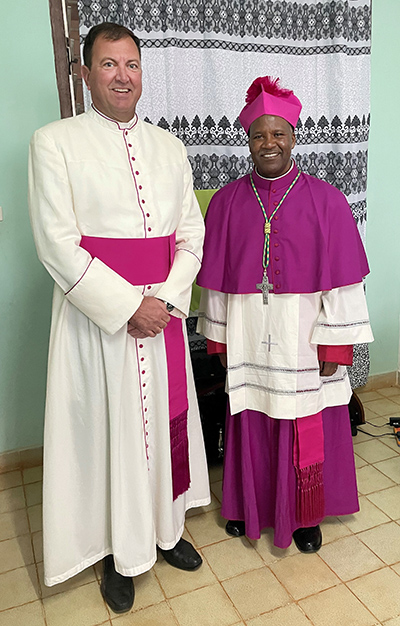 Ordained in 1999, Msgr. Gyhra’s role in Tanzania is his fourth as a Vatican diplomat. He began his work for the universal Church in 2010 in the nunciature in Santa Domingo, the capital of the Dominican Republic in the Caribbean Sea.
In 2005, Bishop Fabian Bruskewitz asked Msgr. Gyhra to go to Rome to get a degree in moral theology. In 2007, as he was finishing the degree and preparing to return to Nebraska, he was contacted by the Holy See’s Secretariat of State.
“I was ‘asked’ to enter the Pontifical Ecclesiastical Academy to prepare to work in the diplomatic service,” Msgr. Gyhra said. At first, he said, he just wanted to go back to Nebraska to be a parish priest.
“Despite providing – what I thought anyway – were very legitimate and compelling excuses not to go down that path, I was told that this was not an ‘invitation’ but more of a ‘directive,’” Msgr. Gyhra noted. “The Secretariat of State had already asked Bishop Bruskewitz to release me for this work and he did so.”
After his first assignment in the Dominican Republic, Gyhra was transferred in 2013 to the permanent mission of the Holy See to the United Nations and other international organizations in Geneva, Switzerland.
In 2017 Msgr. Gyhra was called to work in the Secretariat of State in the Vatican, where he followed the activities of international organizations that pursue subject matters within diplomacy, especially issues concerning human rights and religious freedom.
On Jan. 10 of this year Msgr. Gyhra was informed that Pope Francis had approved his posting to the nunciature in Tanzania.
The previous nuncio, Archbishop Marek Solczynski and his secretary had been assigned to the nation of Turkey, so Msgr. Gyhra was asked to make the move as soon as possible in order to take over the diplomatic mission in Tanzania. He left Rome Jan. 28 to work with Archbishop Solczynski for a short time before he left for Turkey.
Msgr. Gyhra is the sole Vatican diplomat in Tanzania, with the title of acting head of the apostolic nunciature.
“I have that title since I am not a nuncio,” Msgr. Gyhra explained. “I expect that Pope Francis will nominate a new nuncio here at some point.” A typical assignment of the Vatican diplomatic corps is three years.
Tanzanian history and religious practice
In its recent history, Tanzania was evangelized by Benedictine missionaries – priests and sisters who brought the Catholic faith to German East Africa, largely in the late 19th century. This was followed by British rule at the end of World War I. The United Republic of Tanzania came into existence in 1964 and remains a part of the British Commonwealth.
Msgr. Gyhra said the faith life there is generally strong.
“Masses are very vibrant, with much singing and dancing,” he said. “Masses can last for hours.”
Msgr. Gyhra said for many of the Catholic faithful, Mass is the social event of the week in addition to being the center of their worship.
“Parishes, especially outside of the larger cities, are the hub of activity. They include schools, health clinics and pharmacies,” he said. He said most parishes have “outstations” on the peripheries of their boundaries. They are often open-air, thatch-roofed huts that serve as a chapel for the occasional celebration of Mass and other sacraments.
The Church in Tanzania operates several Catholic universities and regional seminaries.
“In most dioceses, the number of priestly vocations is quite high,” Msgr. Gyhra said. As the Church grows, new dioceses will likely need to be established in the future, he noted.
Sixty percent of Tanzania’s population of about 65 million are Christian, most of whom are Catholic. The remaining 40% is predominantly Muslim, but there also are animists, creation worshipers and members of other religions.
Topography, people, wildlife
A native of St. Anthony of Padua Parish in Steinauer, Msgr. Gyhra pointed out differences between the American Midwest and East Africa, separated by 8,850 miles and eight time zones. Tanzania is about the size of Nebraska, South Dakota, Iowa, Missouri and Kansas combined – roughly 366,000 square miles. 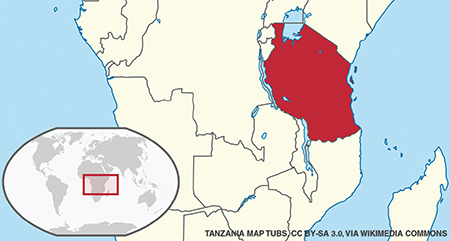
A developing country, Tanzania is largely agrarian. The main agricultural product is plantains, a fruit similar to bananas which are used in almost every meal in Tanzania. Farmers also raise cattle, hogs and chickens, and Tanzania has a significant fishing industry.
Because of Tanzania’s climate, agricultural production continues year round. Located south of the equator, summer in Tanzania is November through March, with temperatures commonly reaching 100 degrees.
Tanzania is perhaps best known for its unique nature and wildlife. Nearly 10% of the country is dedicated to national parks which include the famous Mount Kilimanjaro, the highest mountain in Africa with an elevation of 19,341 feet, and the Serengeti region in northern Tanzania, spanning 12,000 square miles with several protected game reserves. Common native wild animals include cheetahs, lions, gazelles, ostriches elephants and giraffes.
The Catholic Church in Tanzania
While considered “missionary territory,” the Catholic Church in Tanzania has 34 dioceses and 42 bishops who serve 22 million Catholics. They are assisted by 3,105 priests and 12,730 women religious.
The Church in Tanzania is under the auspices of the Vatican's “Dicastery for Evangelization.” The Church relies heavily on financial subsidies allocated for all the dioceses, parishes, seminaries, schools, hospitals and religious communities within the country. Revenue for the subsidies comes from collections taken up annually in parishes around the world as part of World Mission Sunday each October.
“It is part of my duties to distribute these subsidies to the various Catholic entities in Tanzania,” Msgr. Gyhra said.
One of the most important works Msgr. Gyhra does is helping find new bishops in Tanzania. The process of nominating new bishops is a detailed process.
“Working with local bishops, I coordinate the search for possible candidates for bishop and the findings of these inquiries are sent to the Dicastery for Evangelization in Rome,” Msgr. Gyhra said. From the names and files of candidates submitted, Pope Francis names new bishops.
Since he arrived in Tanzania, Msgr. Gyhra represented the Holy See at the ordinations of two new bishops.
“My role in those ordination Masses was to present and read the apostolic bull,” the document that officially authenticates the nomination of the new bishops appointed by the pope, he said. While Swahili is the official language of the country, English is the language of business, commerce and diplomacy. Swahili however, is the more common language of usage in Tanzania, which has more than 100 ethnicities, tribes and languages.
“I am learning a little Swahili and am able to celebrate Mass in that language,” Msgr. Gyhra said.
Impressions of Tanzania
Msgr. Gyhra said extreme poverty is present everywhere.
“It is very sad to see, indeed distressing,” he said. “Unemployment hovers around 12% and many people literally live day to day,” he observed. “Those fortunate enough to have a stable job at best usually make about $500 a month. The majority of people might not make $200 a month.”
Much of the infrastructure of Tanzania reflects the poverty of the country of 65 million.
For a recent trip for an episcopal ordination, Gyhra said “it took seven hours to travel 300 miles by car partially on asphalt roads – ones with massive potholes and partially on dirt or stone roads that would need days of motor grading if not a bulldozer to get them into decent shape.”
He said the culture and pace of life is much different than in the United States. “The pace of activity and work is much slower, which makes it difficult to get anything done speedily or efficiently,” he said. “So it requires a lot of patience.”
Despite the poverty he said the people are generally very happy and kind, even though they have little or nothing which they can claim as their own.
“Perhaps there is a lesson there about the relationship between material possessions and happiness,” Msgr. Gyhra said.
Msgr. Gyhra also said the political and social climate of the country is fairly calm which cannot be said of a number of other African countries at the present time.
“I am fortunate in the sense that the apostolic nunciature is located in a relatively good and safe area of Dar es Salaam, a city of 7 million which is home to many embassies for foreign nations.”
While the capital was moved to Dodoma in 1996, Dar es Salaam remains the major economic and business hub of the country.
Msgr. Gyhra sees his work in Tanzania as a time of growth and promise not only for himself but for the future for the Catholic Church in the continent of Africa.
“Overall, I think this will be a very good learning opportunity for me, to live and experience the universal Church where the faith is growing and vibrant. The future of the Church, insofar as numbers are concerned, is in the global South and Africa is a major part of that growth. While the Church is sadly waning and in terrible need of renewal in the Western world, it is growing very quickly here. Naturally, there are plenty of “growing pains” that come with that, but the future of the Church is quite promising in Africa.”
