

Q. May an adult who has suffered a serious mental illness/injury and no longer expresses the understanding of an adult receive Holy Communion?
A. Thank you for your question. The short answer is yes, it is possible for someone to receive Holy Communion even if they have suffered an injury or suffer from an illness that causes them to no longer be able to express their understanding of the Eucharist. The more in-depth answer comes from the desire of the Church to protect the dignity of the person and the reverence of the Blessed Sacrament.
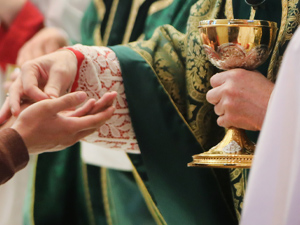 On the one hand, it is important that the person is able to be united with Our Lord, especially when suffering through a serious injury or illness. On the other hand, it is important that people have as much of an awareness as possible of the fact that they are not simply receiving holy bread, but that they are receiving the very body, blood, soul, and divinity of Jesus Christ.
In the 2017 document, “Guidelines for the Celebration of the Sacraments with Persons with Disabilities,” The United States Conference of Catholic Bishops offered a helpful guide to caring for people in these kinds of situations. In the document, the bishops state, “[w]hen baptized Catholics who have been regular communicants develop advanced Alzheimer’s or other age-related dementias, there is to be a presumption in favor of the individual’s ability to distinguish between Holy Communion and regular food. Holy Communion should continue to be offered as long as possible, and ministers are called to carry out their ministry with a special patience.” The bishops state that the person should still be offered Communion, if they are still capable of receiving food, so long as they had previously shown that they understood that the Blessed Sacrament is not ordinary bread.
The reason for this is that a brain injury or illness does not rob a person’s intellect of its knowledge of these truths, because the intellect is a faculty of the soul. Rather, it is the brain’s ability to express or recall what the person knows to be true that has been damaged. Therefore, the person’s history of demonstrating their knowledge of the Eucharist is sufficient for continuing to give them Holy Communion after an injury or illness removes their ability to presently demonstrate their faith. After all, receiving Our Lord in Holy Communion is one of the ways that a person who is suffering can draw near to the Sacred Heart of Christ and be reassured of His love for them and that He wills to be yoked to them to carry their sufferings with them.
This question was answered by Father Robert Johnson, assistant pastor at St. Joseph Parish in Lincoln. Write to Ask the Register using our online form, or write to 3700 Sheridan Blvd., Suite 10, Lincoln NE 68506-6100. All questions are subject to editing. Editors decide which questions to publish. Personal questions cannot be answered. People with such questions are urged to take them to their nearest Catholic priest.
