

by Dennis Kellogg, director of communications
SEWARD (SNR) – Priests across the Diocese of Lincoln received updates on the Church’s liturgical practices from one of their own who has spent more than a decade working in the Vatican and for the United States Conference of Catholic Bishops (USCCB) in Washington, D.C.
Father Andrew Menke, who was ordained in the Diocese of Lincoln in 1999, returned to Nebraska to speak at the Nov. 8 “Priest Study Day” at St. Gregory the Great Seminary in Seward.
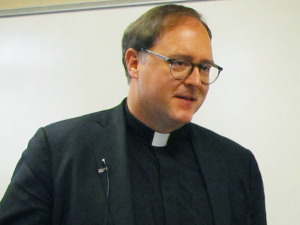 Menke went to Rome for a temporary summer assignment in 2010. That turned into a full-time position with the Vatican’s Congregation for Divine Worship and the Discipline of the Sacraments. In 2015, he came back to the United States to take a liturgy position with the USCCB’s Secretariat of Divine Worship. Less than two years later, he was named executive director of the office.
“We assist the bishops in anything having to do with the official prayer of the Church, the liturgy or divine worship,” Menke said in an interview with the Southern Nebraska Register. “A big part of what we do is to help the bishops to prepare the liturgical books and then also help make sure that the things that are published for clergy and faithful are accurate, and that they represent what the Church wants the liturgical texts to say.”
Father Menke said his work at the USCCB allows him an opportunity to work directly with bishops in their dioceses and even parishes with questions about the liturgy.
“It’s kind of an interesting perspective, in that regard,” he said. “We can kind of see what the Holy See wants us to do. But then we also see what the reality is in parishes. And we try to help bridge that gap a little bit.”
Menke updated the priests on three liturgical areas: the new translation of the Rite of Penance and Exposition and Benediction, the new O.C.I.A. (formerly R.C.I.A.) and the new translation of the Breviary.
Reconciliation
Regarding the Sacrament of Reconciliation, Father Menke said the book that guides the priest has been retranslated, “but the faithful won’t really probably even notice it.” He said the first part of the prayer of absolution will be slightly different, but the essential part of the prayer is not changing. Menke said the book is issued in Latin by the Vatican, and the Church is reassessing the English translation of all of its official rites to make sure they are accurate.
Father Menke explained the Church issued renewed rights for everything after the Second Vatican Council. He said after having its liturgy in Latin for centuries, the Church then had to put it into local languages.
“I think the Church kind of had to feel its way. What should that sound like? Should that sound like conversational English like this? Or should it sound a little bit more formal? And when they made the first attempts, they took the route of making it a little less formal,” he said. After decades of reflection, Church authorities “decided the translation needed to be a little more strictly accurate and should be a little more of an elevated kind of language.”
Father Menke said the work of that translation has been a challenge, but it’s a good challenge.
“It should lead us to chew on these words, and ponder them,” he said. “What does this mean? What am I saying? How am I praising God?”
OCIA
The process for adults wanting to join the Catholic Church will also see some slight changes. The name of that process, the Rite of Christian Initiation of Adults (R.C.I.A.) will change to Order of Christian Initiation for Adults (O.C.I.A.). Menke said the pastors and the teams that help with bringing adults into the faith will have a new guide for that process.
“They’ll have to get to know a new book and a new translation,” he said. “It won’t change fundamentally what happens in the course of the process, but they just will have to get used to a new book.”
These slight changes to the liturgical process are part of an ongoing effort to make sure the translations being used in the Church are accurate and true to the intent of the original documents. However, as Father Menke pointed out, today’s liturgy is not different in its essence than the ancient liturgy.
“In its essence, not at all. The same thing happens,” Menke said. “We believe that the bread and wine become the body and blood of Christ, that the sacrifice of our Lord is re-presented to us mystically on the altar, and that we have the ability to participate in that and to pray with that and to ask mercy and repentance from the Lord. And if we’re ready, to receive Holy Communion. So that’s the same thing that’s been happening for 2,000 years.”
Menke said it was after the Second Vatican Council when the Church faced “a pretty massive change.”
“So the essence is the same, but the expression is very different,” he went on to explain. “It used to be very strictly Latin and basically led by the priest and the sacred ministers. The faithful participated in their minds and hearts, not so much with their mouths. After the Second Vatican Council, the rights have been simplified to some extent. They’ve been put into the local languages so you can hear what’s going on. There’s more participation in the sense of things for the faithful to say and to do. They have a part to play. So in that sense, yes, it looks a lot different than it did in the past.”
Liturgical prayer, personal prayer
While Father Menke has spent years studying liturgical prayer, he also recognizes the importance of personal prayer. He said they complement each other and are the “two lungs” of the Church body. Each has an important part to play.
“Liturgical prayer is where we pray as a community. We’re the Body of Christ and we all belong together,” he said. “We all have a part to play; we all need to pray together. That’s the model that the apostles gave us. We see it from the beginning.”
He said in liturgical prayer you have to put aside your own personality and understand you may have designed it differently, but it’s important we pray together in this way. Personal prayer, though, is also important.
“It’s a very personal relationship with the Lord,” Menke said. “And it’s as different as we’re different. I know people have different personalities; people talk to God in different ways. And that’s a beautiful thing. We’re all in different places. Some people are joyful in this moment, other people are suffering in this moment. And we take all these things in our personal prayer.”
In both liturgical and personal prayer, Father Menke said one thing important to keep in mind is that both are sacred.
“When you step into a Mass, you should feel like you’re doing something different,” he explained. “You’re not at a talk show. You’re not at a play. You’re worshipping God. And it should be like you’ve left the secular world and now you’re in the world of the worship of God. And I think we might fail in that in some ways. Not that it should be robotic and artificial, but the way that we speak, the way that we sing, the way that we decorate our churches, all those things can send a message that this is something sacred. And sometimes I don’t think we do that as well as we should.”
Healing, respect
Working in the USCCB’s office dedicated to liturgy, Father Menke has seen firsthand the passion many Catholics have for the way the liturgy is celebrated. He said that passion is a good thing because it means people care about the liturgy and what it looks like.
“But it is very frustrating at times when you see, living in a time where the secular world is so against us and so many Christians have fallen away from their faith, you hate to see Catholics fighting each other, because they disagree about what the liturgy should look like,” Father Menke said. “Family members can scuffle, I get that. But when it gets to the point where there’s animosity and that kind of thing, it’s just very, very frustrating. So as much as we can we try to promote some healing and be respectful of different opinions.”
Menke said if he gets the opportunity to return to the Diocese of Lincoln, he would look forward to being the pastor of a church. He said he spent 10 years in parishes before he left for Rome, but didn’t have the opportunity to be a pastor. If that happens, he hopes to be able to use the experience he has gained at the Vatican and with the USCCB to help his parishioners increase in faith and love, especially of the liturgy.
“I’m not going to pretend that I have all the answers,” he said, “but I guess I would hope that someday if and when I’m a pastor, I can take the sacred liturgy in the parish seriously and try to make it as good as I can. And then encourage the faithful in their own spiritual lives.”
Watch the Southern Nebraska Register’s interview with Father Andrew Menke on our YouTube channel:
