

Q. Can I send my guardian angel to protect a loved one?
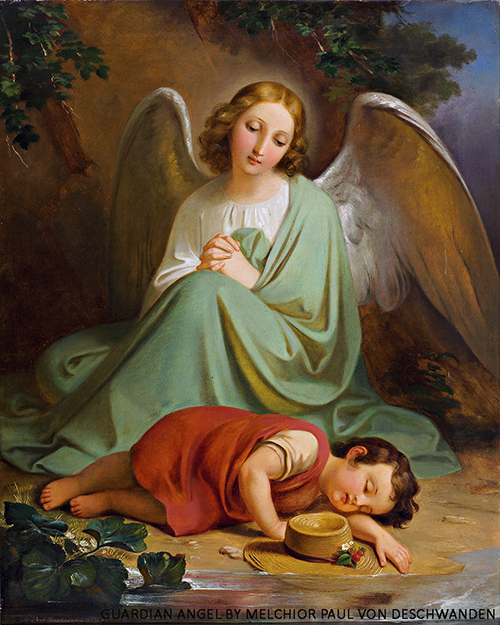 A. Like most Catholic children, I remember praying the “Guardian Angel Prayer” every night before bed. I was very faithful to this prayer. The idea that I had a special angel watching out for me was comforting— again, like I imagine it is for most children.
It seems to me that, culturally, Catholics do a good job of explaining to children that they have a guardian angel and that they should ask for their angel’s help when they are scared. It seems though that, because we focus so much on guardian angels with children, it is easy for all of us to fall into the mindset that guardian angels are a simply a nice idea that we tell to children to help them sleep at night.
This could not be further from the truth. Scripture is full of references to angels as guardians. The Church Fathers loved talking about angels, especially guardian angels. In a homily on the psalms, St. Bernard of Clairvaux said, “Heaven denies us nothing that assists us” and therefore guardian angels “have been placed at our sides to protect us, instruct us, and to guide us” (Sermo XII in Psalmum Qui habitat). God loves us so much and so desires that we be free to love Him back that He assigns angels to be the guardians of His people.
While the idea that every person has a personal guardian angel is not technically doctrinal teaching (it is possible that angels guard multiple people), the fact that angels are appointed guardians is doctrinal: “From its beginning until death, human life is surrounded by their [angels] watchful care and intercession.” (CCC 336). The idea that every person has his or her own guardian angel is clearly implied in Scripture and held by many of the Church Fathers, so there is very good reason to believe that it is true.
The role of our guardian angel is to provide “watchful care” and “intercession.” They assist us in making prudent decisions and in prompting us in big ways and in little ways. More importantly, they are our constant intercessor, praying on our behalf. Knowing that we have a guardian angel is meant to fill us with “serenity and confidence in facing difficult situations, since the Lord guides and protects the faithful in the way of justice through the ministry of His Holy Angels” (Directory on Popular Piety n. 216).
As far as sending our guardian angel to help someone, as far as I am aware, the Church does not have a definitive position on this. However, if we think in terms of asking our guardian angel to pray for someone, then we can certainly do that.
Guardian angels are a beautiful expression of God’s love for us, but like all things that are not God, we need to be careful about getting too caught up in the role they play in our lives. Issues can arise when “the daily events of life, which have nothing or little to do with our progressive maturing on the journey towards Christ are read schematically or simplistically, indeed childishly, so as to ascribe all setbacks to the Devil and all success to the Guardian Angels” (Directory on Popular Piety n. 217). Also, “the practice of assigning names to the Holy Angels should be discouraged” (ibid.) since it belongs only to God to give names to His angels, as He did with Gabriel, Raphael, and Michael.
Guardian angels are great, but they are great because they manifest God’s love and solicitude for His people. They should be a source of comfort for us, and we should turn to them for assistance throughout our daily lives, but they are not God. If we spend more time focusing on our guardian angel than God, we need to reorient our focus back to Him.
This question was answered by Father Caleb La Rue, chancellor of the Diocese of Lincoln. Write to Ask the Register using our online form, or write to 3700 Sheridan Blvd., Suite 10, Lincoln NE 68506-6100. All questions are subject to editing. Editors decide which questions to publish. Personal questions cannot be answered. People with such questions are urged to take them to their nearest Catholic priest.
