

On December 8 we celebrate the Solemnity of the Immaculate Conception of the Blessed Virgin Mary.
The Solemnity of the Immaculate Conception has particular importance for us. The United States Bishops proclaimed Mary, under the title of the Immaculate Conception, to be the principal patroness of the United States. Under the same title, Mary is the patroness of the Diocese of Lincoln. And under this title, Mary is close to us at St. Gregory the Great Seminary because our chapel is the Immaculate Conception Chapel.
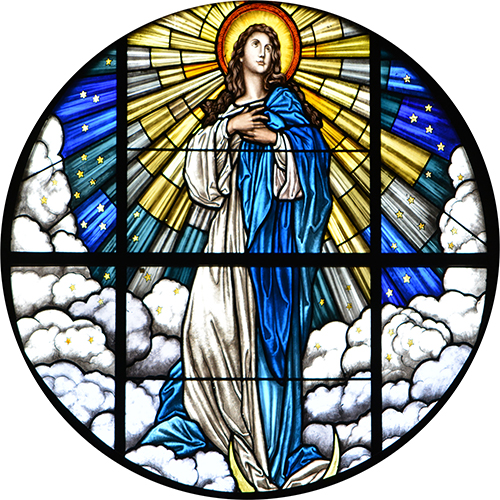 Several of the parishes in our diocese have also been named after Mary’s Immaculate Conception. Having a patron or patroness named for us gives us particular connection with that holy person and a special opening for seeking his or her intercession in heaven.
Sometimes there is confusion about this celebration. Very often people think of it as the conception of Jesus in Mary’s womb. That confusion is sometimes made stronger by the Gospel reading for the Mass that day. It comes from St. Luke’s account of the Annunciation when the Archangel Gabriel came to Mary to announce God’s plan that she become the mother of Jesus (Lk 1: 26-38).
However, this celebration is about Mary’s conception in the womb of her mother, St. Anne.
The Church uses this Gospel because the angel Gabriel’s greeting to Mary tells us something very important about her. Gabriel says, “Hail, full of grace! The Lord is with you.” Lucas Pollice, a professor of theology at the Augustine Institute, says that a more accurate translation of the Greek is “Hail, you who have been filled with grace.” It indicates something that has already been accomplished, even though for her to be filled with God’s grace would seem necessarily to have waited until after Jesus had atoned for our sins and restored our relationship to the Father through His Passion, Death, and Resurrection. It indicates that somehow Mary had been preserved from Original Sin.
When Adam and Eve followed the lies and temptations of Satan, they gave themselves into the dominion of Satan and broke their friendship with God. Human beings descended from them inherit their humanity as it was harmed by that sin. That includes all of us, and we enter the world not full of grace. The consequences of that sin were spelled out in Genesis chapter 2 and included that they (and we) would die, would labor with great difficulty for our daily bread, and that there would be an enmity between the offspring of the serpent and the offspring of the woman. The Fathers of the Church saw a glimmer of hope revealed in that the offspring of the woman would crush the head of the serpent.
This would be accomplished in Jesus, who would overthrow Satan and restore to us humans the possibility of relationship with God by taking on Himself the consequences of our sins. God would enter our history as one of us, taking to Himself our human nature, being born of Mary. However, the Fathers of the Church thought, if Mary was tainted by sin, would that not make for something unsuitable—that the all-holy God would take His human flesh from one tainted by sin? The Fathers of the Church believed it was suitable that God do something special to preserve Mary from contact with sin, that He could because He is all-powerful, all-merciful, and not bound by time, and that this had been done was revealed in Gabriel’s greeting as reported in the Gospel passage.
This requires some careful thinking, and it may seem complex to some, but we are blessed that those Fathers of the Church studied, reflected, and prayed about these things to provide the insights to support our Faith. The belief in the Immaculate Conception of Mary was widely held through the history of the Church, and in 1854, Pope Pius IX in the document Ineffabilis Deus officially declared this to be a teaching of the Church to be held by all. He said:
“We declare, pronounce, and define the doctrine which holds that the most Blessed Virgin Mary, in the first instance of her conception, by a singular grace and privilege granted by Almighty God, in view of the merits of Jesus Christ, the Savior of the human race, was preserved free from all stain of original sin, is a doctrine revealed by God and therefore to be believed firmly and constantly by all the faithful.”
A reflection on this, which is particularly helpful to me, is that it reflects the amazing care and work of God on our behalf so that we would be able to live in relationship with Him. From St. Pope John Paul II’s Theology of the Body, we understand that we are created by God out of love and for love. God’s intention is that we could live in that relationship of love with Him that would last forever in heaven. Satan’s temptation and successful overthrow of Adam and Eve’s connection with God through sin opposed that desire of God, but God would not let that be the final answer. The Catechism of the Catholic Church, paragraph 55, teaches: “After the fall, [God] buoyed them up with the hope of salvation, by promising redemption; and he has never ceased to show his solicitude for the human race. For he wishes to give eternal life to all those who seek salvation by patience in well-doing.”
The whole of the Old Testament gives the history of God caring for his people, helping them to know Him and follow Him, that they might live in relationship with Him. All these pointed to Jesus and prepared for his arrival when, in the fullness of time, God entered our human history to save us. It is reasonable to look at all of history as God’s labor in love to provide and restore His relationship with us even despite our turning away from him through our sins. The teaching of the Immaculate Conception is part of that marvelous providence of God for our salvation, which included Mary and His spiritual preparation of Mary for her role as the mother of Jesus, Who is at the same time her son and the Son of God.
As we celebrate the Solemnity of the Immaculate Conception of Mary on December 8 by assisting at Holy Mass on the Holy Day of Obligation, perhaps we call to mind the wondrous love and care God has for us by writing the history of the world for our salvation. We remember in a special way God’s immediate preparation for the coming of our Savior by preserving Mary from Original Sin in the moment of her conception in advance of what Jesus, her son who is also Son of God, would obtain for us through His Passion, Death, and Resurrection.
Father John Rooney is vice rector, assistant professor and director of technology at St. Gregory the Great Seminary in Seward. He is also administrator of Sacred Heart Parish in Shelby.
