

Q. Why is the Precious Blood not normally distributed during Masses in the Lincoln Diocese?
A. The short answer is because the Bishop of Lincoln has determined not to. The reasons behind this decision can broadly be categorized as an argument from tradition, practicality, and Eucharistic theology.
Tradition
The first is an argument from tradition. Beginning with Our Lord at the Last Supper, in which He instituted the Sacrament of the Eucharist and gave us His Body and Blood under the appearance of bread and wine, distribution of both the Precious Body and Blood was the norm in the Western Church, until around the end of the 12th and beginning of the 13th century. By this point, it had become a general custom to not distribute the Precious Blood “in order to avoid various dangers and scandals” (Council of Constance Session 13), including spilling the Precious Blood, and people becoming inebriated from over-consuming the Blood of Christ.
This custom had its critics, most notably the Utraquists. Utraquism was a heresy closely tied to the teachings of John Wyclif whose central belief was reception of both the Precious Body and Blood being necessary for salvation. They also believed that by receiving both species one received more grace.
As a response to this, and out of a belief that the custom of not distributing the Precious Blood was in the best interest of the Church, the Council of Constance in 1415 decreed that, “since this custom was introduced for good reasons by the church and holy fathers, and has been observed for a very long time, it should be held as a law which nobody may repudiate or alter at will without the church’s permission” (Council of Constance Session 13). The Council then went one step further and established that a priest who communicates the people under both species was excommunicated.
The Council of Trent, in its Twenty-First Session in 1562, said essentially the same things as the Council of Constance, acknowledging that, while it has not always been the case that only the Precious Body is distributed, it has become customary and, given both practical and theological issues that have arisen with regard to the distribution of the Precious Blood, it will continue to be the law of the Church that the Precious Blood not be distributed at Mass unless the Church decides to change this. Of course, this is what happened at the Second Vatican Council, in 1963.
As part of the Council Fathers’ intention to return to more ancient liturgical practices, the Church allowed for the distribution of the Precious Blood during Mass: “The dogmatic principles which were laid down by the Council of Trent remaining intact, communion under both kinds may be granted when the bishops think fit, not only to clerics and religious, but also to the laity” (Sacrosanctum Concilium n.55). The diocesan bishop was given the competence to determine how and when (or if) the Precious Blood would be distributed within his diocese.
So, while there is a strong argument from tradition justifying the distribution of the Precious Blood, there is also a strong argument from tradition to support not distributing the Precious Blood.
Practicality
A second argument can be made from the perspective of practicality. Unlike the Precious Body, the Precious Blood cannot be stored for later consumption. Therefore, care has to be taken to avoid the danger that “more than a reasonable quantity of the Blood of Christ remains to be consumed at the end of the celebration” (Missale Romanum, Institutio Generalis, n. 285a). Having been present at Masses where the Precious Blood is consecrated in large amounts and not consumed by the faithful, I can tell you there are few less reverent experiences than consuming an entire chalice of the Precious Blood. Add to this the dangers of spilling, and the logistical issues of making sure there are enough ordinary ministers of Holy Communion, and some bishops have determined that, from the perspective of safeguarding the Precious Blood, it is best not to distribute the Precious Blood on a regular basis.
Theology
The final argument is a theological one. Communion under both species is helpful so that “the fullness of the sign may be made more clearly evident to the faithful in the course of the Eucharistic banquet” (Redemptionis sacramentum n.100). But while it is helpful for symbolic value, the constant teaching of the Church is that when receiving the Precious Body one receives “all the fruit of Eucharistic grace” (CCC 1390). One does not receive “more” Jesus by receiving the Precious Blood, in the same way one does not receive “more” Jesus by receiving a larger piece of the Precious Body.
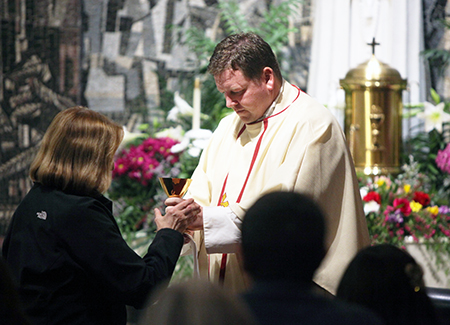
These reasons, as well as others, have led the bishops of the Diocese of Lincoln to not permit the Precious Blood to ordinarily be distributed at Sunday Masses, though it is allowed in certain circumstances such as Corpus Christi, Holy Thursday, newly ordained priests’ first Masses, weddings, and weekday Masses at the discretion of the pastor or celebrant. Because this is a prudential decision, our current bishop or a future one could change this policy and Catholics are free to disagree with it. We are, however, all of us, bound to follow it.
This question was answered by Father Caleb La Rue, chancellor of the Diocese of Lincoln. Write to Ask the Register using our online form, or write to 3700 Sheridan Blvd., Suite 10, Lincoln NE 68506-6100. All questions are subject to editing. Editors decide which questions to publish. Personal questions cannot be answered. People with such questions are urged to take them to their nearest Catholic priest.
