

by Dennis Kellogg,
director of communications
LINCOLN (SNR) - Catholic school students in the Diocese of Lincoln have maintained or improved their academic performance for the past five years, despite the challenges presented by a worldwide pandemic. That’s the conclusion of diocesan education administrators after an analysis of data from the Iowa Test of Basic Skills (ITBS), given annually to all students in grades three through eight in the diocese.Schools also have the option to test ninth-graders.
The testing results show students at all grade levels performing at a two-to-three higher grade-level equivalency across all subjects. The subjects tested are reading, English language arts, math, science and social studies.
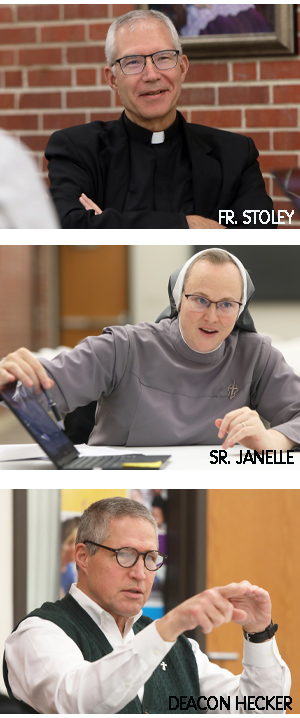 “I think it shows the resiliency of our kids, it shows the dedication of the parents and the teachers,” said Father Lawrence Stoley, superintendent of Catholic schools for the Diocese of Lincoln. “I mean those weren’t easy years, and yet despite all of the obstacles, they not only maintained, but they made advances.”
Jeremy Ekeler, associate director of education policy for the Nebraska Catholic Conference, said the data emphasizes the great work being done in Catholic schools in the state.
“These test results validate the hard work of our teachers. There are none better than those in the Catholic dioceses of Nebraska, period,” Ekeler said. “Our students’ successes during COVID are due to that good work built upon a well-established foundation: our schools partner with families for the sake of young people.”
The data analyzed covered ITBS testing from 2018-2022 in the diocese. The testing for all those years was compared to a “normative” test done in 2017, before COVID began affecting schools and learning across the world.
The analysis by the diocesan education office focused in particular on seventh- through ninth-grade students because that offered the most number of years of test data, according to Father Stoley. On average, 479 to 511 students were tested each year at each grade level analyzed across the diocese. Father Stoley said the data show above grade-level equivalency performance on average by students across all grades tested.
“We didn’t take a hit like much of the nation did during COVID,” said Sister Janelle Buettner, principal of North American Martyrs School in Lincoln.
The Diocese of Lincoln analysis showed, for example, eighth graders are performing, on average, at 10th grade and six-month grade competency levels in English Language Arts, which covers reading, written expression, conventions in writing, vocabulary, spelling, capitalization and punctuation. In the complete composite scores, which include English Language Arts, math, science and social studies, eighth-graders are performing, on average, at a 10th grade level.
The National Assessment of Educational Progress (NAEP) showed nationwide declines in math and reading scores. In math, the average eighth grade score dropped to its lowest level in several decades.
The local ITBS data show eighth-graders in Catholic schools in the Diocese of Lincoln performing at the equivalent of three grade levels above their current grade in math.
“Math was our largest increase for eighth graders,” Sister Janelle said.
The results show a similar positive performance when considering the national percentile rank of students in the diocesan schools. The national percentile rank compares the scores of students across the country in the same grade level who took the ITBS test. The 50th percentile in the rankings means half of the students who took the same test scored lower, and half scored higher.
Across the testing data for the school subjects analyzed, diocesan students performed at the 65th to 75th percentile in all subjects. In the complete composite across all subjects, seventh-grade students in Lincoln Diocese schools performed at the 68th percentile, eighth-graders at the 67th percentile and ninth-grade students at the 69th percentile, when compared to students across the country. In English Language Arts, seventh-, eighth- and ninth-graders performed at the 74th, 72nd and 75th percentiles, respectively.
The results reflect a positive and consistent academic performance for students in the Diocese of Lincoln despite the onset of the COVID pandemic, which closed schools in March 2020. When students returned in the fall of 2020, many schools operated under a hybrid model, with some students taking classes remotely, but many returning to the classroom. By the end of that school year, almost all students in the diocese were back taking classes in person.
“At the time when (the pandemic) started, it was a very dark time,” Father Stoley said. “One thing I saw throughout the whole time was a really good attitude. (Teachers) were determined not to let this affect their day-to-day living, made extra efforts to laugh when they could and enjoy the good things that they could at the time, and that spread to the student population and I think that took their anxiety level down a little bit and they realized we can get through this, and we did.”
Father Stoley said all teachers had to work harder to address the needs of students. Stoley, who is a longtime teacher and administrator in the diocese, said educators had to create plans and often put them online for students who were out with COVID, as well as address the needs of students in the classroom and those at home learning at the same time.
“Doing a lesson plan was really like doing a plan and a half,” Father Stoley said.
“It was a heroic effort,” said Deacon Matthew Hecker, Ph.D., chief administrative officer of Catholic schools for the diocese since 2018.
Deacon Hecker said when students did mostly return to the classroom in person, teachers faced another challenge.
“They needed to develop more differentiated instruction because not everyone was at the same place at that time,” he said.
Teachers and parents also had to be in tune to students’ mental health needs as they returned to school.
“COVID affected everybody,” Sister Janelle said. “Socially, emotionally and academically. We saw the need for helping with mental health challenges. It says a lot about the parents, teachers and students. The mental health of students has gotten better since they returned. We were able to get them back to where they were.”
Ekeler of the Nebraska Catholic Conference said the impressive academic performance of Catholic school students underscores the importance of allowing for school choice in the state, an issue expected to be debated again in the next session of the Nebraska Legislature, beginning in January.
“Catholic schools have once again proven to be an amazing option for families. But sadly, Nebraska is one of just two states without any school choice policy. Catholic social teaching and common sense demand that every family who wishes to attend our schools has access,” Ekeler said.
Father Stoley said Catholic schools are mission-driven and staying true to that mission is an important reason families want their children to be a part of the schools.
“The mission is to serve families and one thing I think we did well is to keep our eye on the mission: what’s good for families given the circumstances; what’s good for kids?” Stoley said, adding, “It’s a good witness to the kids that with our faith there’s really nothing that we can’t overcome.”
Deacon Hecker also pointed to the importance of mission. He said Catholic schools in the diocese emphasize partnering with parents, who are the main educators of their child. Hecker said the ability of parents and teachers to work together to help students continue to learn under such difficult circumstances the past several years has been amazing, but not necessarily surprising.
“It gets us back to the centralizing of our mission,” Deacon Hecker said. “We are Catholic. It’s what our parents and educators opt into. This is more than a job for our teachers – it’s their mission.”
