

With the death of Pope Benedict XVI, his nearly eight-year pontificate, which had, in some sense, perhaps been at risk of being overshadowed by his nearly 10 years as “Pope Emeritus,” can now take its proper place in history. Indeed, we can now dispense with the title “emeritus,” resuming reference to this great servant of the servants of God as Pope Benedict XVI. Yet again, more importantly, we can begin to reflect upon the imprint and legacy that Pope Benedict has left on the Church.
Though not wishing to overlook other outstanding aspects of the legacy that Pope Benedict has left us, not least of all his corpus of three encyclicals or even his revolutionary decision to resign from office, I consider Pope Benedict’s enduring legacy to be found in his commitment to dialogue boldly with the modern world.
This vision was already evident in his remarkable homily as Dean of the College of Cardinals at the Mass “For the election of the Roman 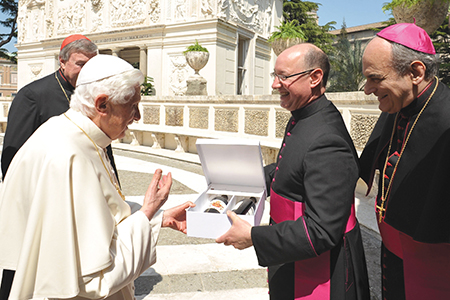 Pontiff” April 2, 2005 (before the conclave which would go on to elect him Bishop of Rome April 19, 2005), where he proclaimed:
“Every day new sects are born and we see realized what St. Paul says on the deception of men, on the cunning that tends to lead into error (cf. Ephesians 4:14). To have a clear faith, according to the creed of the Church, is often labeled as fundamentalism. While relativism, that is, allowing oneself to be carried about with every wind of ‘doctrine,’ seems to be the only attitude that is fashionable. A dictatorship of relativism is being constituted that recognizes nothing as absolute and which only leaves the ‘I’ and its whims as the ultimate measure.”
Of course, together with Pope St. John Paul II, Pope Benedict XVI had already set out as Prefect of the Congregation for the Doctrine of the Faith to lay a new and robust theological foundation for all matters of Church life, both to catechize the Christian faithful and to evangelize the modern according to the authentic vision of the Second Vatican Council. Both at Pope St. John Paul II’s right hand and then throughout his pontificate, Pope Benedict developed this “hermeneutic of continuity,” as he called it, to describe the harmonious development throughout salvation history of the whole of Catholic teaching, notably including the interplay of faith and reason, biblical studies, wide-ranging matters of moral theology, ecumenism, evangelization, social justice, and the Sacred Liturgy.
Indeed, it was in this context that I first met the then-Cardinal Joseph Ratzinger in New York, as he had come to give the Erasmus lecture at St. Peter’s Lutheran Church January 27, 1988, which laid out a compelling case for rooting modern biblical studies in the whole of the tradition from the Fathers of the Church forward. Ironically, this scholarly lecture has come to be remembered as much or more for having been interrupted by activists, but I will ever remember his calm and erudite presentation, even while under provocation.
Indeed, the then-Cardinal Ratzinger’s remarkable manner in conducting curial meetings at which I was asked to participate is something I will always treasure. Pope Benedict XVI could listen, reflect, integrate and then synthesize a discussion of a group of curial heads unlike any other. In consequence, meetings he conducted were incredibly productive and came to be, for me, emblematic of what a meeting ought to look like. In Rome, Pope Benedict was universally held in the highest regard for this amazing gift.
One of my most treasured memories of Pope Benedict XVI will be the luncheon that I was honored to attend April 28, 2010, in celebration of our successfully completing the retranslation of the Roman Missal in fidelity to the original texts. The Pontiff recognized the importance of this project for the English-speaking world, and he wished to celebrate its completion with his brother Cardinals and Bishops of the commission that had labored to see this good work brought to completion.
For the luncheon, I was tasked with a small but wonderful assignment: to choose the wines for the meal from among the English-speaking countries of the world.
As we bid farewell to this successor of St. Peter and fellow Christian, we join together in crying out, Well done good and faithful servant!
Msgr. Thomas Fucinaro has been pastor of the Cathedral of the Risen Christ in Lincoln since February 2022, when he returned from 25 years of service to the Holy See as an Official in the Vatican Congregation for Divine Worship and the Discipline of the Sacraments.
