

Southern Nebraska Register
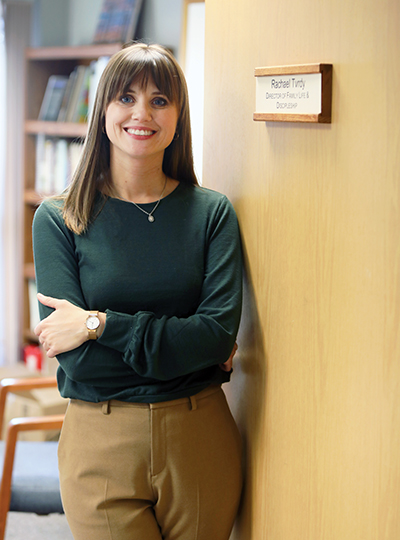
Rachael Tvrdy was hired in November to be the director of Family Life & Discipleship. She spoke with the Register about her background, and how her office will support parishes in fostering parish-based discipleship, and strengthening the spiritual life in the Diocese of Lincoln.
Tell us about your background. You’re no stranger to the Diocese of Lincoln.
I was born and raised in Lincoln. I attended Blessed Sacrament School and Pius X High School. I graduated from the University of Nebraska-Lincoln with a bachelor’s in family science.
After college, I worked as a foster care visitation worker. I monitored visits between foster children and their biological parents, documenting the interactions and evaluating for safety. I witnessed the unaddressed generational trauma at the root of the broken foster care system which often remains untreated. I sensed that social work was not my path and instead felt a call to become a FOCUS missionary, serving at the University of Florida and Vermont from 2012-2015.
After FOCUS, I felt a more distinct call, not just to be a missionary, but a missionary for the family. This led me to the Pontifical Institute John Paul II for the Studies on Marriage and the Family in Rome, where I earned my master’s in marriage and family sciences in 2017.
 What did you take away from the time you spent studying at the John Paul II Institute for Marriage & Family in Rome?
What was most impressed upon me was that the family is the vehicle for New Evangelization. This vision has informed all my professional efforts. My master’s program was specially formulated as a multidisciplinary degree, studying God’s plan for love, family, and the human person.
Pope John Paul II created the Institute because he “loved human love.” For each Wednesday audience, he spent the first five years of his pontificate preaching on the Theology of the Body. This was intentional, as he knew we were entering turbulent times culturally, and needed the Theology of the Body to refute the culture’s lies. I also understood the role of the Domestic Church and how prominent the family’s role is in the future of the Church. This is precisely why the family is under such great attack; because it’s the primordial cell of society and reveals God’s image, who is Himself a communion of love.
What kind of work did you do with the Fellowship of Catholic University Students (FOCUS)?
On campus, you have to slowly earn trust by spending many hours with students before mentioning God or religion. Many students, particularly at the University of Vermont, one of the most liberal campuses in the country, grew up with no faith whatsoever. Speaking about religion, in general, was quite taboo and was met with hostility.
On a day-to-day basis, discipleship looked like sharing life: going out to eat, working out together, having conversations, and eventually inviting them to Mass, Bible study, or Newman Center events. When you hear the word “discipleship,” it may sound intimidating but it is surprisingly simple. It’s about walking with someone, in friendship, toward a person: Jesus Christ. The way we win others over to the faith is less through words spoken and more through time spent.
You most recently worked in a similar position for the Archdiocese of Omaha. How will that experience influence what you’ll be doing in the Diocese of Lincoln?
While working for the Evangelization and Family Life Office in Omaha, my role was “Marriage Preparation and Marriage Enrichment Coordinator.” My heart has always been in marriage preparation. I see it as a critical moment when many young adults come to our doors looking for a sense of belonging.
Around 1,200 couples are married yearly in the Archdiocese, and I coordinated and ran our marriage prep retreats. The couples seemed disengaged, as if they were at a traffic class. Couples were disengaged because the process was information focused, not relationally focused. Based on this, I piloted a marriage mentoring approach called “Witness to Love.” Its primary goal is for engaged couples to root themselves in their parish family through friendships with other married couples. This friendship goes beyond the wedding day, leading to lasting support and a lifeline to the community.
An unofficial part of my role was the young adult apostolate in Omaha. I hope to continue to empower young adults to form a network and space for socializing, formation, and activities. This approach was very fruitful, primarily because young adults, who often don’t feel like they fit in our parishes, are hungry for a space to call their own.
What are some of the ministries you’ll be working with as the director of Family Life & Discipleship?
In the Family Life Office alone, there are many ministries that Father Sean Kilcawley and his staff have been faithfully running for the last 10 years, which include: Engaged Encounter, marriage enrichment, divorce support, grief/bereavement, fertility awareness, chastity education, youth ministry, and the freedom from pornography apostolate. We have great, dedicated leaders who coordinate these essential ministries, and I hope to expand their resources and recruit more lay leaders to serve in future years.
Regarding discipleship, I have been privileged to be a student of the Encounter School of Ministry (ESM). All discipleship starts from a lived encounter with Christ, which is what ESM encourages. In my opinion, there is no better discipleship formation out there, and I would love to encourage the families of our diocese to join this program.
So often, we focus only on individuals in discipleship efforts, but I propose we begin by engaging whole families. We should encourage married couples to enroll in these programs because Christ sent the apostles out in pairs. His own directive in the Gospels provides a framework for spouses to become “marriage disciples” sent out two by two.
What is your long-term vision for the Diocese of Lincoln with regard to family life and discipleship?
When I think of my long-term vision, it is not necessarily my own. It is the vision of Pope John Paul II. It is the restoration of the domestic Church. I strongly recommend various approaches: Witness to Love, small groups focused on family spirituality, such as Domestic Church or the Together in Holiness series, and more offerings tailored for families growing in their faith.
Religious and priests receive seven years of formation for their vocation, and engaged couples only receive six months. The extent of that preparation is a weekend retreat and a few meetings with their pastor, which are very valuable in and of themselves, but incomplete without continued accompaniment. This lack of accompaniment often results in parents who lack the tools to pass on their faith to their children.
I’d love to see parents take their role as primary caregivers of their children as a task and responsibility. I encourage families in parishes to form small groups with other families, through whole family catechesis and small groups, to walk and grow together.
Who is your favorite saint, and why? (You can only pick one!)
My favorite saint is St. Thérèse of Lisieux. I attribute my reversion back to my faith in college through praying her miraculous nine-day rose novena.
