

By Reagan Scott
for the Register
When she was in the fourth grade, Maren Cherovsky was able to begin the school year at St. Wenceslaus Elementary in Wahoo. Coming from the Lincoln Public School (LPS) system, what made the switch notable was the fact that Cherovsky, who is Deaf, would have the support of a sign interpreter at her Catholic school.
Cherovsky was born Deaf and uses a cochlear implant (C.I.) to access the world around her. She started school with LPS, which has a program for Deaf and hard of hearing students, but lived in Wahoo and had a daily commute of up to 40 minutes each way.
“My parents felt that it was the right time and age [to switch], and they wanted me to go to school in the city I lived in,” Cherovsky said.
That first school year, Cherovsky was able to join her cousin’s class, and said the transition was a smooth one. Today, she is a senior at Bishop Neumann High School, also in Wahoo, where she enjoys taking Spanish and participating in trap shooting. 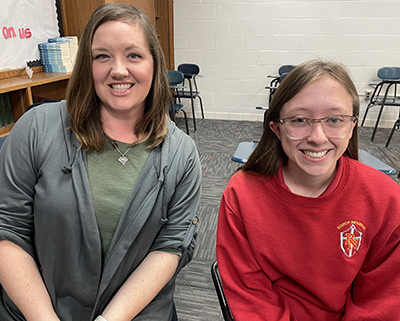
Nickie Oliva is the second interpreter Cherovsky has been with in her time at Saunders County Catholic Schools, and has been working with Cherovsky since she was in seventh grade.
Cherovsky said that at first she wasn’t eager to accept Oliva’s help interpreting; Oliva describing her as “fiercely independent.”
“The first week, I thought I didn’t want her,” Cherovsky said, laughing. “But I’m really lucky to have her. I haven’t had a relationship with an interpreter like I’ve had with Nickie.”
Oliva is in her 15th year in the field, having graduated from Eastern Kentucky University with a bachelor’s degree in interpreting in an education setting.
“There are a lot of different ways you can go with sign language,” Oliva said. “I wanted a schedule that would work for being a mom.”
Looking back, Oliva can see God’s hand in her career. Her interest in signing began when she was 10. The first boy who asked her to dance was Deaf, and asked her in sign language. When she was 12, her grandma gave her a sign language dictionary for Christmas. She also had the opportunity to work with Deaf and hard of hearing individuals as part of a study abroad program in England.
Now, Olivia is the parent of a child with hearing loss. Her son has mild to moderate hearing loss in both ears and wears hearing aids. He uses an FM system to support his hearing, as does Cherovsky.
Oliva explained that the FM system is “a mobile microphone [Cherovsky] can carry from class to class, that is connected to her cochlear implant.”
Cherovsky’s teachers and classmates can wear the microphone in class, during group work and presentations, and the audio signals are transmitted to a receiver in Cherovsky’s C.I.
“It’s funny; should the teachers forget to pass the FM [device], Maren’s classmates are so well adapted at using the microphone that they will remind the teacher to pass the microphone before starting a read-out-loud activity, or presentations,” Oliva said.
In addition to the FM system that Cherovsky uses, Oliva interprets for her in each of her classes throughout the day. She uses American Sign Language (ASL) to communicate what Cherovsky’s teachers and classmates are saying.
“I position myself in an area where I will be visible to her. You can find me standing close to the teacher to eliminate visual fatigue Deaf and hard of hearing students have,” she said.
This close proximity helps eliminate what Oliva calls the “ping-pong effect,” wherein a Deaf or hard of hearing individual has to look back and forth between a speaker and interpreter. This also helps prevent visual fatigue for Cherovsky, who has Retinitis Pigmentosa, which is the narrowing of the visual field.
Oliva said there has been lots of interest in sign language among the students, who have the opportunity to see it used throughout the day.
Cherovsky said, “There’s definitely been an interest in ASL; a lot of students have been very helpful and supportive. A lot of them want to know, ‘What’s the sign for this word?’ Or they want to know their name sign.”
Name signs, Cherovsky and Oliva explained, are signs given to a specific individual, created based on a particular attribute for that person. Name signs keep users of sign language from needing to spell out (fingerspell) the names of people with whom they interact or who they reference frequently.
Oliva also interprets for Cherovsky at school assemblies, and finds it amusing to see the younger students sometimes mirroring her facial expressions while she signs.
“I use a lot of facial expressions to express the spirit of the speaker,” Oliva said. “If they’re upset, your facial expressions have to match that.”
Last summer, Cherovsky travelled to the United Kingdom as part of an English class trip, and Oliva was able to accompany her as an interpreter. Tricia Meduna, a fifth-grade teacher at St. Wenceslaus who is hard of hearing, was also able to join the group.
“I had been wanting to go on the trip and thought I could help chaperone,” Meduna said. “When I heard Maren and Nickie would be going, I knew I would get more out of it with Nickie interpreting.”
Cherovsky said it was fun to see all the places she’d read about during the school year, and that she and Oliva “definitely grew closer” as a result.
In classes and activities, the students at Neumann have had the benefit of exposure to sign language, not only in their encounters with Oliva, Cherovsky and Meduna – who previously taught junior high and high school math and science at Neumann – but also Ann Lombardo, the school librarian.
Lombardo is Deaf and uses a cochlear implant. She was diagnosed with progressive hearing loss as an early teen. After completely losing her hearing, it was 10 years before she got a C.I., which she said enabled her “to be in the hearing world again.”
Lombardo said the staff and students at Neumann have been incredibly supportive, and allow her to advocate for herself and her needs.
“I tell my students, ‘I can’t promise you we’re not going to miscommunicate,’” Lombardo said. But where misunderstandings occur, Lombardo is able to teach individual signs to students, to help bridge the communication barrier.
If Lombardo sees Oliva and Cherovsky in the hallway, they’re signing to one another.
“You can’t sign in public without people looking at you,” she said.
Meduna, who teaches sign through Southeast Community College, brings sign language education to her own classroom, as well. She teaches her students a couple signs a day so they can build on what they’ve learned.
Like Lombardo, Meduna was born with full hearing, but contracted chicken pox and a high fever when she was 5 months old. The fever damaged the nerves in her ears, and while this did not completely deafen her, she does rely on hearing aids.
She said she hopes her story is one that motivates her students.
“I want them to see that if I can do it, they can do it. We’re all going to have struggles, we all have weaknesses, and we have to go out of our way to ask for what we need. If I have misunderstandings with my students it’s OK. We’ll just ask each other to repeat.”
Meduna has loved having the opportunity to live her faith in a Catholic school setting.
“I can’t imagine being able to help someone without sharing my faith,” she said.
When Lombardo moved to Colon with her husband, she worked for an area public library before the desire formed to work in a more faith-based environment. She has enjoyed working at Neumann the past three years.
“It’s been awesome,” Lombardo said. “Any Catholic community is at its best when we don’t take for granted that we’re in a Catholic setting.”
She said she really encourages Catholic schools to hire people with disabilities, and thinks there should always be a goal and desire to make sure Catholic schools are moving in a direction where they can be as accessible as possible.
“I can’t tell you how loved I’ve felt here, with a disability,” Lombardo said. “Neumann has been so awesome for me that way.”
Oliva has also loved the strong sense of community at Neumann. When she and her husband were both diagnosed with cancer within three months of each other during the 2017-2018 school year, the school rallied around them, holding fundraisers and offering support.
“It brings joy to my heart,” she said. “The community has just been amazing.”
___
Sign language - Modes of communication
By Reagan Scott
for the Register
Nickie Olivia, Tricia Meduna and Ann Lombardo explained the difference between the modes of communication used by those who are Deaf and hard of hearing.
“The Deaf community typically uses American Sign Language (ASL), whereas in the education system, Signing Exact English (SEE), is the mode of communication used with mostly younger students. The grammatical structures are different, as well as the sign choices,” Oliva said.
Lombardo said ASL is “a complete language unto itself,” that it’s about concepts and pictures, not necessarily English words in order. ASL also has its own grammar and syntax.
SEE, in contrast, involves signing sentences exactly as they’re spoken and written in English, to help Deaf and hard of hearing students learn and understand English grammar and sentence structure.
While SEE uses signs from ASL, the development of this mode of communication also involved creating new signs, such as signs for word endings like “-ing.” However, since SEE is a way of signing the English language, it is not considered a language unto itself, as ASL is.
Meduna said that even now, she’s used to signing with English grammar, since the sign that she learned growing up had grammar in it.
Oliva said, “Typically, as a student progresses through K-12, the mode of communication can shift to a mixture of both SEE and ASL, what we call Manually Coded English (MCE), or also known as Pidgin Signed English (PSE). This is ASL signs, but in English grammatical order like SEE.”
Now, with Cherovsky rapidly approaching graduation, she and Oliva will soon no longer be together in the classroom setting. Cherovsky will attend Southeast Community College, and is still determining what major she would like to pursue.
“Maren and I have gone through a lot in the past few years,” Oliva said. “I’ll miss working with her; I’ll miss working here. It’s amazing to see how much growth she’s had from seventh grade to now.”
They both know their parting will be hard, but are content in knowing they’ll continue to be in each other’s lives. Both of them, perhaps, leaving the Saunders County Catholic Schools a better place than when they joined it.
