

Southern Nebraska Register
Bishop James Conley will celebrate the annual Chrism Mass Monday, April 3, at 5 p.m. in the Cathedral of the Risen Christ, 3500 Sheridan Blvd., Lincoln. All are invited to attend.
Father Christopher Eckrich, master of ceremonies for the Diocese of Lincoln, called Holy Week “the holiest week of the entire year within which unfolds the drama of Salvation.”
Holy Week begins with Palm Sunday and the joyful acclamation of “Hosanna” as the Lord rides in to Jerusalem seated on a donkey. The rich symbolism of the event is seen only in hindsight as the Son of David comes into his city, fulfilling the Messianic prophecies.
“Yet not even three days go by before one of his own turns on him and promises to betray him with a kiss,” Father Eckrich said.
“‘Spy Wednesday’ gives way to Maundy Thursday,” he continued, "when our Lord at his Last Supper gives his apostles a new maundatum or ‘command’ and institutes two of the most important Sacraments: the Holy Priesthood and the Holy Eucharist. The two go hand in hand, as without the priest there is no Eucharist.”
The Mass of the Lord’s Supper on Thursday ends with its attendants in silence. Masses conclude without music, and the Eucharist is reposed so that people may remain in adoration, as at the Garden of Gethsemane with the Lord, attempting to ‘keep an hour’ with him as the apostles did nearly 2,000 years ago.
“Then at midnight our Lord is taken from us, just as he was taken from the apostles when he was arrested, and hidden from their sight,” Father Eckrich explained.
He called Good Friday “a day of unease, of sorrow, of pain, of penance.”
With the death of the Lord, the Church is plunged into mourning, to beg forgiveness for the effect of sin: the innocent death of our Savior.
With Holy Saturday, however, the faithful cling with hope to the Savior’s promise to rise from the dead, and this hope is realized with joy at the Easter Vigil and Easter Sunday.
“As I said, we are familiar with the unfolding drama of Holy Week, we know how the week ends,” Father Eckrich said. “We know how pain gives way to joy, darkness yields to the blazing light of His Glory: ‘The night shall be as bright as day, dazzling is the night for me, and full of gladness.’”
Yet, within Holy Week is the Chrism Mass, a fairly unknown rite, which has deep significance, and is equally rich in symbolism as the other more “well-known” liturgies.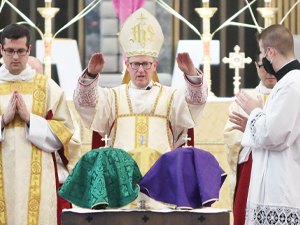
One of the most pervasive elements in the Church’s arsenal is oil. This stems from her history of Judaism in which oil was used in all sorts of applications: to bring soothing to wounds or bodily ailments, as well as for sacred anointings and various forms of consecrations.
When Samuel anointed King David, he took a vessel of sacred oil and poured it over David’s head. It was by that action of being consecrated, or set apart for God, that the “Spirit of God came down and rested upon him.” (1 Sam. 16:13.)
The New Testament also includes expressions of the importance of oil. St. James exhorts the presbyters that if they are called to the bedside of a sick individual, that they are to anoint them with oil, and the sick person will be saved, and the prayers will bring them relief. (James 5:14.) These are the scriptural roots of the Sacrament of Anointing of the Sick.
“Oil is very important in the life of the Church, and still serves many functions to provide spiritual graces to those who use it,” Father Eckrich said.
The Chrism Mass is the Mass in which these Sacred Oils are blessed and consecrated each year for the priests of the diocese. The Oil of the Sick will be blessed by Bishop Conley, and will be distributed to the priests so that when they are called, as St. James foretold, they will go to the bedside of the sick and dying, anointing them and giving them strength from heaven to endure their present trial.
The Oil of Catechumens will also be blessed by Bishop Conley at this Mass, and it will be distributed to the priests, who will use it to anoint those receiving the Sacrament of Baptism.
“This oil disposes the hearts of the catechumens to be more receptive to the graces they will receive in the Sacrament of Baptism,” Father Eckrich explained, “and gives them strength to live out the rigors of Catholicism with added zeal.”
Finally, Bishop Conley will consecrate the Sacred Chrism, the holiest oil in the Church, which takes its name from Christ himself. This oil is used to consecrate things for God, to ‘set them apart’ for his service.
This oil is used when churches are consecrated: the chrism is smeared on the walls, setting apart the building for sacred usage. It is poured upon an altar, consecrating it for the Holy Sacrifice of the Mass.
“Nothing else may ever be done on that altar except consecrating the Eucharist; nourishing the people of God,” Father Eckrich said.
This Sacred Chrism is also used during ordinations, in which a priest is set apart for service to God. The oil is poured upon the new priest’s hands, setting them apart to bring healing, forgiveness, and nourishment. The priest, as an alter Christus is called to be Christ, to allow Christ to be seen in everything he does, to disappear and let Christ shine through his life.
The three oils are blessed and consecrated in the context of this important Mass. Also within this Mass, the priests renew the promises of their ordinations, in which they promised to live a life in service to the Church and to God’s holy people.
“It is after having done so, in a renewed promise of obedience to the bishop,” Father Eckrich said, “that they receive these oils and go back to their corner of the vineyard of the Lord to be Christ to the people entrusted to their care.”
The connection of the Chrism Mass to the very nature of the priesthood is remarkable, which is why this Mass has historically always been held on Holy Thursday, the day the Lord gave the Church the priesthood and the command of service. The Chrism Mass expresses the service each priest is called to live, and is a reminder of the many ways in which the Church provides for the needs of her children: through the sacred oils which provide for the needs of the people in a powerful way.
In the Diocese of Lincoln, the annual Chrism Mass is held on Monday of Holy Week, due to the large area the diocese covers. The Lincoln Diocese encompasses more than 23,000 square miles, so by moving the Mass to Monday, it is easier for the priests of the diocese to travel to Lincoln for the Mass, and return to their parishes for the other Holy Week celebrations.
“So, as we go throughout the drama of Holy Week, as we live the Passion, Death, and Resurrection of Christ in ‘real time,’” Father Eckrich said, “we also remember the ways in which our Lord is providing for his Church, and the many gifts he gives to us, through something as simple as oil.”
