

Fr. Innocent Montgomery grew up in Lincoln and graduated from Pius X High School before entering the Franciscan Friars of the Renewal in 2007. He was ordained a priest and now serves as the local superior for St. Joseph Friary in Harlem, N.Y. He is joined by his brother, Father Angelus, in his work with the Franciscans. Fr. Innocent and Fr. Angelus are both co-hosts of the “Poco a Poco” podcast.
Fr. Innocent recently returned to Nebraska to host a Lenten mission at the Cathedral of the Risen Christ, lead a retreat called “Follow the Lord Little by Little (Poco a Poco)” at Our Lady of Good Counsel Retreat House in Waverly, and provide a series of talks for the priests of the diocese, as well as preach the homily at the Chrism Mass. He talked with Dennis Kellogg, director of communications for the Diocese of Lincoln, about his ministry and his time in Nebraska. What follows is an edited version of that conversation.
Dennis Kellogg, Southern Nebraska Register: Father Innocent, how would you describe your ministry?
Father Innocent Montgomery, CFR: As consecrated men, what we do first is pray. And so there's incredible gifts where as consecrated men were consecrated for prayer. Our main apostolic work is to pray about five hours a day. And so our constitutions lay out this incredible life, and it's challenging. But this is what we're contracted for. Consecrated men are called to be a prophetic witness. It's a prophetic witness to remind us of the one thing necessary, which is intimacy with God, which is prayer.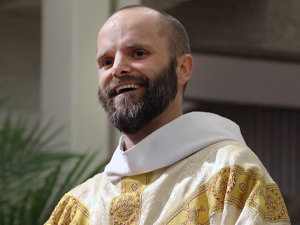
So the first thing we do is pray. And it's from this place of intimacy with Jesus that everything overflows. When you look at the life of St. Francis, I mean, his whole conversion was just wild. And when he had this profound moment of intimacy with God, he started spending time in churches. And one thing he was just captivated by was the Gospel. He knew nothing about the Gospels. He started to read the gospels, he had to ask priests, like what does this mean? What does it mean to “give up everything and come follow me” when Jesus said that? And what does it mean that Jesus healed lepers and hung out with sinners? And so when Francis experiences this, he's captivated. He's like, OK, there's no watering this down, I have to live like that.
So, St. Francis gave up everything, followed Jesus, and he lived like him. So when we talk about our work, we talk about the Gospels, what did Jesus do? I like to say that he lived with brothers, he lived with his apostles and disciples, so there was a fraternity, and then he took care of the poor. When we look at the Gospels, you can't deny the fact that Jesus was attracted to the outcast, to the poor, to the leper, to the sinner.
So as Franciscans that's our identity. That's what we do. We live the gospel. So how that translates 800 years later, for me, for St. Francis, as a brother, we have this beautiful cafe we call St. Joseph's Cafe for the Poor. We renovated this kitchen next door in our apostolic center and it's awesome because it looks kind of like a Starbucks. We invite our neighbors in who are off the street. Sometimes they're drug addicts, homeless, struggle with mental illness, just all very lonely. And we invite them in and we have a meal with them. Coffee doughnuts, we have live music. It's all for free, obviously. And we just spend time with people. And one of the younger brothers recently told me, “I feel like our charism is just like hanging out with people.” (laughs) With the poor, right? So that's a big part of our ministry. And then the other thing is the preaching and evangelization. Jesus traveled around and he preached. And so one of the joys of my life is getting able to travel to places like Lincoln, and you preach the gospel and you visit schools and so a big part of that is just preaching, like Jesus did.
Register: You spend so much time as a Franciscan Friar of the Renewal helping the poor, helping those who are addicted. What do you learn from them?
Father Innocent: One of the ways we evangelize is telling those stories. This friend of mine, his name is Fuego which means “fire.” He's homeless, and there's these little kind of tents that are set up along the way. And we visit our brothers and sisters there. And this is the first time I had met Fuego. I saw him from a distance and he saw me and I just say, “Hey, brother. My name is Father innocent and we just wanted to say hello and see how you're doing and we have some food.”
Immediately, he started to cry and say, “Father, stop, stop. I'm not worthy. You don't want to come over here.” And as I got closer, I noticed the needle marks in his arms. You just noticed this deep, deep poverty. And he's like, “Father, no, like, you don't understand. I'm not worthy, You shouldn't be here.” And the grace of the Holy Spirit at that time to not be afraid and to kind of get on his level, like to kneel down to him and look him in the eyes. And he just couldn't believe that anyone would come close. And at this point, again, he's crying. And it's like, ”Brother, it's okay. I just want to remind you, that no matter any of this stuff that Jesus just loves you.”
And again, with more tears, he says, “Father, no one's ever told me that before.” And so we became fast friends, and I know my presence there can't fix him. Now, if God wants to, praise God, but it's not about fixing, it's about being with and Jesus breaks into the isolation and the darkness. And so that moment, Fuego experienced Jesus, and His love for him, and I just was able to remind him that he's loved even in his darkness. Jesus doesn't wait until you're not addicted to drugs, or like you can get your life together. He comes and He loves us.
And so that happened and I had visited him several more times after that, but it was Holy Hour that night. We had a Eucharistic Holy Hour every day. And I was sitting with the Lord and I was like, man, aren't we all like Fuego? Like, when Jesus comes close we're like, “No, no, I can't, like you don't want to Jesus. I'm too weak.” Over and over again, the sins we struggle with, the darkness, the distraction, we all have a similar response. “No Lord, I'm too weak. It's me again, and I'm struggling.” What does Jesus do? “It's OK.” He comes, right?
So again, that's just a story. Fuego taught me so much about my own heart, and about my own struggle and kind of fear of vulnerability and my weakness. And if we can just be humble and open up Jesus comes. And again, that's just the story I think about, but that happens every day. Our poor brothers and sisters teach us how to be childlike and poor and just let Jesus come.
Register: You moved to Lincoln when you were a child, 10 years old. How much of a part did the Diocese of Lincoln play in your vocation story?
Father Innocent: Huge part. As I was praying through my talks, I realized that I cannot understand my life, my Catholic faith, without the priests of this diocese. From my earliest memories, I remember priests coming over to our house. There was a time when I was at Pius, and through the ups and downs, the struggles of anxiety and depression and a lot of things are going on in my heart, Father Brian Kane was the first priest to teach me about Jesus in the Blessed Sacrament. He was the first priest that told me whenever I'm struggling, I feel alone or don't know where to go, that I can go to the chapel and Jesus is there.
And as a 16- year-old, I remember a particular moment in high school, when I almost had an anxiety attack, and I was like, I can't do this. And I remembered that. And I skipped class because I just said I couldn't do it. And I went to the chapel. Before Jesus, I kneeled there. I said, “Jesus, Father Kane told me that you're here. And so I need you to come to me.” And at that moment, I just received the gift of faith to believe that Jesus was present in the Blessed Sacrament. I can't imagine my life without that. That was a first moment of grace where I believe that he was there and it changed my life.
Now, I mean, it's a journey. It's not magic, but I believed for the first time that Jesus was there and that was the first time I had a real personal relationship with him and that significantly changed everything. All my memories as a consecrated man, of all the big things in my life, from vows to final vows to deaconate ordination to priest ordination, there were at least three, four or five priests from Lincoln there. And so these men, Father Kane, Father John Rooney, Father Craig Clinch, Father Mike Ventre, these men just had a significant profound effect and it’s just a blessing to call them friends.
Register: Your brother, your twin brother, Father Angelus, also is side by side with you in your work. What was it about your early family life that shaped you both to come into this ministry?
Father Innocent: I think one of the most singular graces of my life is that father Angeles and I were called together. To be consecrated with my triplet brother, to be consecrated with my best friend, and to be priests together and to work together in formation is probably one of the most singular graces of my life that God has given me. We always joke that from the womb we believe that God called us. That's an incredible gift. Sometimes I'll be walking around the friary and he's there and I'll be like, “How did you get here? Like, how did this happen?” But we have to be reminded of that gift.
My family is such a gift. My mom and dad, my older brother, Bob, and my triplet sister, Katie, they're just such an incredible gift. And I think what happened was this -- we were given the faith. My parents gave us the grace of the faith to go to Sunday Mass. This was a very strong focus. These priests coming over and we went to Pius. That was incredible gift where the faith was just at the center, especially when we were in high school. What I think our parents gave us particularly is, they're just incredibly naturally virtuous people. They were just very focused. My parents are very gifted in their in their own jobs, but family life, this is important. We have family dinner every night, before you go to bed, I don't care if you're late from sports, I don't care if dad's late getting home, we waited to have family dinner every night together. And so the gift of family and relationships and the value of that -- we're here to support each other. It helped me understand the Church.
Register: It must have been a big transition to go from Lincoln to the Bronx. You could have been a diocesan priest. Why a Franciscan friar in the Bronx?
Father Innocent: Oh, totally. I had this glimpse when I was celebrating Mass and Msgr. Fucinaro was concelebrating and he's like, “Father, for the collection, can you take the basket down for the kids?” I was like, “Oh, yeah, I'm all in. Right?” We help at parishes but it's not a daily experience of being at a parish. So I took the basket down for the kids and all these kids swarmed me and joy welled up in my heart. I was like, “I would love this!” All have families. And being in Lincoln, this is my home. I would have loved this. But again, I love being consecrated. I love being a friar. God's call, God's will, I've never questioned it.
But the beautiful thing is we talked about from the cornfields to the concrete jungle. They'll probably never write a biography about my life, but that might be a good title. “From the Cornfields to the Concrete Jungle.” People ask me, “Do you like New York?” I'm like, “No.” I love being a Friar, but I don't like New York at all. I miss the wide-open spaces. But, this is the beauty of God's call. I have just always known that this was his desire for me to “give up everything and follow me.” That's a part of it -- giving up your home, giving up what's comfortable. But what makes it so much sweeter is the fact that we're living our vocations and then we come back, we just kind of celebrate that. So super difficult, but it's the joy to follow Jesus and give up everything, even though New York’s not easy.
Register: We hear so much about millennials leaving the Catholic faith. Some of the tools you use -- television, radio, podcasting -- I'm guessing is something that is attractive to millennials in particular, but what's your take on the state of what we need to be doing to keep the faith alive in younger generations?
Father Innocent: I do think we have significant problems. I think, for instance, there's just an incredible identity crisis in the Church and in the world. People walk around, they don't know who they are. I think they struggle with technology. There's so many gifts to technology. We see the good, but what I think it does is it invites people to not live in reality. I'd maybe use the word “fantasy.” When I don't like what's happening in my life, or I don't like myself, or I'm bored or I'm anxious. When I don't like what's going on out here, then I can go to my phone, my computer, and I can enter this fantasy world.
I'm not even talking about the struggles of pornography. That's a little bit more concrete fantasy, but I'm just talking about escaping to another place or another reality where it's so familiar, or I can get lost in politics, I can get lost in the news or the latest blogs, all that stuff. So that's what we have to be careful of. It's like an alternate reality where I can run away from my life. I think what we try to do is to remind people actually to stay in reality where Jesus is present. And that's why all of our evangelization with the use of media is all pointing back to him, and what it means to have a personal relationship with Jesus. He is the most real thing about our life.
Register: You spent a week or more here doing a mission doing a retreat, talking with the priests. If you had just a couple of sentences to tell people during this Holy Week what they need to focus on, what they need to be about, what would that message be?
Father Innocent: In prayer, the two words that came up are humility and holiness. Look at the humility of God. I'm quoting St. Francis there. He was just overwhelmed and captivated by the Eucharist and this was his prayer. Brothers look at the humility of God. He became incarnate as the baby in Bethlehem. He becomes a baby in this cave. And then, start with the washing of the feet. The God of the universe, the second Person of the Holy Trinity washes the feet of his disciples. And then he gives us himself in the Eucharist. He gives himself to an insignificant piece of bread. And Matthew 28 comes alive -- I will be with you always. He locks himself in a tabernacle for thousands of years. And he allows himself to wait there and long for real relationship.
Look at the humility of God. He gives us what's most personal -- the Eucharist and his mother. Right at the foot of the cross he gives us his mother. He doesn't have to do that. And you look at the cross, you look at the resurrection, it's all for us. Look at the humility of God, and it teaches us, informs us that humility is such a part of our life. We're supposed to be like him.
And then the great equal sign to this is holiness. We cannot forget that we are made for intimacy with Jesus. We can't forget holiness. Holiness is the truth about everything being transformed into Jesus, and living intimacy with God. It's holiness. I have to remind myself that every day. That's what it means to be a Franciscan Friar of the Renewal. The renewal is not out there. It's in here (points to his heart). In my personal relationship with Jesus, am I allowing him to transform me to make me holy? So humility and holiness is what I got. It's what I long for and what I struggle with. I think those could be two words that could shape our prayer this week.
You can find the video of our interview with Fr. Innocent on the Catholic Diocese of Lincoln YouTube channel. While there, make sure to subscribe to our channel for more Catholic videos from the diocese.
