

By Dennis Kellogg
Director of Communications
Deacon Louden Redinger is preparing to leave the only life he’s known for the past nine years, that of a seminarian. He’s concluding his studies at St. Charles Borromeo Seminary in Philadelphia before returning to serve as a priest in the Catholic Diocese of Lincoln.
“There’s an ending and so there’s a need to say goodbye well,” Redinger said. “But also there’s great hope and excitement for the future. I take great hope in the fact that we’re not ordained to be seminarians forever. I’m so excited to get out there and to get into the parish and be with the people.”
Deacon Redinger, and the other soon-to-be first-year priests, are waiting to find out where that parish will be and who those people will be. They won’t learn their assignments until after their ordination in May. It’s all part of an extensive process that assigns new and current priests to parishes across the diocese. This week, current priests learned if they will continue in their appointments or move to serve a new parish.
Bishop James Conley ultimately makes the decision of who moves and who stays. He has help, though. Father Justin Fulton, vicar general of the diocese, and Father Caleb La Rue, chancellor of the diocese, both advise the bishop, taking two main factors into consideration.
“The needs of the people and then the needs and gifts of the priest,” Father La Rue said. “Each priest has different gifts, different things they’re better at than maybe another priest and things they’re maybe not as strong at as another priest. It’s really about trying to just fit the right priest with the right parish.”
The process includes an invitation to priests to submit forms to the bishop outlining their thoughts about their current assignments, including what they consider to be their strengths and their needs at the present time. Those forms are turned in by Feb. 1. The bishop considers that input before beginning more substantive discussions in March.
“The bishop wants to have a collaborative discussion with the priests,” Father Fulton said. “The bishop has an idea in his mind, a vision in his mind. It isn’t necessarily finalized until he shares that with the priests, probably starting in mid-March. The bishop proposes something and the priest prays about it. And the bishop can say, ‘This is where I would like you to go. How do you feel about it?’”
The new priest appointments are typically announced in April. Priests then move to their new parishes in June.
Father La Rue said there are no set guidelines established as to how long a priest will serve in a parish.
“There is a traditional expectation that an assistant is not going to be somewhere longer than three years and a pastor is going to be somewhere at least eight to 10 (years),” Father La Rue said. “But a lot of it is just dictated by need. The goal, certainly for younger priests, for assistant pastors, is to get them a wider experience of parish life. Have them be under different pastors who can model what it looks like to be a pastor with different styles…. The same with pastors. The goal is always to have somebody be somewhere long enough to kind of get settled and be able to do some things, but sometimes needs arise.”
“It’s hard to predict how the Body of Christ grows,” Father Fulton added. “Bishop Conley tries to take a spiritual look at things. Stability is a good thing, however, sometimes needs arise. We realize we aren’t individual priests. There’s one priesthood – Jesus’ – and we share in it.”
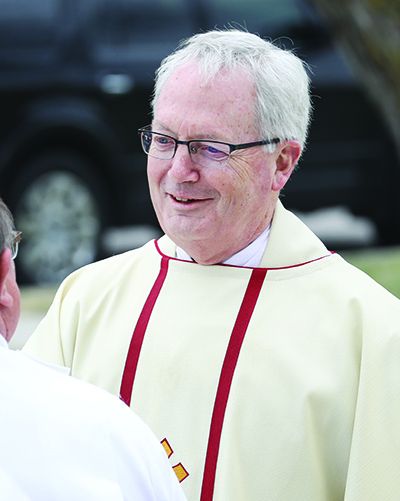 Msgr. Robert Tucker has received new appointments several times during his 34 years as a priest in the diocese. His assignments have included being a pastor in Prague and McCook for three years each, and spending 18 years as rector of the Cathedral of the Risen Christ in Lincoln. He is now pastor of St. Vincent de Paul Church in Seward.
He knows this is a nervous time of year for all priests.
“Before Bishop Conley asked that we fill those forms out every year, I never filled them out. Because I only filled them out twice and each time I got moved,” Msgr. Tucker said with a laugh. “I said I want to stay where I’m at, I’m very happy, and I got moved.”
Msgr. Tucker said it comes down to trusting in the bishop and in God’s plan.
“We understand that if the bishop asks us to do something, we’ve taken this vow of obedience, and we do what he wants us to do,” Msgr. Tucker said. “We trust the bishop has a plan and what he has for us is good. We accept that, but it’s difficult, definitely.”
Msgr. Tucker shared a conversation he had with Father Larry Gyhra (1939-2009), who was in Wahoo for many years before moving to St. Cecilia Parish in Hastings. He said Father Gyhra realized there were people he could relate to there that maybe the former pastor couldn’t as well, and that’s something you only see after time.
“After a while, we see the wisdom of it,” Msgr. Tucker said. “Even the bishop doesn’t know what’s going to happen. He’s making his best judgment.”
That judgment is based on more than the bishop’s feeling or hunch when it comes to assigning priests. It’s founded in the traditions and practices of the Church from the very beginning.
“If you look at the Acts of the Apostles, priests, the apostles, were continually on the move,” Father Fulton said. “I think we have a tendency sometimes to fall in love with the particular priest’s gifts or the priest’s personality, and that can be detrimental to the actual spiritual growth of a parish or person. It’s all about the sacraments and Jesus and the priest really is bringing the sacraments to the people. But the one priest we should be falling in love with is Jesus.”
This time of year, though, it’s not unusual to see both priests and parishioners anxiously awaiting the list of new assignments to see if they will be affected.
“If you’re naturally accustomed to a particular priest who has been there for a while, it’s natural to have a little bit of a letdown. It’s certainly human. We’re people of relationship. We’re built in community, but then again, you never know how God might be working through the gifts of another priest,” Father Fulton said. “We’re blessed with so many good priests in our diocese that, again, if our proper context is falling in love with the Lord, we should never sell another priest short of what gifts that priest could bring to that community or that parish.”
Deacon Redinger is looking forward to sharing his gifts with his first parish. He said he wants to start getting to know the people as soon as possible.
“I just really want them to know that I have a real passion to just be there for them and be a man of the people,” he said. “I’m really looking forward to being taught by them and just see what they have to offer. And to bring the Father’s love to them. I want to be a bridge so that they can have an encounter with God.”
It doesn’t matter to him where he ends up in the diocese. He said his family did a lot of moving while he was growing up, so he is used to new places and different life experiences.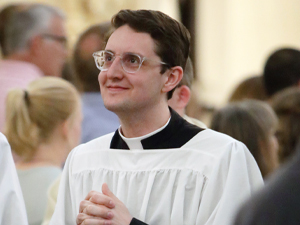
“The reality is, we are pilgrims. We’re sojourners. Constantly on the move. And so I think even growing up, my experience of moving was really helpful for entering into this lifestyle. Every time I see a U-Haul, I say a little prayer for the family or whoever it is moving.”
And wherever he drives his own loaded U-Haul this summer, Deacon Redinger knows it will be the right place for him at this time.
“We’re never going to be alone. There can be a fear from the enemy to make you think that you’re alone in all this,” he said. “Just realizing that we’re connected. I’m thinking of the vine grower from John’s Gospel that we’re connected to the vine if we’re living and abiding with the Father on that vine. The vine can spread out and it needs to spread out. That’s kind of how I see we’re participating in God’s work by being sent out all over God’s green earth.”
