

Q. I noticed in my Daily Roman Missal that at the beginning of the gospel, only the priest is instructed to make the sign of the cross on his forehead, lips, and breast. It seems everywhere that the congregation does this action as well. Should we be doing this?
A. Your question is based on two good instincts: a) the rubrics of the Mass are to be followed faithfully, and b) the priest and the people have different roles in the Mass.
First, the rubrics: the rubrics are the parts of the Roman Missal written in red (“rubric” is related to the Latin word for red) which explain what is to be done, by whom, and how. In this case, the rubrics instruct the priest to make the Sign of the Cross on the book of the Gospels, his forehead, his lips, and his breast as he introduces the gospel. No mention is made of the people doing this.
While the rubrics say what must be done and by whom, they do not specify everything that might be done, especially by the faithful. For instance, many faithful will make an act of reverence such as a bow before receiving Communion. Although there is no instruction to do so in the Missal, this small action, arising from a sound sense of devotion, can help remind someone of who they are about to receive.
Another less common example occurs at the Lamb of God: some faithful will strike their breast as they say “Lord I am not worthy…” to express an interior sense of sorrow for sin. In short, there does seem to be limited room for the faithful to incorporate devotional actions, provided they are not contrary to the rubrics, nor ostentatious and distracting to others.
Second, the role of the priest: Canon 907 of the Code of Canon Law states, “In the eucharistic celebration deacons and lay persons are not permitted to offer prayers, especially the eucharistic prayer, or to perform actions which are proper to the celebrating priest.” In other words, the priest is supposed to do the priest’s parts, and the lay faithful their parts.
The theological basis for this canon is that a priest, by the sacrament of orders, has the power to act in persona Christi – in the person of Christ. This means that during Mass, the priest is acting as an instrument of Christ, doing and saying things which belong properly to Christ.
The most obvious example is the consecration. The priest says, “this is my body” and “this is my blood,” though the bread and wine become the body and blood of Christ, not of the priest himself. Because only the priest can act in persona Christi, the parts which are proper to the priest cannot be done by others.
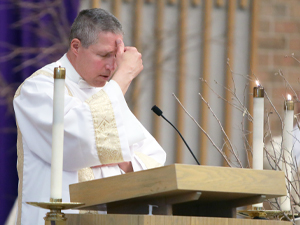 So is the signing of the forehead, lips, and breast an action proper to the priest? What is the meaning of the action anyway? History can help us here.
The oldest witness to this action comes from liturgical texts of the 9th century. These texts instruct the faithful to make the sign of the cross on their forehead prior to the reading of the gospel. By the 11th and 12th century, this gesture had developed into the signing of the forehead, lips, and breast. Many texts indicate that this was done not only by the priest, but by the faithful as well.
Various meanings were given to the action, but they generally indicated that it helped promote a proper disposition to receive and proclaim the gospel fully, with one’s mind, lips, and heart. While it certainly remains proper to the priest to proclaim the gospel, there seems to be no problem with the faithful participating in his gesture which helps him to be ready to hear it and live it.
This question was written by Father James Morin, a priest of the Catholic Diocese of Lincoln, who will return to Rome in the fall to complete his degree in Canon Law at the Pontifical Lateran University. Write to Ask the Register using our online form, or write to 3700 Sheridan Blvd., Suite 10, Lincoln NE 68506-6100. All questions are subject to editing. Editors decide which questions to publish. Personal questions cannot be answered. People with such questions are urged to take them to their nearest Catholic priest.
