

Q. Since the True Presence of Jesus in the Eucharist is so central to our faith, and what distinguishes us from other Christian faiths, why does our Creed not mention it?
A. To belong to a faith community of any kind, it is first necessary to understand what that community believes in. You cannot say “I believe” if you do not know what you are expressing belief in. That is why creeds (taken from the Latin credo which translates to I believe) are so important. They are not empty words that are meant to be mindlessly repeated (even if we do sometimes find ourselves doing that), but a clear and concise statement of what a group of believers believes.
There are several proto-credal statements that appear in the New Testament. These statements are believed to be early forms of expressing the Christian faith as distinct from that of Judaism. For example in 1 Corinthians 15:3, St. Paul states, “For I delivered to you as of first importance what I also received: that Christ died for our sins in accordance with the Scriptures, that he was buried, that he was raised on the third day in accordance with the Scriptures, and that he appeared to Cephas, then to the twelve.” It is a clear, concise summation of what separates the new Christians from their Jewish brethren in terms of belief.
As time went on, Christians began to reflect more deeply on various aspects of their beliefs. Questions arose around the nature of Christ and the relationship between the Father and the Son. The Arian heresy put forward the idea that the Son was created by the Father and thus was not consubstantial. As this idea spread and conflict arose, Emperor Constantine called the Council of Nicaea (325 A.D.) to resolve the matter. The council fathers determined that the Son was indeed consubstantial with the Father and put forth what we refer to as the Nicene Creed as the authentic statement of Faith for all Christians.
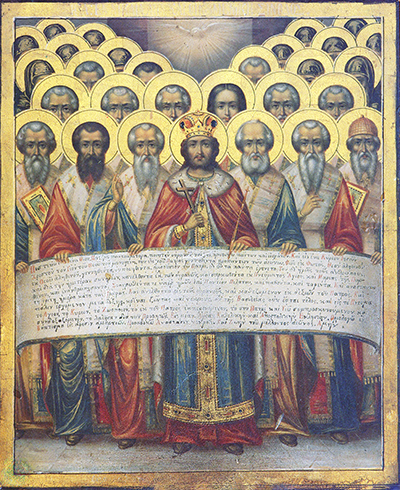 Controversies continued to arise, and more councils were called. The Council of Constantinople (381 A.D.) confirmed the Nicene Creed and expanded upon it, so as to further clarify the authentic Chrisitan doctrine in the face of errors. There is some debate about whether the enlarged creed actually originated in the Council of Constantinople but the now called Nicene-Constantinopolitan Creed was confirmed by the Council of Chalcedon (451 A.D.), making it the authoritative statement of faith that it remains to this day.
While the Nicene Creed was used early on as the statement of faith that those who were to be baptized would make prior to their baptism, it was first officially inserted into the Mass by the Byzantine Emperor Justinian in 568, in all churches within his domain. From there it spread organically to Spain and France until the early 11th century, when it was officially added to the Roman Rite, at which point it became nearly universal in the West.
So why does the Creed not mention the Real Presence? Essentially because no one denied the Real Presence on a widespread and systematic level until the Protestant Reformation, a thousand years after the Council of Chalcedon had confirmed the Nicene-Constantinopolitan Creed. Prior to that, as is evidenced by the writings of the Church Fathers, belief in the Real Presence of Christ in the Eucharist was the clear belief of Christians.
The Creed asserts the Truths of the Catholic Faith against errors that arose, and the error of the Protestants had not yet arisen. It is possible the Creed could have been expanded to include a reference to the Real Presence, but (and this is my informed speculation) the antiquity and universality of the Creed by the time of the Council of Trent would make it difficult for the Council Fathers to change it.
It should also be noted that the General Instruction of the Roman Missal states that the Creed is recited as a preamble to receiving Holy Communion. “The purpose of the Symbolum or Profession of Faith, or Creed, is that the whole gathered people… may also call to mind and confess the great mysteries of the faith by reciting the rule of faith in a formula approved for liturgical use, before these mysteries are celebrated in the Eucharist.” Expressing the Creed is a way of expressing communion with the Church prior to receiving Holy Communion.
Because Catholics believes what is said in the Creed, it means they are truly in communion with the Catholic Church, and free to receive the Body of Christ, the source and sign of the communion of the Church.
Like anything else, the Creed can simply become something we do because that’s what we do. However, it is important to consider the words of the Creed and, more importantly, consider whether we truly believe what we are saying. It can be helpful to take a few minutes and simply read the Creed, reminding ourselves of what the words are that we are saying, and asking for the grace to truly believe these words that we profess.
This question was answered by Father Caleb La Rue, chancellor of the Diocese of Lincoln. Write to Ask the Register using our online form, or write to 3700 Sheridan Blvd., Suite 10, Lincoln NE 68506-6100. All questions are subject to editing. Editors decide which questions to publish. Personal questions cannot be answered. People with such questions are urged to take them to their nearest Catholic priest.
