

By Shelby Siegfried
for the Register
Bishop Conley, retired Catholic veterinarian contemplate caring for the gifts of God’s creation
St. Francis of Assisi is often known as the saintly figure seen adorning birdbaths and gracing gardens. His iconic image – a bearded man in brown – exudes a deep love for animals, nature, and poetry.
While these impressions of St. Francis are undoubtedly accurate, they only begin to scratch the surface of his profound sanctity.
St. Francis’s unique relationship with animals was marked by extraordinary deeds. He famously preached to the birds, calmed a ferocious wolf, and orchestrated the very first live nativity scene featuring animals. Yet, beneath these remarkable acts was a profound devotion to God, recognizing God as the Creator of all things, deserving of the utmost reverence.
St. Francis’s journey to this devotion was a remarkable one, characterized by a wild youth and a stint as a soldier. However, a life-altering conversion experience redirected him. He renounced his family’s wealth and embraced a life wholly dedicated to God. His unwavering commitment to values such as poverty, humility, obedience, patience, and compassion attracted followers, eventually leading to the establishment of the Franciscan order. He also held the distinction of being the first saint to bear the stigmata—the wounds of Christ crucified—and was swiftly canonized after his death. Even today, nearly 800 years later, more than three million pilgrims annually visit the tomb of St. Francis, solidifying his status as one of the most beloved saints in history.
Bishop James Conley shed light on what Catholics can learn from St. Francis’s devotion.
“St. Francis is often celebrated for his profound appreciation of God’s creation,” he said. “He authored numerous prayers and hymns praising God and His creation, and he held a great fondness for animals.”
Conley also highlighted the story of the Wolf of Gubbio, a rabid animal that terrorized the region until Francis tamed it, demonstrating how Francis regarded all of creation as a sacrament of God’s love, emphasizing that animals and pets are signs of His beautiful creation.
Conley himself has cherished the companionship of animals throughout his life. He fondly reminisced about his earlier experiences with dogs, including Toby and Holly, a cocker spaniel and a collie, during his youth. Later in life, after moving to the countryside, he acquired a golden retriever named Stella. These dogs, known for their gentleness, love, and obedience, provided him with great companionship.
Unfortunately, his journey toward the priesthood required him to part ways with Stella, as seminary life did not accom-modate canine companions. Stella found a new home with a young high school student.
During the bishop’s leave of absence in 2019 for mental health issues, a challenging period in his life, Conley’s therapist recommended getting a dog for solace and companionship.
Bishop Conley’s friend, Bishop Jim Wall of Gallup, N.M., said his housekeeper’s daughter had golden retriever with a litter of 12 pups in El Paso, Texas.
“We drove down there and picked up four puppies – one for me, one for him, one for his housekeeper, and one for the gentleman who ran the retreat house where I was staying in Phoenix,” Bishop Conley said. “I’ve had ‘Stella 2.0’ ever since.”
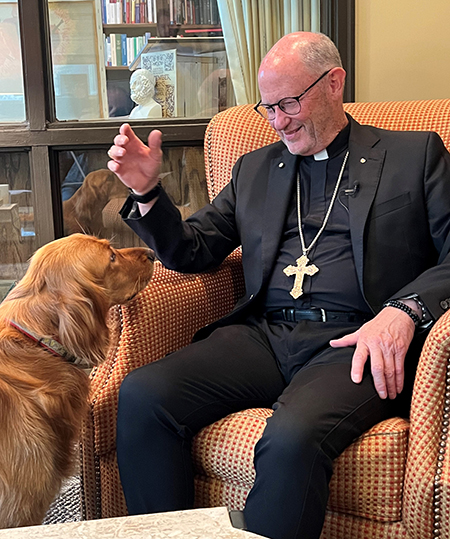
Stella is a fitting namesake to the legacy of the Bishop’s first golden retriever, and she remains a beloved companion at the Chancery, providing joy and comfort to everyone she encounters.
While the Catholic faith encourages love and appreciation for animals, Conley expresses apprehension about the tendency for some to equate pets with children, a perspective he believes deviates from St. Francis’s natural order.
“In our time, some people have taken their love for pets to extremes,” he said. “Instead of having babies, people have pets, which is neither good nor right. Pets, although wonderful companions, should not be viewed as replacements for human beings.
“This does not imply that having pets is inherently wrong,” he stressed. “Instead, it emphasizes the importance of maintaining a proper order in our affections. Pets, like us, are creations of God, deserving of love and care, but they do not possess the same level of dignity and sanctity as human beings.”
Dr. Patrick Wahlmeier of St. Michael Parish in Hastings, a longtime admirer of St. Francis, reflected on his role as a veterinarian who cared for pets and livestock for 37 years at a full-service mixed animal practice serving multiple communities in south-central Nebraska.
“My home church was named St. Francis of Assisi,” Wahlmeier said. “Then I went on to become a veterinarian, and St. Francis continued to be a part of my life, so in one way or another, he’s always been there for me.”
Now retired from practice, Wahlmeier contemplated his time caring for God’s creation.
“My Catholic faith instilled in me a deep respect for God’s creation,” he said, “helping me be more empathetic toward both animals and their owners. Every situation was an opportunity to provide the best care, and prayer was a constant companion, especially during challenging moments.”
As a veterinarian working in rural Nebraska, Wahlmeier cared for a wide variety of animals, from small companion pets to cattle, swine, small ruminants like sheep and goats, as well as routine equine medicine. He noted that farmers and ranchers were often just as attached to their animals as pet owners.
“Farmers and ranchers deeply care for their animals,” he said. “Animal health and herd health are vital to them, and they work diligently to ensure their animals thrive.”
The Church has a long-standing tradition of blessing livestock, farms, and ranches, especially during the Rogation days in the liturgy.
Bishop Conley explained: “In the past, people relied heavily on farming and livestock for sustenance. We prayed for good weather, healthy crops, and the well-being of our animals because they were our livelihood. Even today, in rural Nebraska, where we’re a significant cattle-producing state, we continue to seek God’s blessings on our farm operations and livestock.”
Recognizing the inevitable end that all living creatures face on Earth, Wahlmeier acknowledged that being a veterinarian sometimes meant handling difficult situations.
“It’s challenging to say goodbye to an animal that has been a companion,” he said. “We care for them to the best of our abilities, but ultimately, they are in God’s hands.”
When the question of whether animals go to heaven arises, Conley offered clarity.
“Animals do not go to heaven,” he said. “Heaven is a place for human beings. However, there’s an understanding of the new heavens and the new earth, where all things will be restored in Christ. I won’t have my dog, Stella, with me, but I’ll have the love she gave me, and that I gave her, magnified in heaven. We will experience the joys and loves we have in this world in an even more abundant way in heaven.”
Every year, on or around Oct. 4, Catholics worldwide celebrate the feast of St. Francis with prayers for creation and a blessing of animals.
